The Centauri Return Expedition
Five hundred people cross to Alpha Centauri at nearly a tenth of the speed of light, survey it for five years, and come home with a map of the sky drawn from two suns.
Fast is the only road
No known physics shortens the distance. Warp bubbles and wormholes need kinds of energy no one has shown can exist. That leaves speed.
The voyage is planned backward from one limit: a founder who leaves at forty is home by a hundred and fifty. Alpha Centauri is 4.37 light-years away. With five years of survey, that leaves 105 years for two crossings, and the slowest speed that fits is about 9% of the speed of light. Each crossing takes about 53 years: a burn of almost three years at three-hundredths of a gravity, 47 years of coasting, and another burn to stop. Relativity gives the crew back only about five months over the whole voyage.
The people aboard make that century two ways. The founders are expected to live far longer than anyone does now, long enough to leave, work and return. Their children, born aboard, grow into a second crew that learns the work in flight and comes home with it.
Everything ahead becomes a weapon
At 9% of light speed, every gram in the path hits with the energy of 83 tonnes of TNT. The space between stars is nearly empty but not quite: thin hydrogen and helium, and dust grains mostly smaller than a micron. Over one crossing, that gas and fine dust deliver about 7 gigajoules to every square metre of forward surface, a steady scouring that erodes material away. Rarer, larger grains are a different danger. A grain a tenth of a millimetre across strikes like 130 grams of explosive; one a millimetre across, like 130 kilograms. How many grains that size lie along the route is not yet known.
There is no light answer to this. The expedition meets it with mass, energy and redundancy.
The column
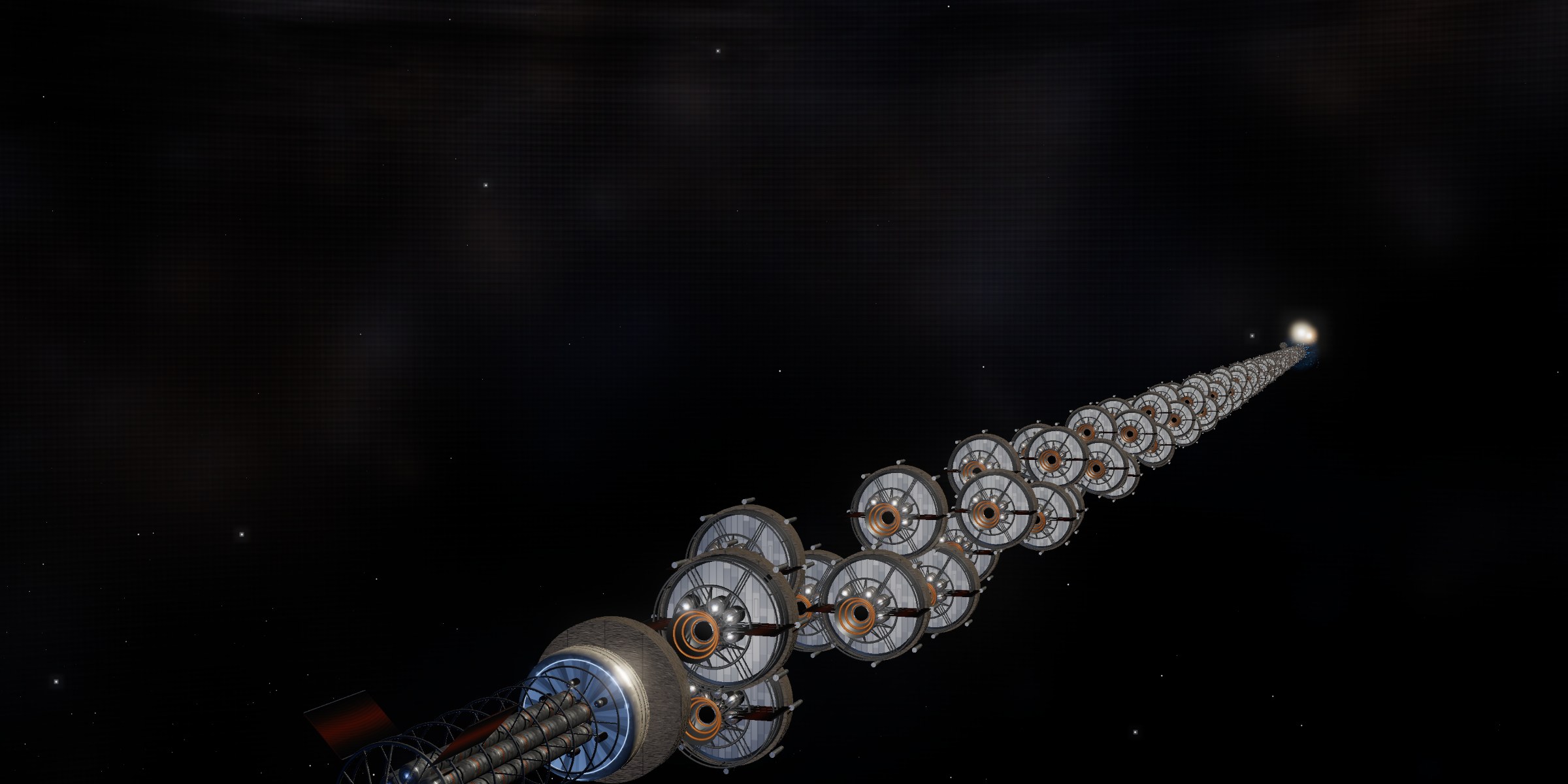
Four hundred and one ships fly as one long column: two hundred escorts ahead, the crewed ship, and two hundred escorts behind. Every escort is more than a kilometre across, wider than the crewed ship's ring, and carries a thick sacrificial bulwark on its forward face, so the people fly in the shadow of the ships ahead as well as behind their own shield. Each ship sits slightly off the line of the one in front. When the column burns, its exhaust passes beside the ships behind, while their bulwarks still overlap against the dust.
Three defenses work together.
- Lasers. The leading escorts fire powerful lasers ahead, sweeping the path to vaporize grains before the column arrives and break them into gas and charged plasma.
- The plasma buffer. A continuously pumped plasma ahead of the column carries fields that push charged debris aside, including what the lasers have ionized.
- The bulwarks. Whatever gets through erodes the bulwarks of the forward ships. An escort too damaged to protect the others steers out of the line, and the next one takes its place.
The lasers and the plasma buffer are proposed defenses. The model below computes what they face, not how well they work.
Two hundred out, two hundred home
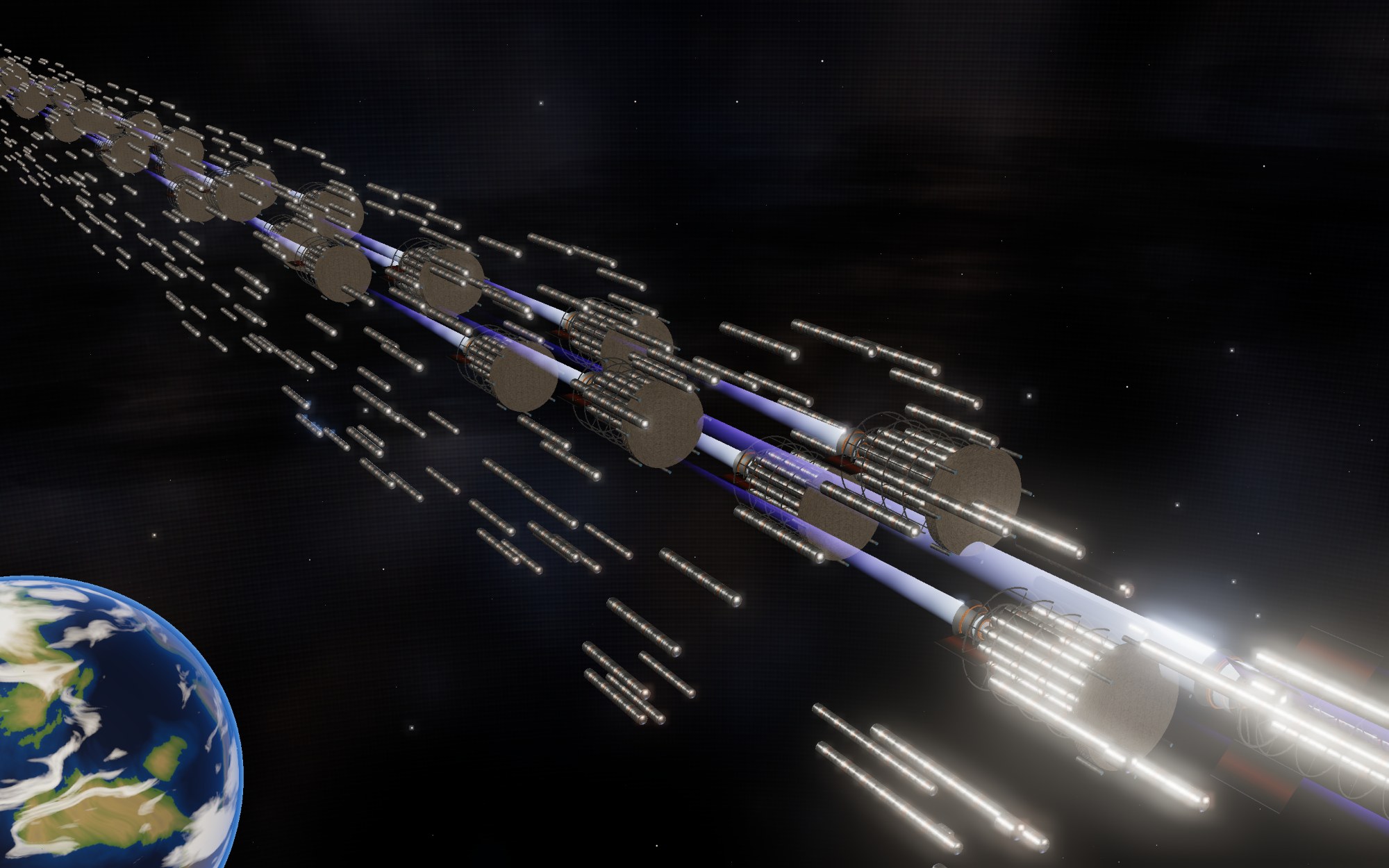
Every ship carries its own fuel. The two hundred escorts at the front lead the way out and wear their bulwarks down doing it. They need fuel for two burns, about 11 times their own mass, and they stay at Alpha Centauri as the survey's base, their reactors and structure serving the work long after the crew leaves. The two hundred behind ride out in the column's shadow with their bulwarks untouched. When the column turns for home, they are at the front.
Going home does not double the fuel; it squares it. The homebound escorts and the crewed ship must be sped up and stopped twice, so each carries about 114 times its own mass, 11 times 11. The fleet leaves the Solar System at about 38 billion tonnes, almost all of it fuel.
No ship can carry a hundred times its own mass in one tank. Each one is a stack of tank sections that it sheds as they empty. A released section keeps its speed, so every one is steered wide of both star systems.
The ring
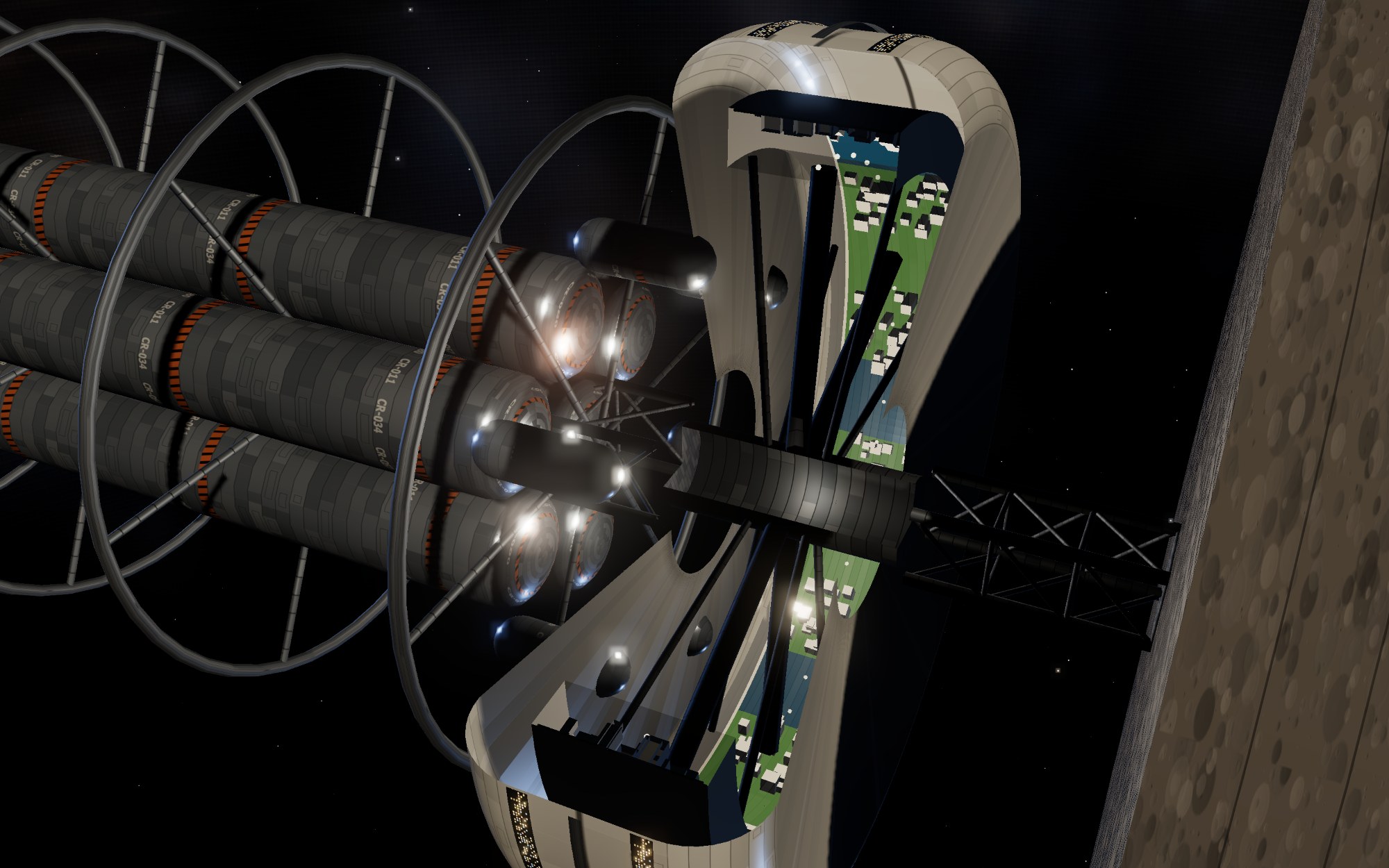
Only the central ship carries people. Inside its hull, behind a forward shield wider than the ring, a ring a kilometre across turns around the line of flight 1.34 times a minute, giving Earth gravity at the floor. Its circumference is just over three kilometres, a main street that closes on itself. Because the spin axis points along the thrust, burns tilt “down” by less than two degrees.
The design assumes a ship of a million tonnes, before fuel, for 500 people: two thousand tonnes each for structure, radiation shielding, a closed ecology, workshops, and the landers and laboratories of the survey.
The voyage
Follow the whole mission: the first burn and the shed tank sections falling behind, a worn escort leaving the line, the turnaround, the survey, and the homebound escorts taking the lead. The clocks and ages come from the mission model; drag the view to look around the fleet, or open the habitat housing.
The budget
The exhaust speed decides almost everything. This design assumes exhaust at 8% of light speed, close to the ceiling for deuterium–helium-3 fusion. At 5%, the crewed ship would need about 2,000 times its own mass in fuel; at 3.3%, the figure for the 1970s Daedalus design, about 100,000.
How the thrust is spent matters almost as much. Burning hard and then coasting is the cheapest way to meet the deadline. Thrusting all the way to the midpoint would need a top speed of about 16% of light and about 7,700 times the crewed ship's mass in fuel, instead of 114. The price of the short burns is power: the engines must deliver about 3.5 megawatts for every kilogram of ship.
Bringing the crewed ship alone up to cruise speed takes as much energy as the whole world now uses in about 580 years.
Five years among two suns
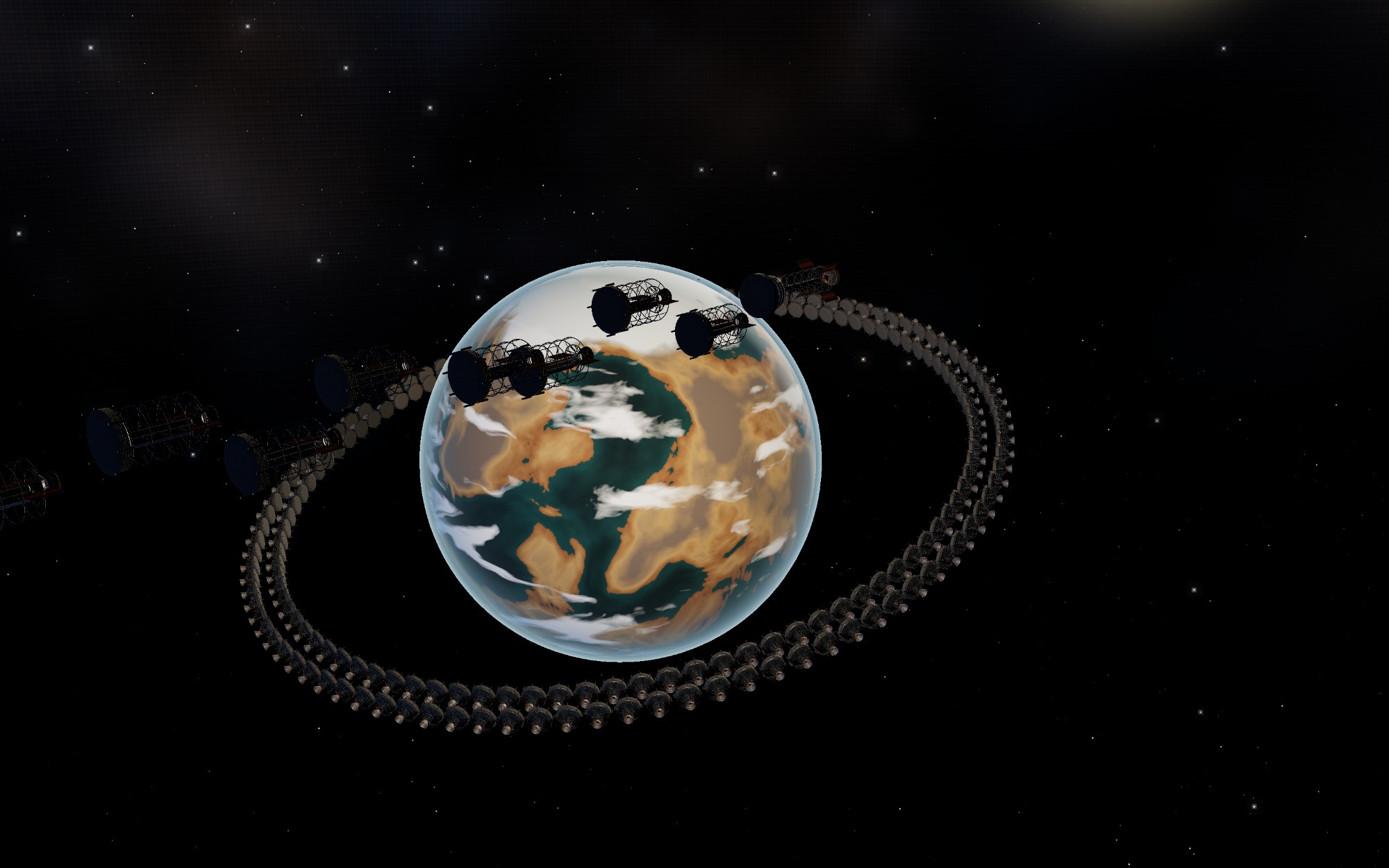
Alpha Centauri A and B are a pair of sun-like stars that orbit each other every 80 years. The ship brakes into that pair and stays five years, sending landers and probes to whatever worlds are there. Proxima Centauri, the red dwarf with a planet in its temperate zone, lies about 13,000 astronomical units from the pair, too far for the ship to visit. It is surveyed by flyby probes released during the crossing.
A map from two suns
Astronomers measure the distances to stars by parallax: the shift of a nearby star against distant ones as Earth moves around the Sun, from a baseline two astronomical units wide. From Alpha Centauri, the baseline is 276,000 astronomical units, 138,000 times longer. Seen from the two suns, even the Andromeda galaxy would shift by about a sixth of an arcsecond, which today's instruments can measure. That gives a direct geometric distance to another galaxy, without the chain of assumptions astronomers rely on now.
The observations have to be made at the same time from both ends, so Earth keeps its own instruments watching while the ship observes. A radio link across 4.37 light-years carries only a thin stream. The full record, along with samples and the people who made it, comes home on the ship.
What has to be true first
- A fusion drive with an exhaust near 8% of light speed, close to its theoretical limit. No fusion rocket has flown.
- Tens of billions of tonnes of fuel, most of it helium-3 that would have to be mined from the gas giants.
- Engines and reactors that deliver megawatts for every kilogram of ship.
- Energy on the scale of centuries of present world use.
- A census of the larger dust grains along the route, taken by precursor probes.
- Lives far longer than any now, and a closed ecology and a society of 500 that hold together for more than a century.
- Laser and plasma shields at a scale never demonstrated.
Observatories come first. Panoptes, solar gravitational-lens telescopes at the edge of the Sun's focal region, could image Alpha Centauri's planets before anyone is asked to go.
Sources
- NASA Science, “Cosmic Distances.” The distance to Alpha Centauri.
- Hoang et al., “The Interaction of Relativistic Spacecrafts with the Interstellar Medium,” The Astrophysical Journal 837 (2017). Gas and dust damage along a relativistic route to Alpha Centauri.
- Project Daedalus, British Interplanetary Society (1973–1978). A two-stage fusion probe design with exhaust near 10,000 km/s.
- Anglada-Escudé et al., “A terrestrial planet candidate in a temperate orbit around Proxima Centauri,” Nature 536 (2016).
- Energy Institute, Statistical Review of World Energy. World energy supply of about 600 exajoules a year.