What if the tide could feed an inland sea?
Flood a district. Catch the sun under thousands of separate shells. Let the ebb carry the salt away. Repeat along an entire coast.
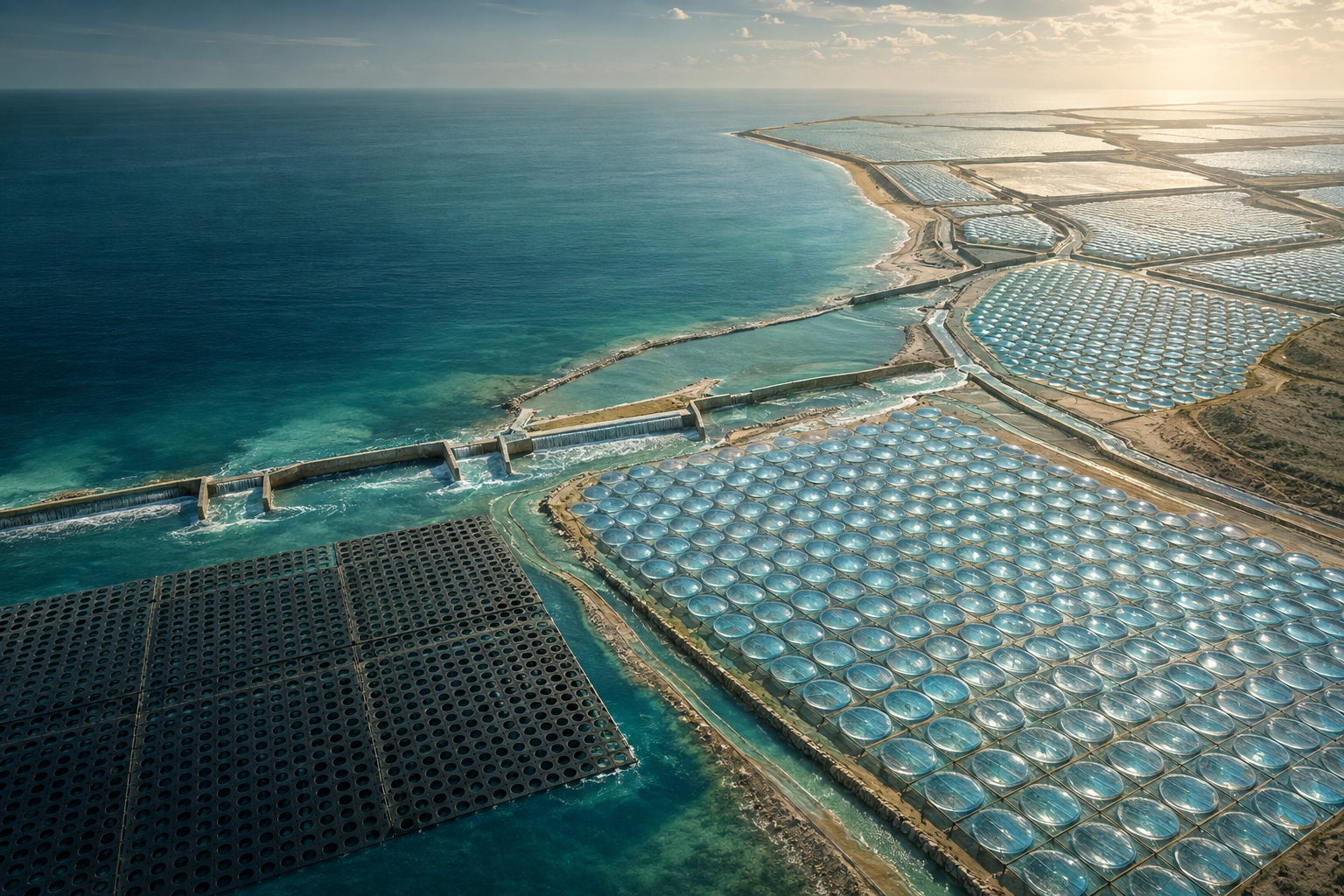
The blanket rides up and down with the sea. The upper gate fills the shore cells; the lower gate discharges only under outward head. This schematic animates elevations and flow direction. The calculation below integrates storage and both gate flows separately.
Choose the size of a tidal district.
The district is 500–1,000 acres of cells and channels. The floating bay blanket extends seaward as a separate area, initially assumed equal to the district footprint. Its upper liquid layer is retained in the physical proposal; no unmeasured freshening is credited to the calculation.
Sunlight and water must be there together.
— Sea level— Cell fill fraction— Sunlight
Repeat it until the output becomes a river.
The lake target retains 9,500 km² of water, a 30 km³ fill over twenty years, 2.5 m/year evaporation, 0.15 m/year rain, 0.1 m/year seepage, and 90% delivery. A salt-export outlet is included for 20 mg/L plant product and a 500 mg/L lake ceiling. Existing lakebed salt is unmeasured and excluded.
What would have to cost less?
A passive coast trades machinery for area. These are editable construction allowances, including the shell, cell, shaded condensing margin and gutter as one installed unit. They are not quotes. The floating blanket, shore works and inland route also have to be funded.
The top few feet are a hypothesis worth isolating.
The proposed 0.3–1.5 m upper bay layer rises with the floating blanket and reaches the high inlet on the flood. Natural circulation through holes may control where salt accumulates. The 2022 wick-free study demonstrates a thin heated layer and convective salt rejection; it does not demonstrate a fresh liquid layer of this depth. The cells therefore still distill the incoming liquid.
Solar heat is concentrated in a shallow active skin. Warming the whole upper layer on every tide is a separate energy burden; it is not included as a free preheating benefit. A bay experiment should measure salinity and temperature versus depth through repeated flood and ebb cycles, including the salinity and volume actually leaving the upper sluice.
What the calculation does.
Thirty days of ideal semidiurnal tides and repeating daylight are integrated at one-minute steps, with two days of startup discarded. Fixed one-way openings admit and discharge water under hydrostatic head. A dry cell must warm its active water skin before producing condensate. Nighttime tide exchanges continue but supply no solar production. The model records water, salt and solar-energy balances; it assumes all generated vapor is collected within the entered net efficiency.
The optical shell remains a proposed Fresnel envelope. Facet angles, off-axis sunlight, wind loading and passive condenser heat transfer need design work. Waves, neap tides, channel friction, silt, leakage, dry salt crystallization, rain and seasonal weather are not resolved. Flood and ebb opening areas are aggregated; channel surveys must show that every cell can actually receive that flow. The shore operates passively. An inland route can require lift beyond the tidal envelope and is included only as a cost reserve here.