One clearing
in 128 impressions.
Hold the camera still, ask the same question again and again, then make 128 incompatible forests flow toward one shared geometry.
Drag to look · scroll to zoom · arrow keys turn

The camera does not move.
Its optical center remains 1.62 metres above one moss patch. North is the scarred redwood; east is the fallen log; south is the split path; west is the nurse log. Every generation receives those bearings, distances, counts, and exclusions in the same words.
The resulting panorama is not a photograph of a real clearing. It is a region-locked mean-rank atlas of 128 independently imagined places after their cartoon structure and texture structure have been decomposed, segmented, converted into region geometry, and warped into agreement. Coherent regions anchor the field; uncertain regions receive only correction that survives forward–backward and whole-atlas tests.
- Optical centers
- 1
- Final witnesses
- 128
- Changed per request
- Seed string
- Chosen projection
- Dual fisheye
Two ways to ask for everywhere at once.
Eight generators were asked for a flat equirectangular world, and eight were asked for paired 180-degree hemispheres. Both branches used one byte-identical prompt template apart from the final seed token.
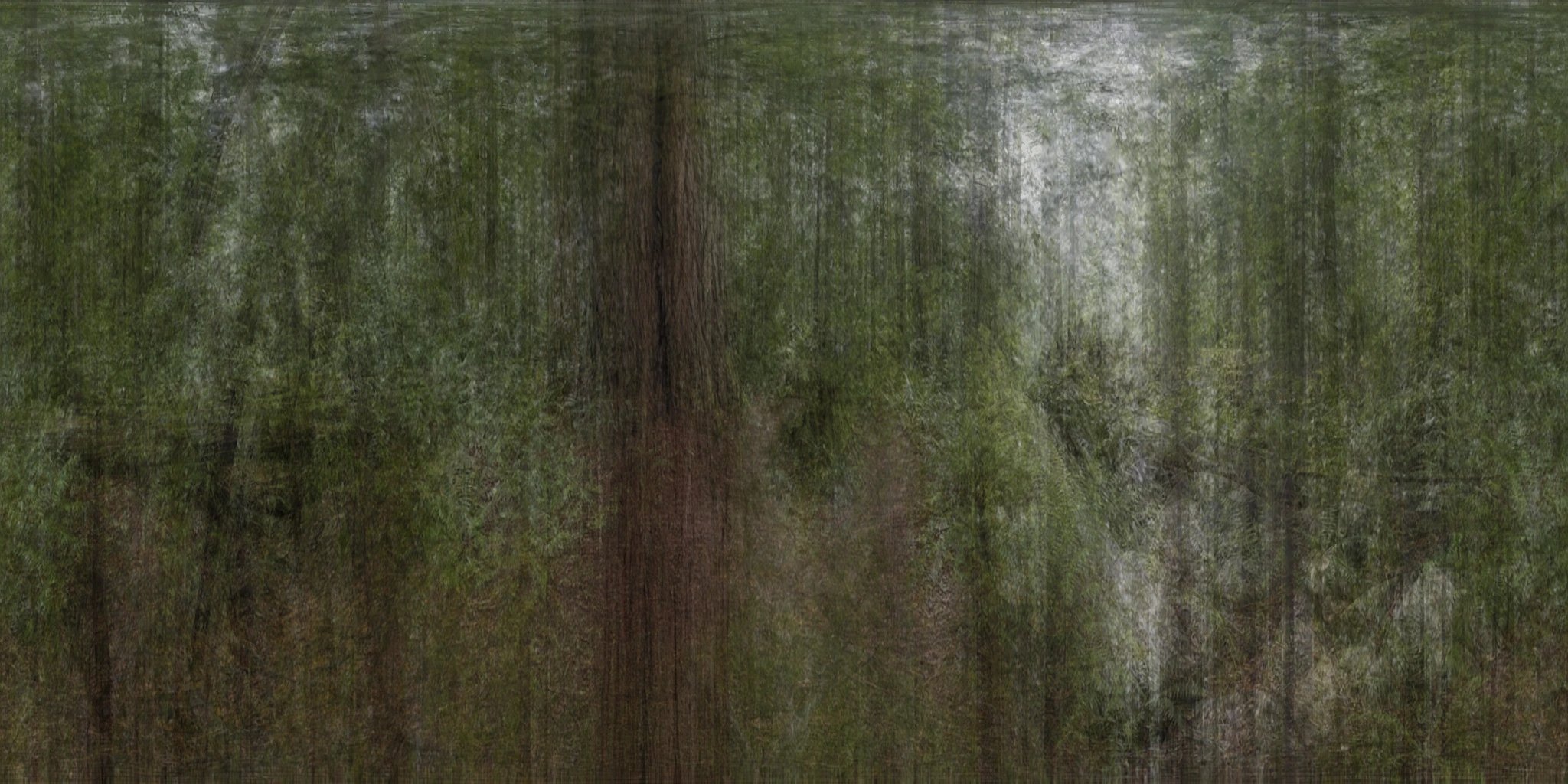
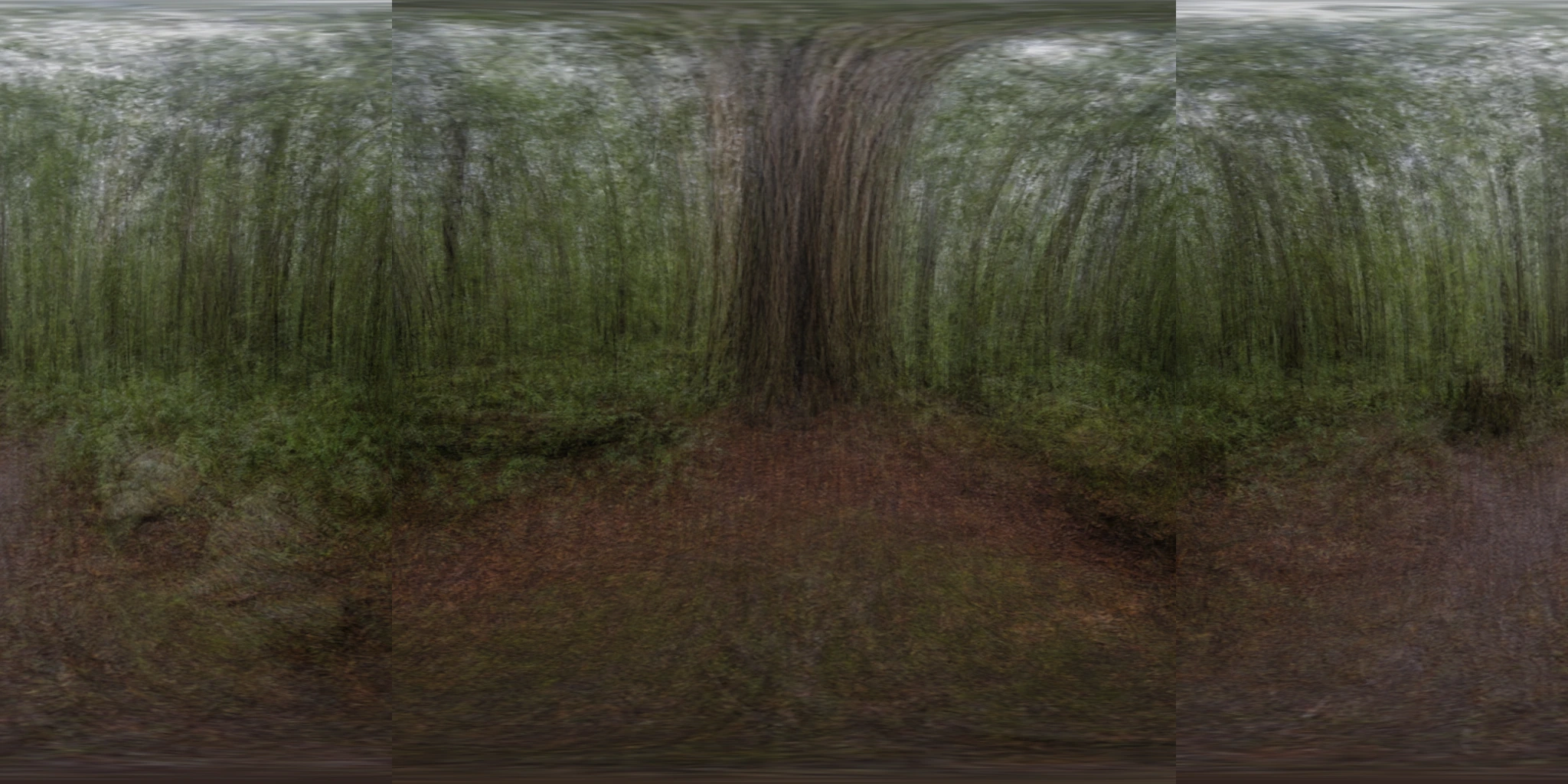
The hemispheres reduced measured disagreement by 38.6 percent. Their circular constraint gave the generator a simpler local geometry; inversion then recovered the full spherical atlas. The direct-panorama branch stopped at eight.
The mean is fog. Regions give it memory.
Sorting all 128 values and averaging them is algebraically identical to an ordinary mean; mutually exclusive trees disappear. The immersive atlas instead sorts intact witness pixels by luminance, finds the mean rank, then chooses one nearby witness for each transported Meyer cartoon region. A graph penalty keeps neighboring regions together. All 128 compete; 89 survive into the atlas.
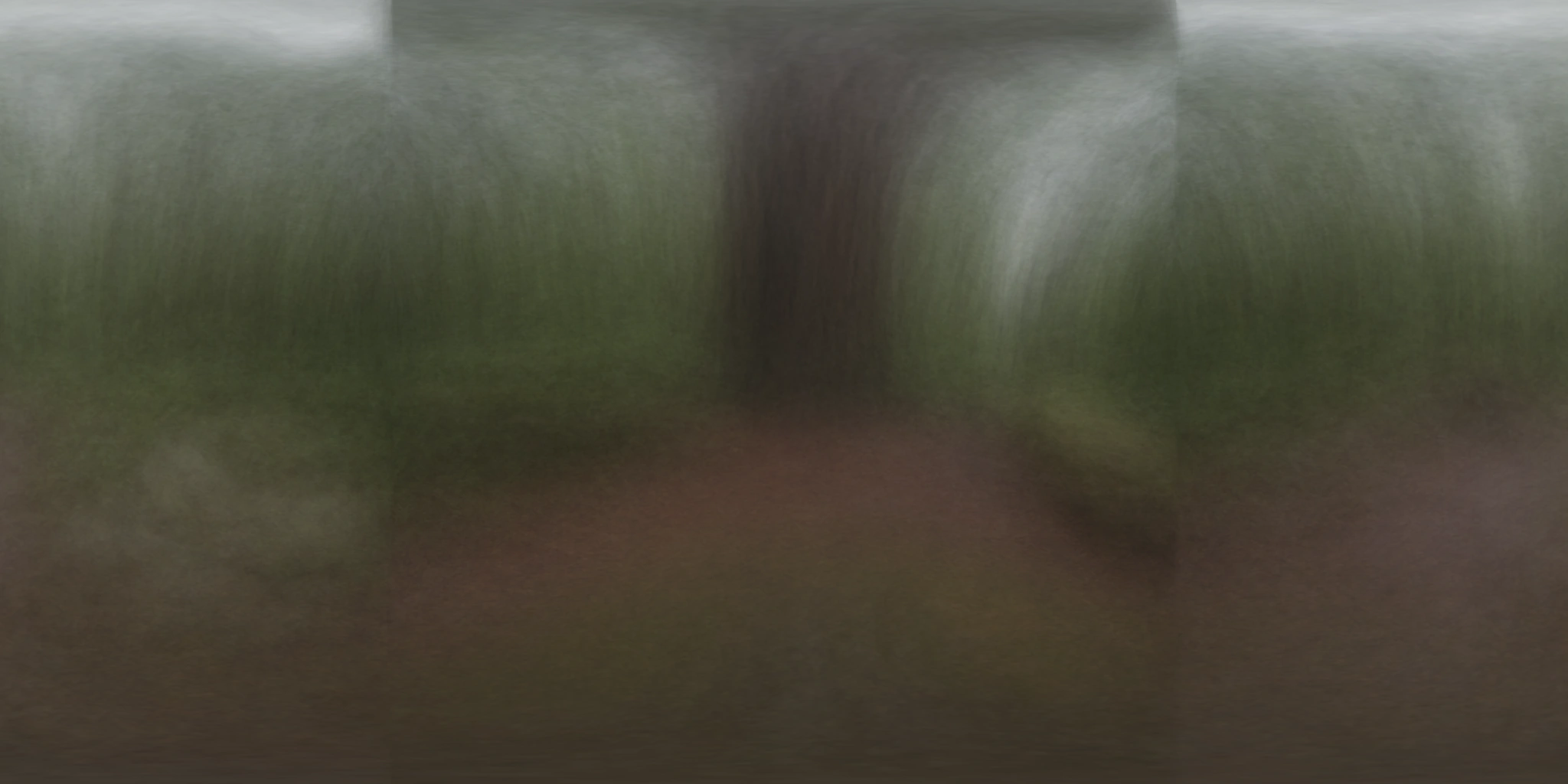
The image becomes a field before it becomes a place.
Meyer decomposition first separates broad structure from oscillating detail. The same BFFT causal-density segmenter then turns each channel into regions. Ordered region boundaries—processed with the Portsmouth font-vector method—join the region centers as flow controls. A periodic signature first synchronizes 25 generator yaw positions. Local projective fits make a 33 × 17 displacement lattice. BFFT boundary confidence, residual energy, and forward–backward cycle error then mark reliable anchors and uncertain territory; seven bounded corrections survived the full 128-view gate. ConvStar expands the accepted field to the full spherical warp without missing its coarse control points.
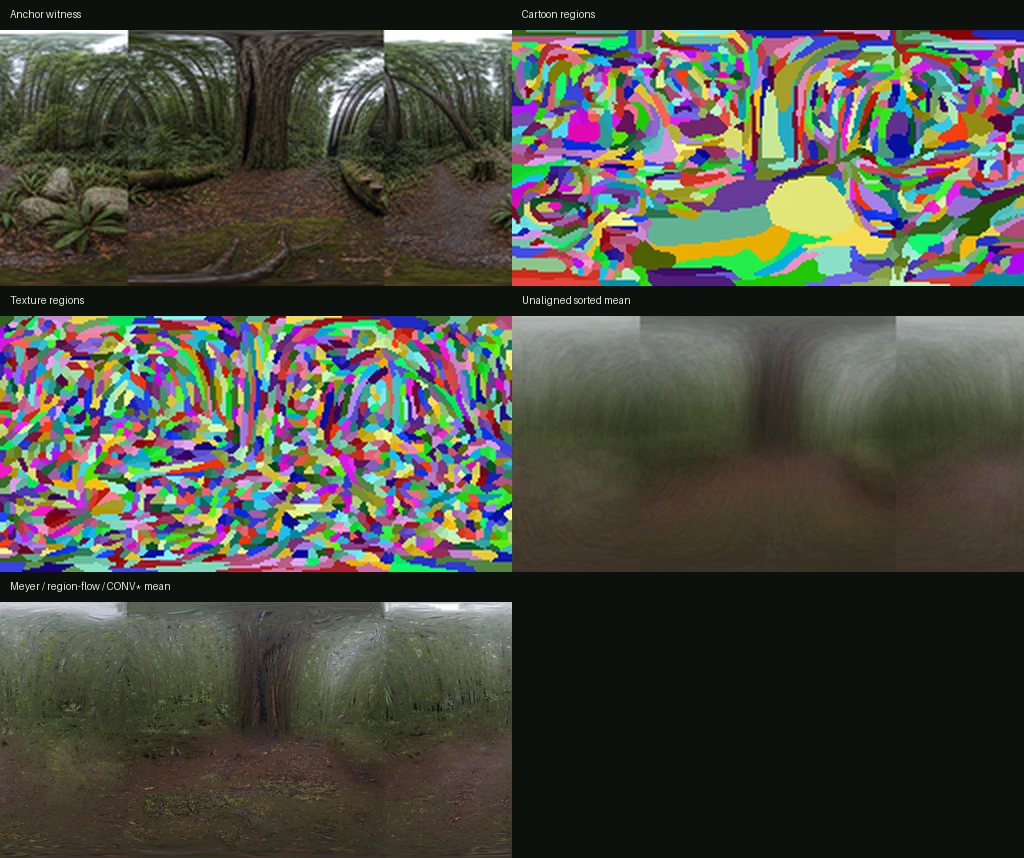
- Cartoon regions
- 115,697
- Texture regions
- 197,554
- Turn events measured
- 111,795
- Atlas witnesses
- 89
- Minimum Jacobian
- 0.122
One prompt, one point, one flow of opinions.
- Fix the scene.Specify one optical center, compass, horizon, light, weather, and the position of every major object.
- Choose the sphere.Compare eight panoramas with eight inverted dual-fisheye frames; stop the less coherent branch.
- Split every witness.Run the exact Meyer operator over all 128 atlases, yielding a cartoon layer and a signed texture layer.
- Make regions speak.Segment both layers independently, trace their ordered boundaries, and fuse persistent centers and turns.
- Flow the geometry.Fit local perspective maps, hold certainty as the anchor, propagate bounded corrections into uncertainty, interpolate with ConvStar, and warp each original panorama once.
- Lock the light.Sort whole pixels, find the mean rank, then choose and feather one coherent witness across each atlas region.
128 witnesses · 876 transported atlas regions · BFFT 6672b52f…8677 · output 34570934…adf8