A scene-compiled renderer whose nearest established relative is hierarchical radiosity, extended beyond diffuse patch exchange to carry directional reflection, refraction, and wavelength-dependent light.
compile the scene→retain transport→gather a view
The problem
Ray tracing is computationally expensive and fundamentally inefficient.
Light transport belongs to the scene, but a conventional probabilistic renderer repeatedly rediscovers it as sampled paths. Direct light, indirect light, reflection, and refraction are evaluated again across pixels, frames, and nearby camera views even when most of the illuminated scene has not changed. Acceleration structures make each geometric query cheaper; they do not make the repeated transport itself a retained part of the scene.
The hypothesis
A retained scene-level light-transport representation can be discovered, solved, queried, and updated for less total work than tracing equivalent illumination path by path—even after charging the method for construction and maintenance.
Can sparse deterministic transport be performed more efficiently than nondeterministic probabilistic rendering by applying a transport-based radiance-field model?
Here, the radiance field is literal: light carried at a position, in a direction, and at a wavelength. The proposal is to compile the durable relationships of that field into the scene, solve illumination over those relationships, and let cameras query the result.
The retained renderer
The implementation is hybrid. It does not abolish rays. It uses them to discover visibility, locate changing boundaries, and continue genuinely directional events; it avoids making a newly sampled complete light path the primary representation of every contribution.
Compile and solve the scene
1 · GeometryAnalytic rectangles, triangles, and spheres keep exact intersection rules. A bounding-volume hierarchy rejects geometry that a query cannot reach.
2 · TransportEmitter beams and visible surface relationships become weighted deposits and graph links. Blocked and negligible exchanges are omitted; changed silhouettes and materials split the field where necessary.
3 · IlluminationDirect light seeds the field. Diffuse energy marches through sparse links until the unpropagated remainder is below its numerical budget, producing indirect illumination without storing complete sampled paths.
4 · DirectionMirror, rough-reflective, and glass events retain orientation. Prism transport separates red, green, and blue, while bounded internal feedback is integrated and terminated.
Gather a camera view
5 · Visibility and radianceThe camera finds the nearest visible surface, reads its solved illumination, and follows directional optical continuations where the material demands them. Smooth scanline spans are interpolated; projected edges, sphere tangencies, and surface changes receive exact boundary work.
The rendered result
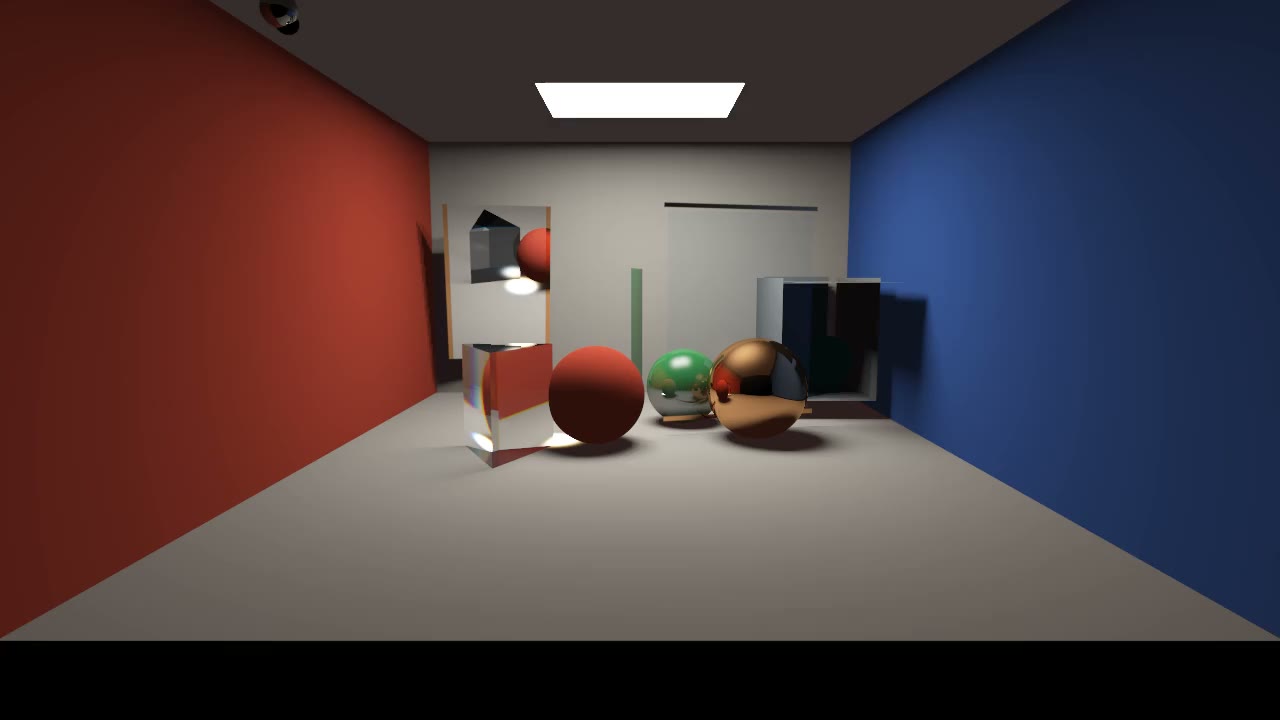
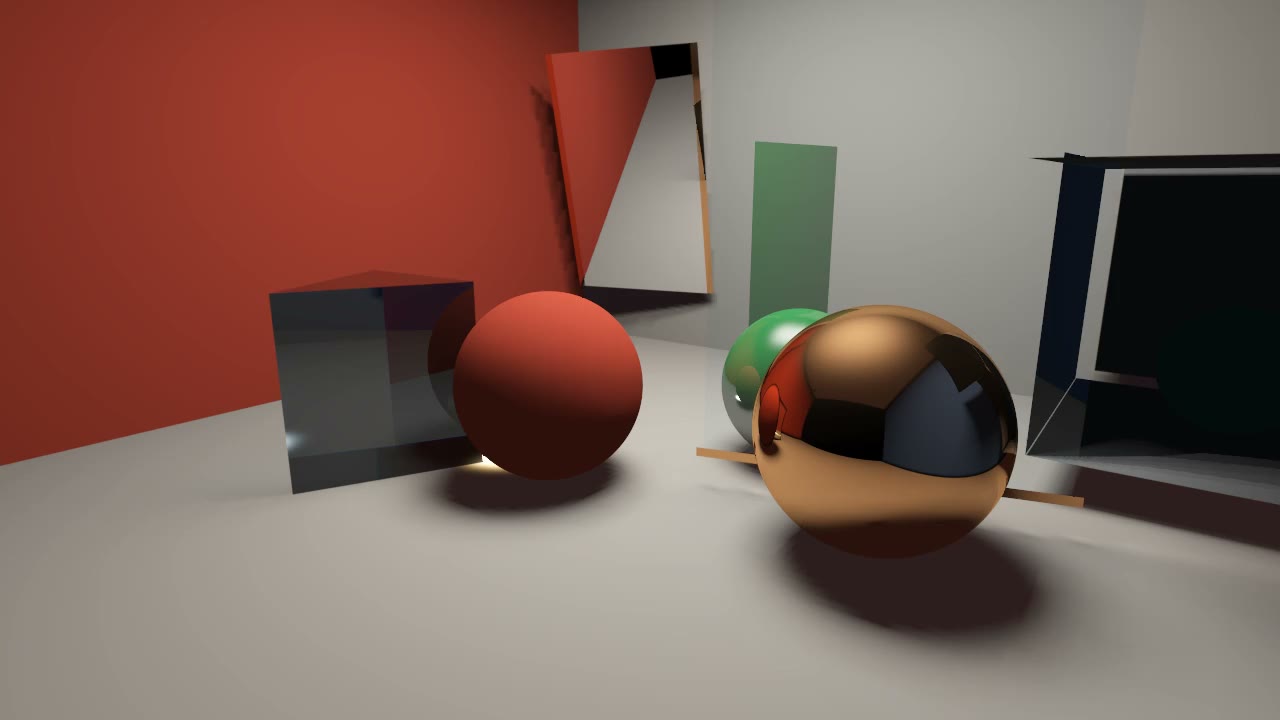
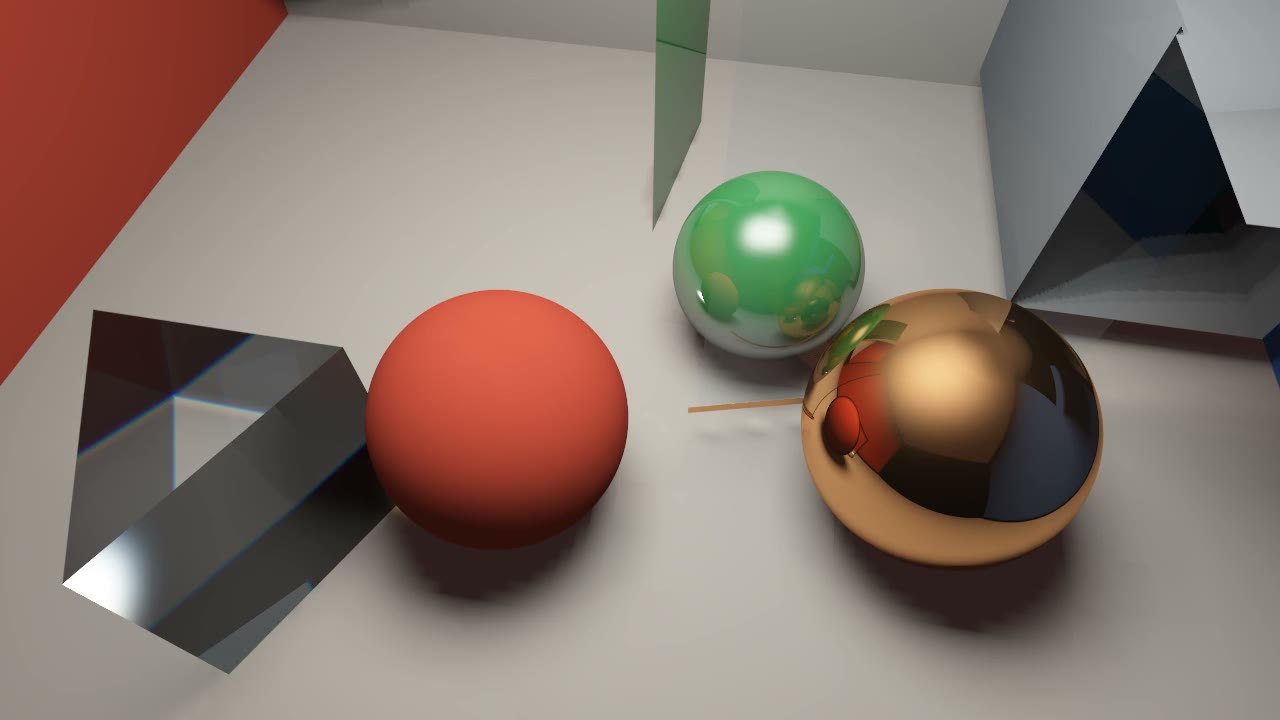
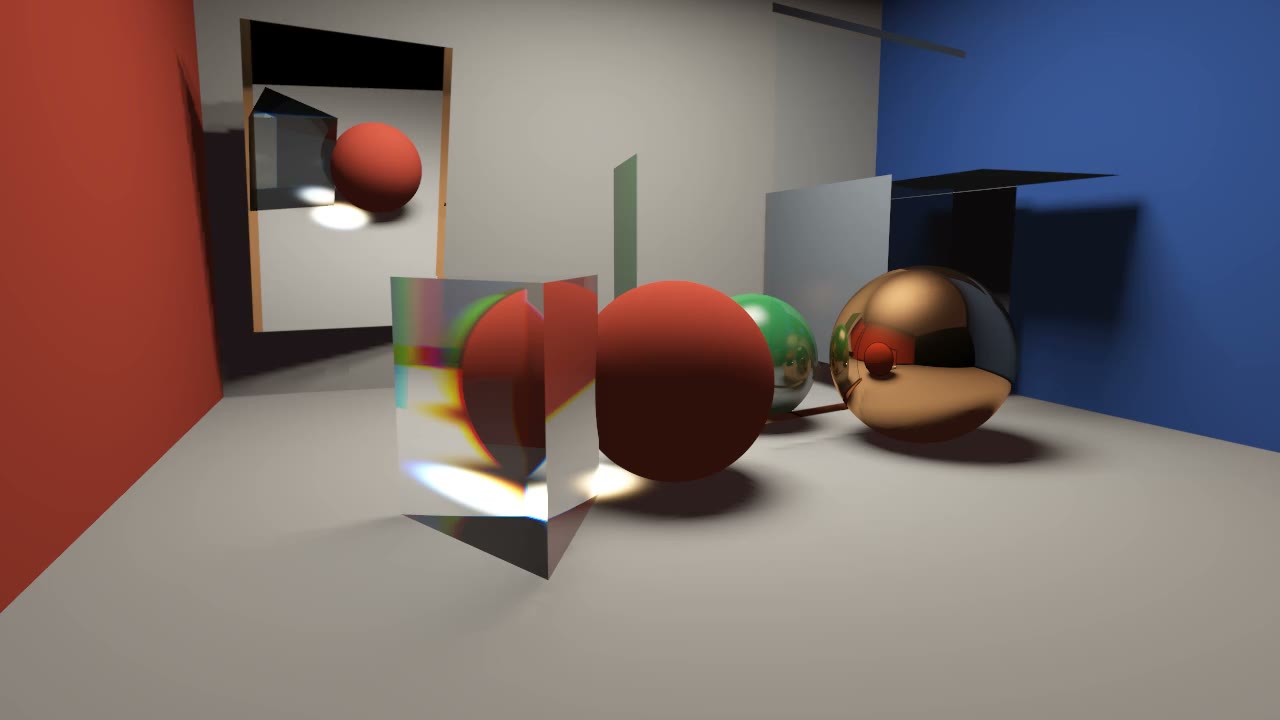
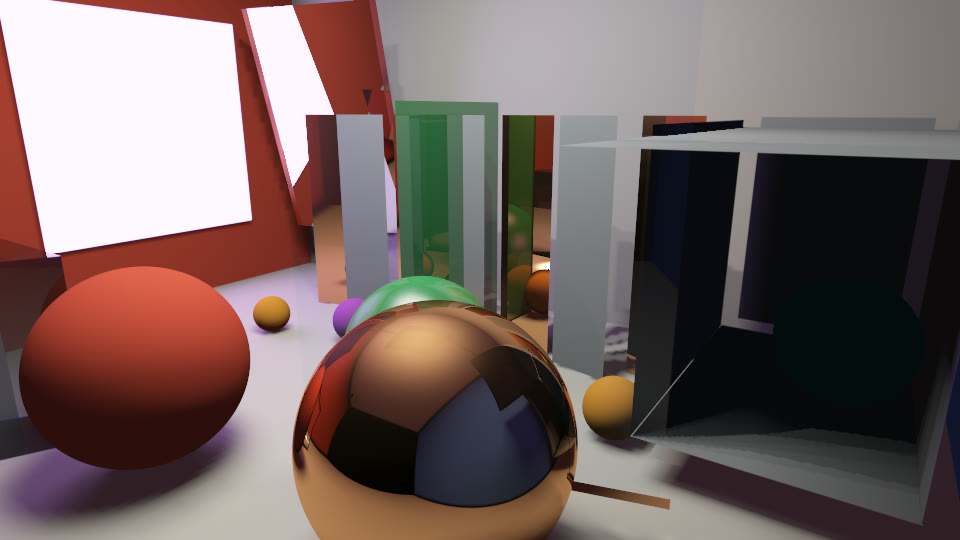
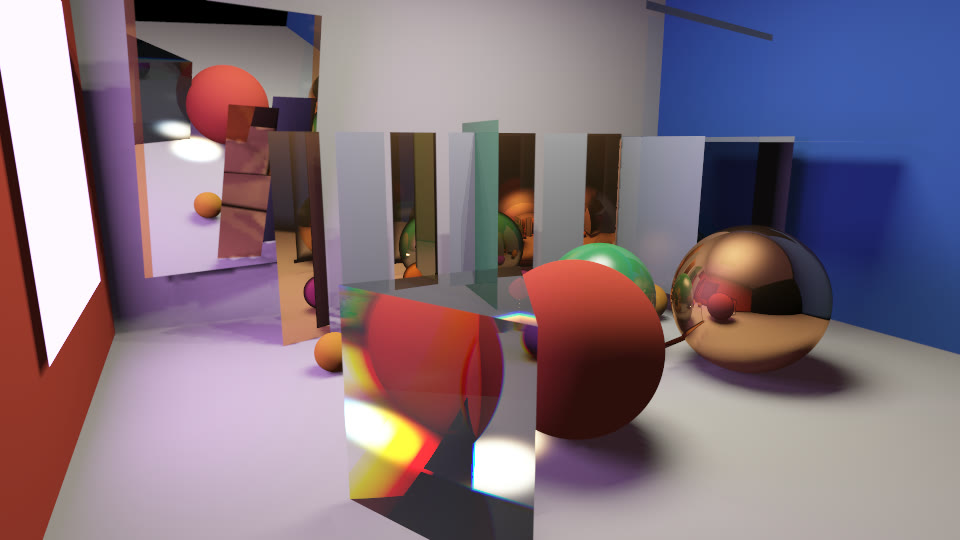
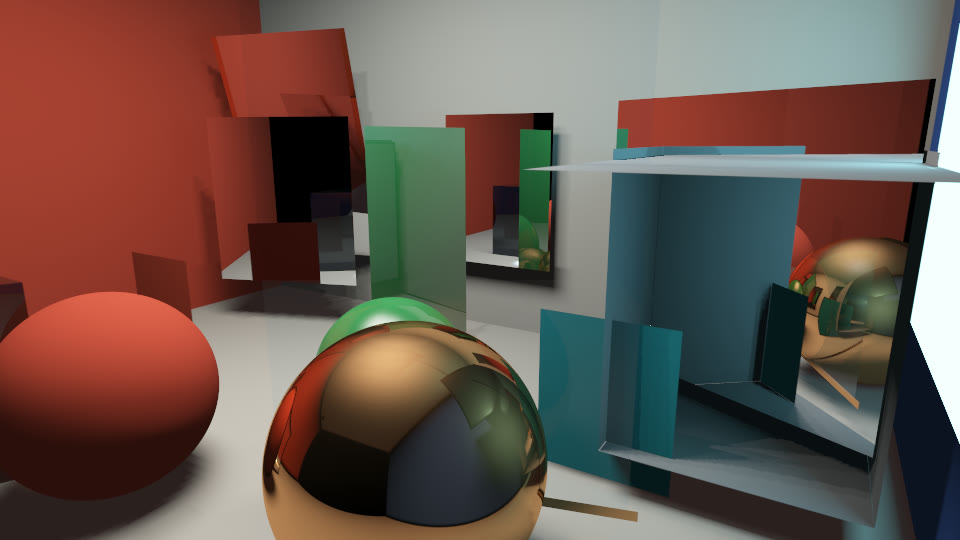
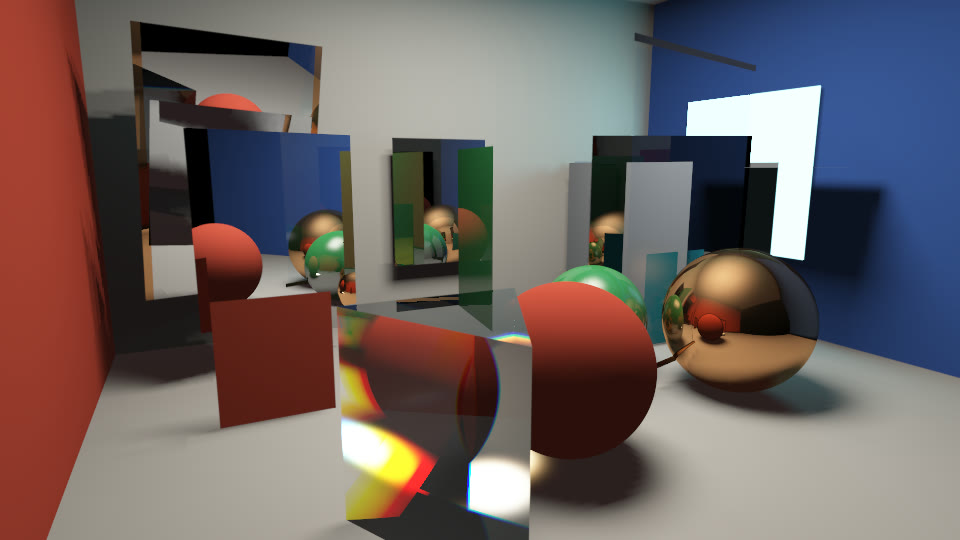
The room, lights, materials, and solved diffuse field remain fixed while the camera completes this forty-second loop. View-dependent visibility, mirror returns, and glass transport are evaluated for each frame.
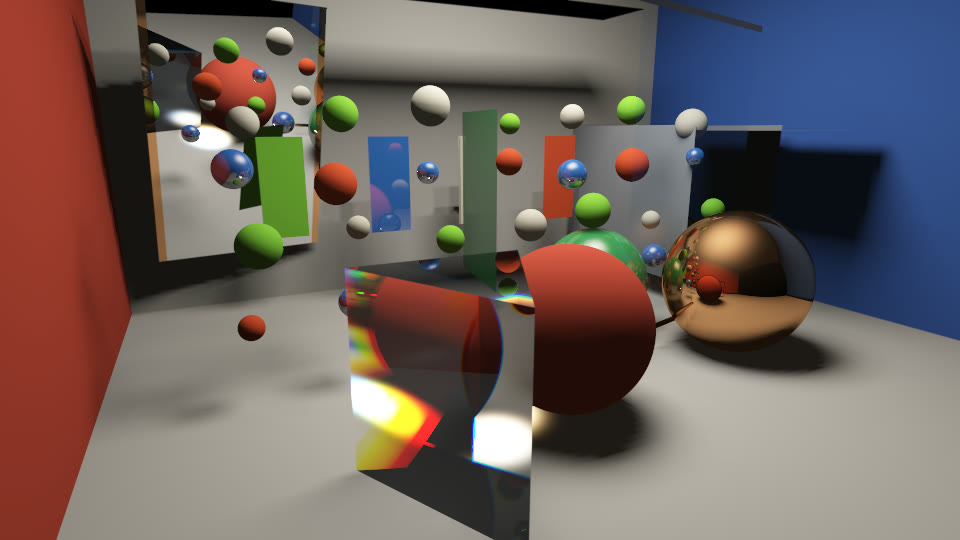
The same scene exposes colored diffuse transfer, indirect light in a recess, broad area-light shadows, mirror returns, and three-channel refraction through the prism.
The wide view establishes the room, area light, prism, mirrors, cavity, and colored surfaces.A closer view puts glass, reflection, curved surfaces, and indirect light into the same image.The overhead view reveals boundaries and shadows hidden from the opening camera.The low return makes the prism's separated red, green, and blue transport visible.
Three transport tests
These are demonstrations of the renderer, not separate methods. Each changes the geometry or lighting and contains 240 frames at 640 × 360, played for eight seconds at 30 fps.
Overlapping area lights · flat blockers
Aperture canyon
A violet side light and a white ceiling light shine through seven staggered fins. Partly visible emitters, overlapping shadows, and five small receivers stress exact subdivision of rectangular source visibility.
Partial fin silhouettes divide the two broad emitters into different visible regions.The high view exposes narrow contributions between neighboring fins.
Scene graph
42 primitives · 19 diffuse nodes · 230 links
Average frame
1.904 s
Boundary reconstruction
0.999 s
Web media
8 s · 495 KB
View-dependent reflection · repeated returns
Mirror relay
Three differently oriented mirrors share a room with a cyan side light, two diffuse receiving panels, and a rough reflector. Reflected geometry changes with the camera while the scene's diffuse illumination remains retained.
The oblique camera sees several nested and displaced reflections at once.The high view shows the three mirror planes overlapping without becoming one surface.
Scene graph
36 primitives · 16 diffuse nodes · 154 links
Average frame
2.117 s
Boundary reconstruction
1.146 s
Web media
8 s · 501 KB
Curved silhouettes · many partial occlusions
Occlusion garden
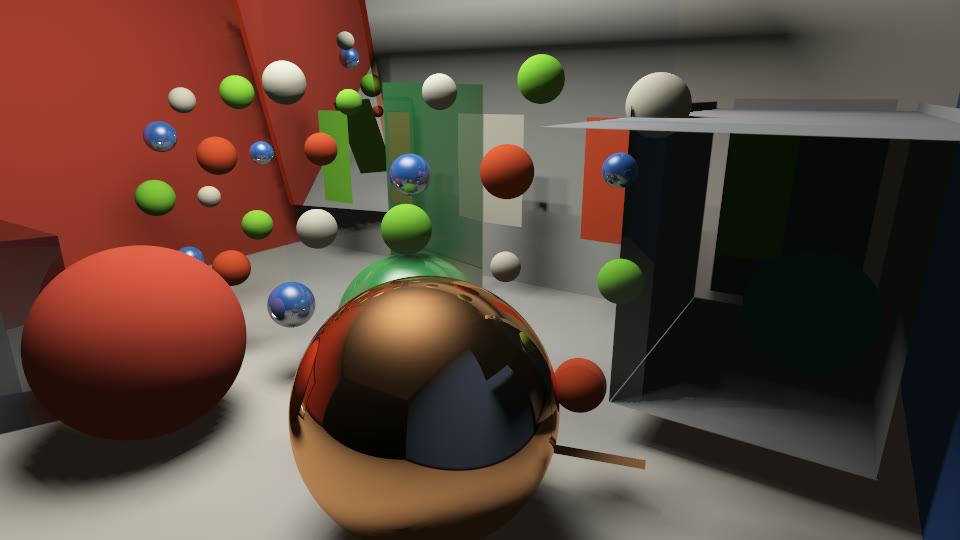
Twenty-eight suspended spheres and five colored flags create many curved silhouettes and partial occlusions. Their crossing contours stress camera-boundary detection and reconstruction.
Each sphere contributes a curved silhouette instead of a square image patch.The high view collects many partial occlusions over the same illuminated room.
Scene graph
63 primitives · 47 diffuse nodes · 1,491 links
Average frame
1.263 s
Boundary reconstruction
0.898 s
Web media
8 s · 520 KB
Measured on the M4
Every result below was measured on a 2024 Mac mini, model identifier Mac16,10 and model number MU9D3LL/A, with an Apple M4 10-core CPU—four performance cores and six efficiency cores—and 16 GB of memory.
The figures separate what has been demonstrated from what remains a hypothesis. Playback rate is not render rate: the 30 fps videos are encoded presentations of frames that took much longer to calculate.
1920 × 1280 frame
730.234 ms total
Its scene field
14 diffuse nodes · 140 links
Its camera work
653,111 primary · 2,595,363 secondary traces
Its spectral beam
879 fibres
3200 × 2400 optimization
2.432 s → 1.664 s
Verified change
31.61% faster · byte-identical image
Average time for one 640 × 360 stress-scene frame
Scene
Scene structure
Whole frame
Boundary work
Share
Aperture Canyon
42 primitives · 230 graph links
1.904 s
0.999 s
52%
Mirror Relay
36 primitives · 154 graph links
2.117 s
1.146 s
54%
Occlusion Garden
63 primitives · 1,491 graph links
1.263 s
0.898 s
71%
In a separate fixed set of 4,096 spatial queries, bounding-volume traversal took 1.891 ms for 1,000 objects, 3.072 ms for 10,000, 3.398 ms for 100,000, and 5.253 ms for one million. Building the million-object index took 203.323 ms and its recorded primitive-plus-index storage was 380 MB. Those numbers measure geometric lookup, not a complete million-object illumination solve.
Preliminary conclusions
The implementation establishes that a scene-compiled transport representation can produce coherent diffuse interreflection, area-light shadowing, reflection, and wavelength-separated refraction, then expose the illuminated scene to more than one camera view.
It also establishes that repeated work exists which can be removed structurally: one measured 3200 × 2400 optimization reduced total time by 31.61% while producing a byte-identical image, and geometric query time increased only 2.78 times when the indexed object count increased by 1,000 times for the fixed query set.
It does not yet establish the full hypothesis. The stress scenes require 1.263–2.117 seconds per 640 × 360 frame, boundary reconstruction alone consumes 52–71% of that time, and the 1920 × 1280 record still performs millions of camera-dependent traces. There is no matched end-to-end comparison against a nondeterministic probabilistic renderer that charges both systems for construction, updates, and equal-quality images. The present answer is therefore precise: retained transport has removed measured repetition and produced a working renderer, but general superiority remains open.
Current limits
The retained field currently assumes fixed geometry, lights, and materials; changing them can invalidate transport, and an incremental update system has not been demonstrated. Geometry is limited to analytic rectangles, triangles, and spheres, so arbitrary skinned or deforming meshes, displacement, and fine texture-driven normal fields need another hierarchy. Diffuse transport is resolved at object or facet scale, which cannot preserve every fine indirect-light gradient.
The prism carries three wavelength channels rather than a continuous spectrum, rough directional transport is approximate, and participating media are absent. Fog, smoke, subsurface transport, continuous spectra, polarization, diffraction, and coherent wave interference would require transport state that this renderer does not contain.