Going away?
Send in the dog.
Open the app. Arrange a dog. Leave for the weekend. When you return, request collection and wait for the garden to be yours again.
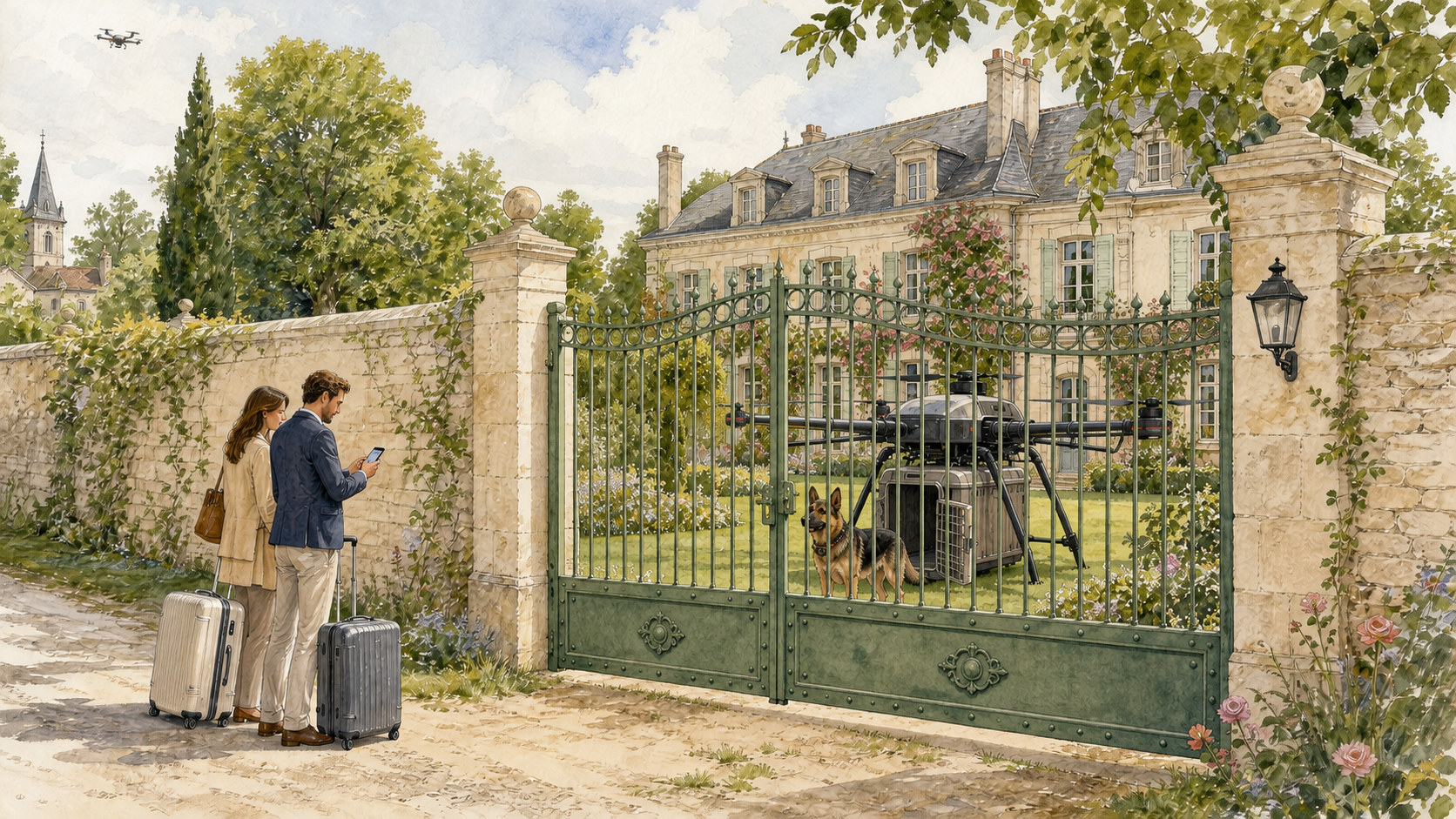
Your house has company.
You have a small château, a flight to catch, and very little desire to organize another household service. Yardwatch Airlift proposes a guard dog for the hours you are away, delivered and retrieved by cargo drone. No permanent dog ownership. No drive to a kennel. No need to turn a trip into a staffing exercise.
The dog is remarkably indifferent to your possessions. He has no use for the silverware, the laptop, or the family paintings. Sausage left on the kitchen counter may complicate that assessment. Otherwise, the garden is the attraction: somewhere to explore, something to notice, and a new arrival who is suddenly much less alone than expected.
Two moments in the app
For a property already surveyed and accepted by the service, the customer chooses the absence and requests delivery. The app confirms when the dog has arrived and the guarded period has begun. The household leaves after that handover.
On the way home, the customer requests collection. The service recalls the dog into the carrier and confirms departure. The useful final message is explicit: the dog has left and entry can resume.
Collection requested and collection complete are different states. The homeowner waits outside the guarded area until the second one arrives.
The weekend, in four messages
Illustrative service states. This is a proposed service, not a live booking app.
A living presence, with eyes above
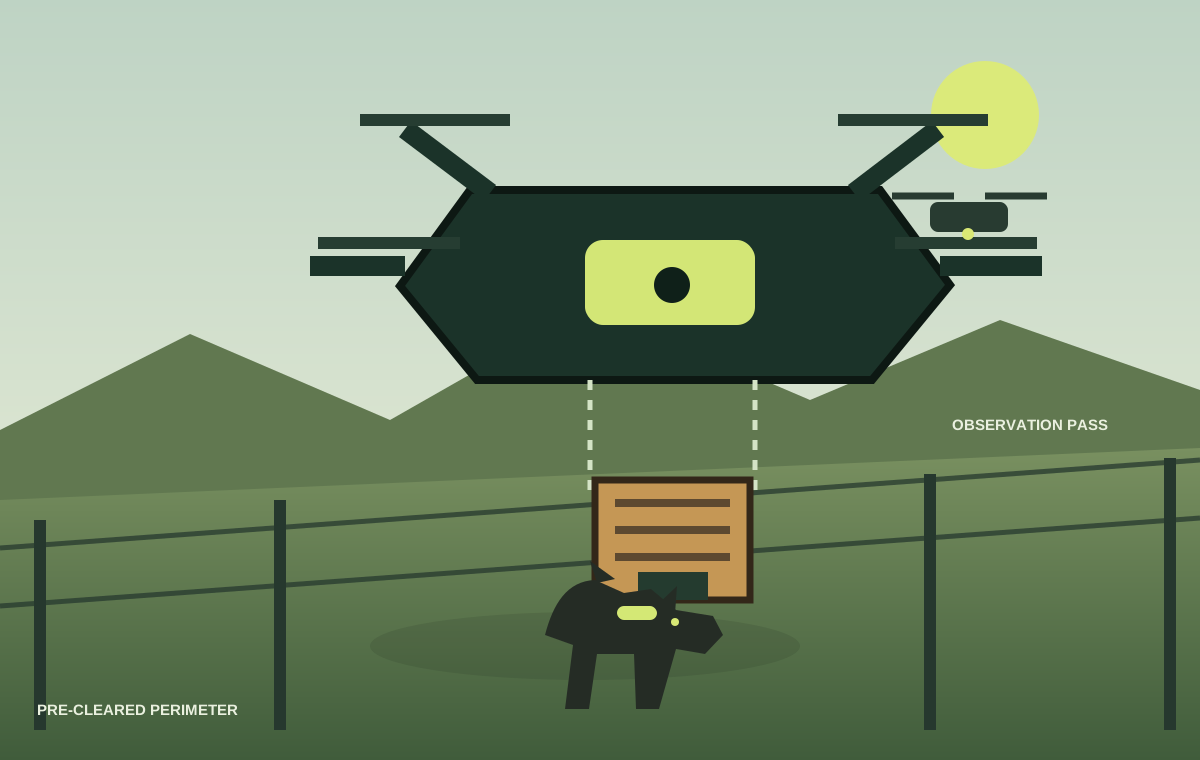
A camera can report an arrival. A dog gives that arrival an immediate consequence: the property is occupied by an attentive animal. Independent small drones extend the view beyond the collar camera, while a remote operator follows what is happening on the ground.
A garden with a boundary
The proposal begins with a property survey: walls, fences, gates, access routes and places a dog could leave. RTK positioning and a secured GPS-camera collar support a territory already understandable on the ground. Location estimates and collar cues cannot substitute for dependable containment.
Four-hour rotations belong to the operating plan. A longer booking would require fresh coverage, rest, water, shelter appropriate to the weather and reliable transport between the property and the trainers’ home base.
A familiar routine in an unfamiliar place
The training concept separates home-base handlers and their commands from ordinary local speech, potentially using trainers from a distant language community. The intended advantage is resistance to casual verbal distraction. Unfamiliar vocabulary is not authentication, and a dog’s response cannot be guaranteed by a stranger’s accent.
The app delegates the animal handling to the service. Remote oversight and a controlled return to the kennel are as much the product as the arrival.
A particular kind of household
Picture the residential outskirts of Paris: a private enclosed garden, a well-kept house, and owners who fly often enough that temporary coverage has recurring value. Prosperous enough for frequent trips; still interested in a convenient alternative to permanent staffing.
This is a proposed starting market, not a claim about every European or North American home. The useful dividing line is the property: an exclusive, containable outdoor area with predictable access. Shared courtyards, frequent visitors and a household that cannot keep people out during a booking are a poor fit.
The return needs to be boring.
A homeowner can be bitten by the very dog hired to guard the home. Ownership of the house does not establish a relationship with the animal. Children, guests, gardeners, emergency access and an early return all matter to whether a property can participate.
Property acceptance, agreed access rules, insurance and liability contracts would be part of the service. A signature does not make a bite harmless or establish that all responsibility has disappeared. France’s official guidance on dog bites describes reporting and liability-insurance consequences; this proposed service would need its own legal and operational assessment.
Book the presence. Keep the weekend.
The appeal is the small amount of life it asks from its customer. A suitable property is prepared once. Subsequent absences begin with an app request and end with a confirmed collection. Behind those few taps sits an unusually demanding service; in front of them sits someone who would quite like to catch their flight.