Wash your hands
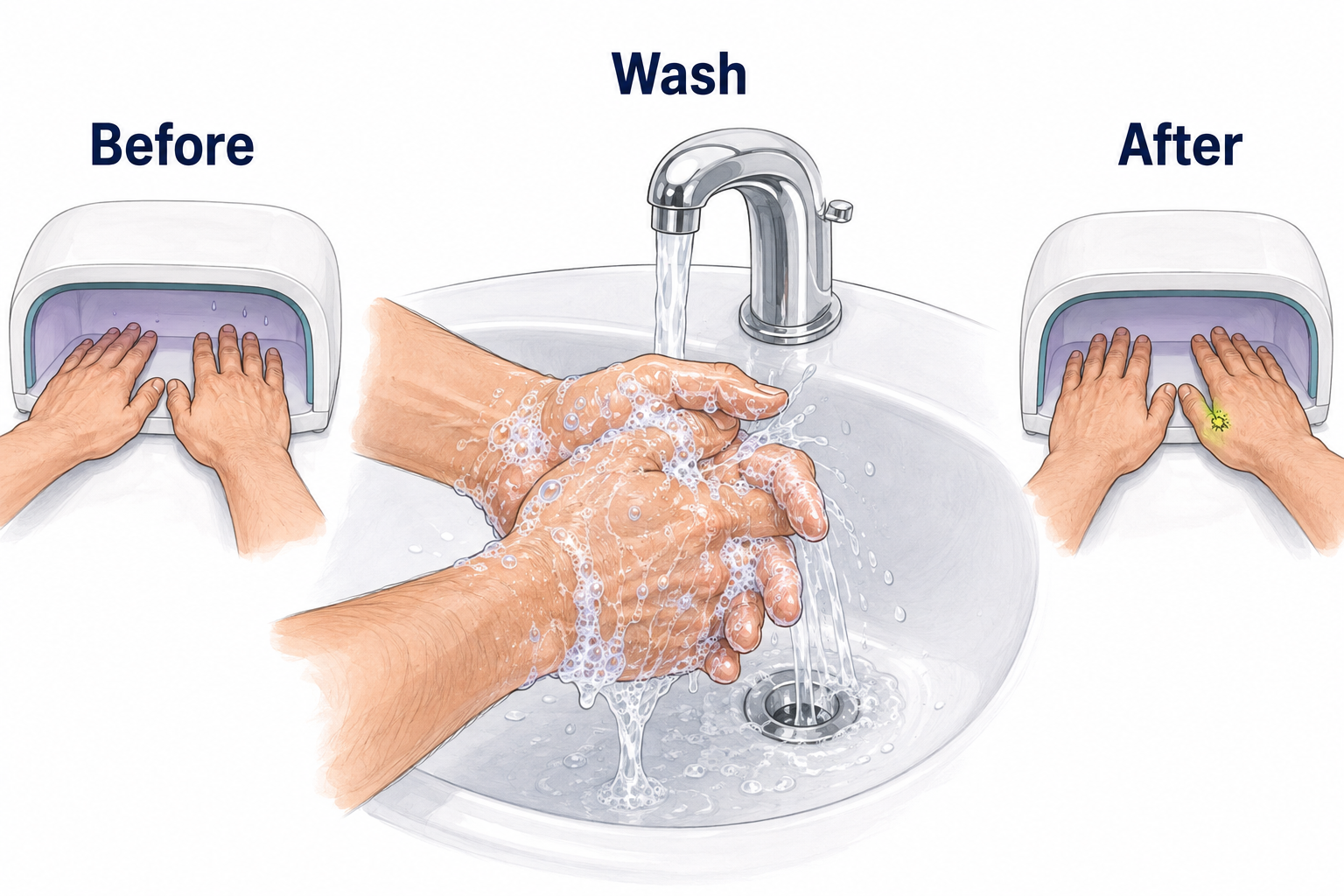
Before washing, put both hands into the first enclosure. It automatically sprays enough tracer liquid to coat them. Wash with soap and water. Afterward, put both hands into the second enclosure: its light reveals what remains. A visible patch shows you where to wash again.
Both openings accept the hands together. There is no dose to catch or spread. The useful work is the washing; the two brief interactions make its result visible.
A missed spot becomes obvious
A person can repeat the same washing habit and repeatedly miss the same part of a thumb or the space between fingers. A visible remainder gives the next action a location.
Fluorescent handwashing-training materials already exist. Visible Clean would make that feedback available in an ordinary bathroom, with the application and inspection equipment permanently at hand.
Two simple enclosures
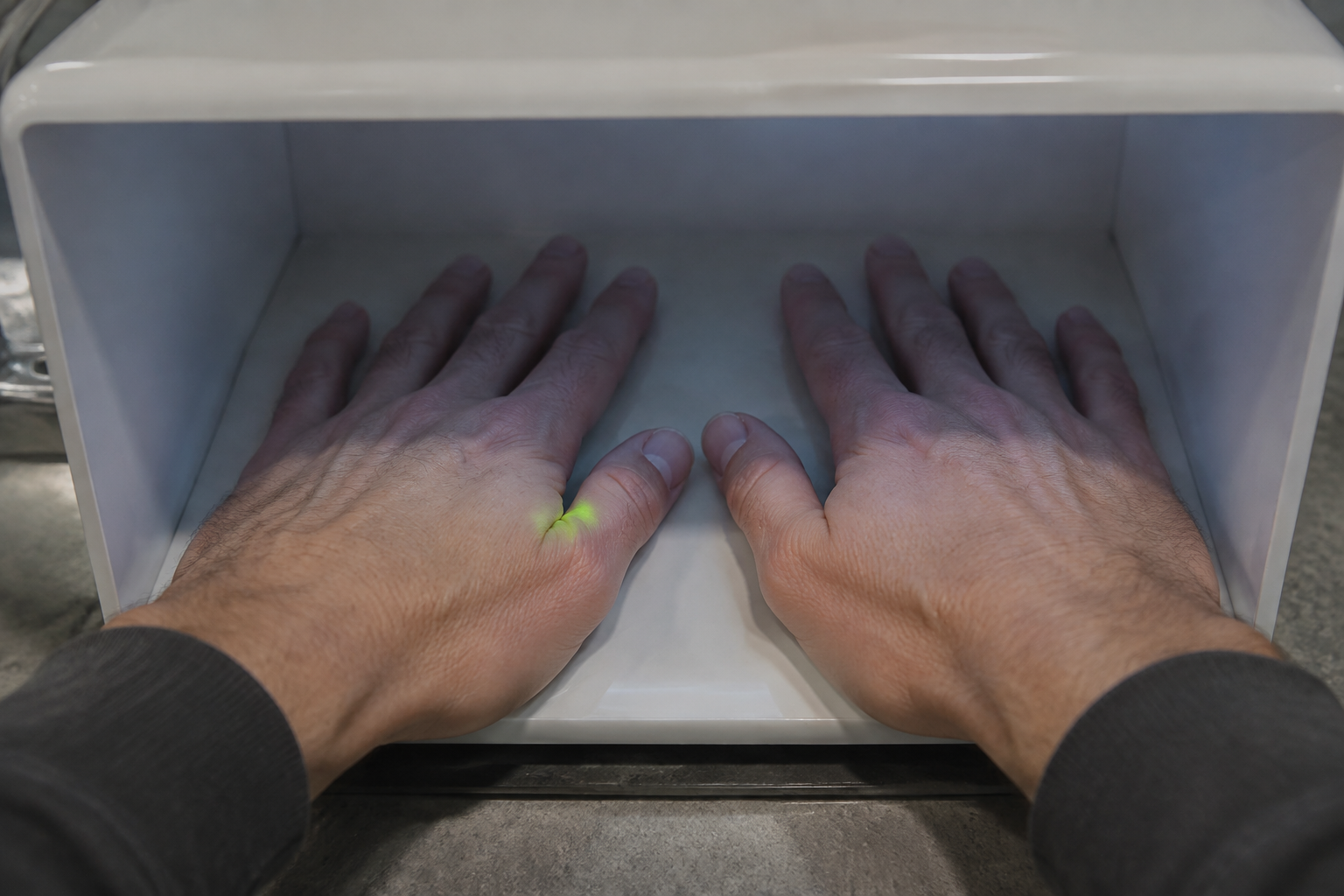
The first holds a liquid cartridge, pump and interior spray outlets. The second holds an inspection light. Each uses a battery and a presence sensor. The housings should be compact, easy to wipe down and positioned so the hands move naturally from coating to the tap, then to inspection.
The spray enclosure must provide coverage around both hands in a comfortable position and collect excess liquid. The inspection opening must give a clear view without glare. These are requirements for the equipment to resolve through its shape and operation.
A school or workplace washroom could test whether the station is used again after the novelty passes. Refills, battery life and cleaning matter because the feedback must be available whenever someone reaches the sink.
A liquid worth trusting
The tracer needs to remain visible where washing was incomplete and come away with thorough washing. A dye that disappears under a cursory rinse gives false reassurance; a stubborn film makes people scrub away the indicator itself.
A riboflavin–cellulose liquid is a preliminary candidate. Its wash-off behavior, direct-spray coverage, repeated skin use and storage stability remain untested.
Candidate formulation and engineering questions
A first candidate combines riboflavin, or vitamin B2, with a small amount of hydroxyethylcellulose in water. Riboflavin has been used in research measuring transfer from surfaces to hands. Hydroxyethylcellulose is a water-soluble personal-care thickener. The proposed combination aims to make a thin liquid that wets the hands under direct spraying and carries a visible signal. Its viscosity must suit the enclosed spray system.
| Ingredient | Mass fraction | Intended role |
|---|---|---|
| Purified water | 99.395% | Liquid carrier |
| Glycerol | 0.500% | Adjust wetting and wet-film behavior |
| Hydroxyethylcellulose | 0.100% | Modest viscosity and a removable carrier film |
| Riboflavin | 0.005% | Fluorescent signal |
| Total | 100.000% | Untested starting values |
This is a proposed composition for nonhuman bench evaluation. It has not been experimentally validated for washing feedback or repeated skin use. Preservation remains unresolved; it is not a finished dispenser refill.
The main objection is chemical: a dissolved dye can escape from a carrier faster than the carrier washes away. Adding cellulose does not bind riboflavin to it. The lamp could therefore go dark while residue remains. The candidate must earn its place by showing that fluorescence and removal stay meaningfully coupled.
The cellulose grade affects viscosity, spray quality and stringing at the nozzle. Riboflavin concentration affects contrast, daylight tint and possible staining. These need measurement in the complete liquid.
Riboflavin also changes under illumination. An opaque cartridge is a sensible starting design; testing must distinguish photobleaching from removal. The illumination wavelength, power and exposure must be assessed together with the formulation.
A water-based cartridge needs a compatible preservation system and demonstrated storage stability. Microbial contamination in water-based personal-care products is a separate engineering issue from how well the tracer glows.
If the soluble marker leaves too easily, the next direction is a dispersion in which the marker remains associated with a removable carrier. Putting a freely soluble dye into an emulsion would not, by itself, solve that separation problem.
Compare the candidate with a polymer-free riboflavin liquid and an established training tracer. Check whether cursory rinsing, missed regions and thorough washing leave distinguishable results. Measure remaining carrier separately from fluorescence so a disappearing dye cannot produce a false pass.
Image contrast must be assessed across skin tones, room lighting and washing conditions. Fluorescent particle removal is distinct from microbial removal. The result reports residual tracer, and cannot establish that washing occurred if application was skipped.