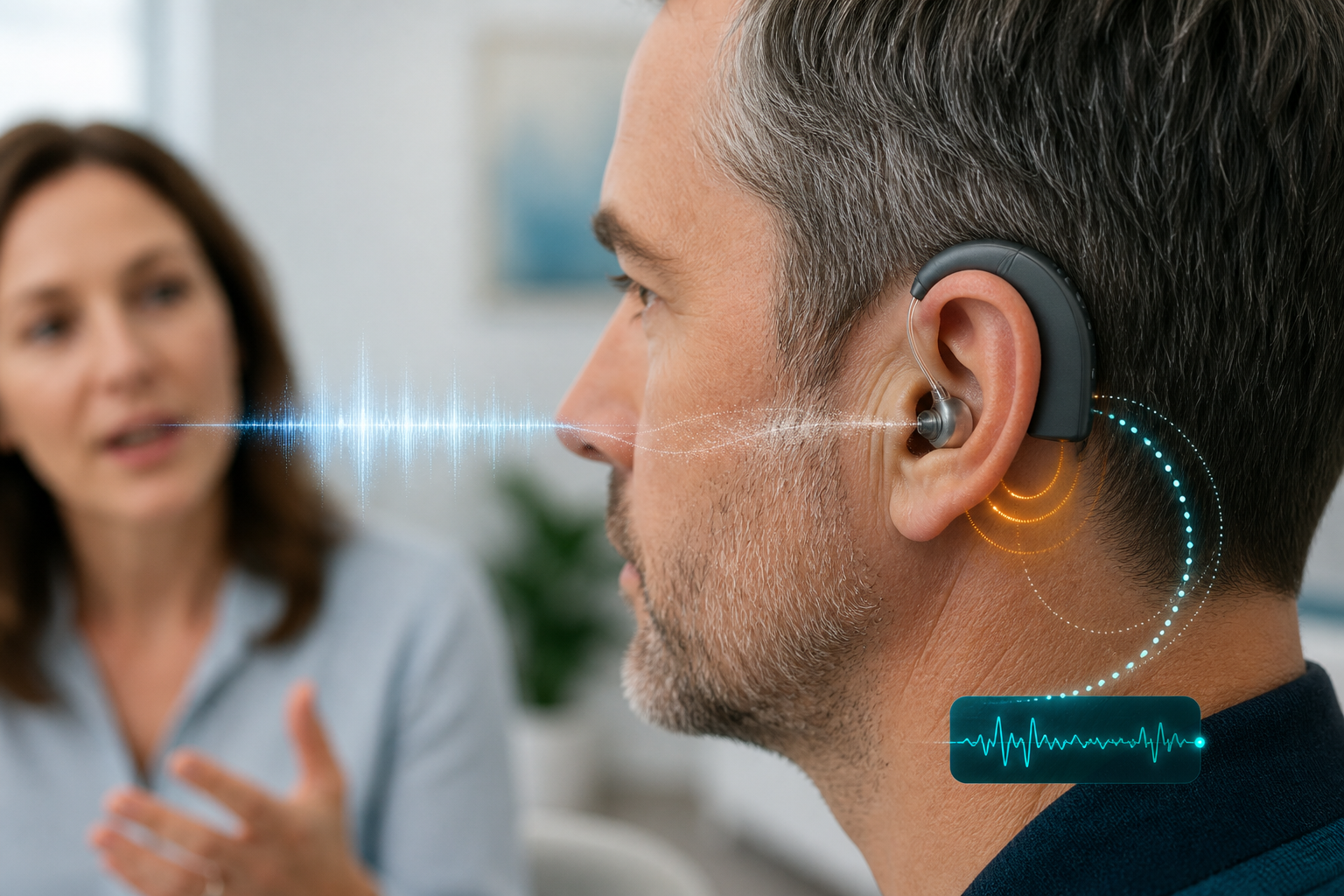
A tinnitus-treating earpiece that uses biofeedback to treat some forms of tinnitus and specially designed sound to mask other forms, while testing slower progression as an explicit long-horizon hypothesis—and lets speech pass through while it works.
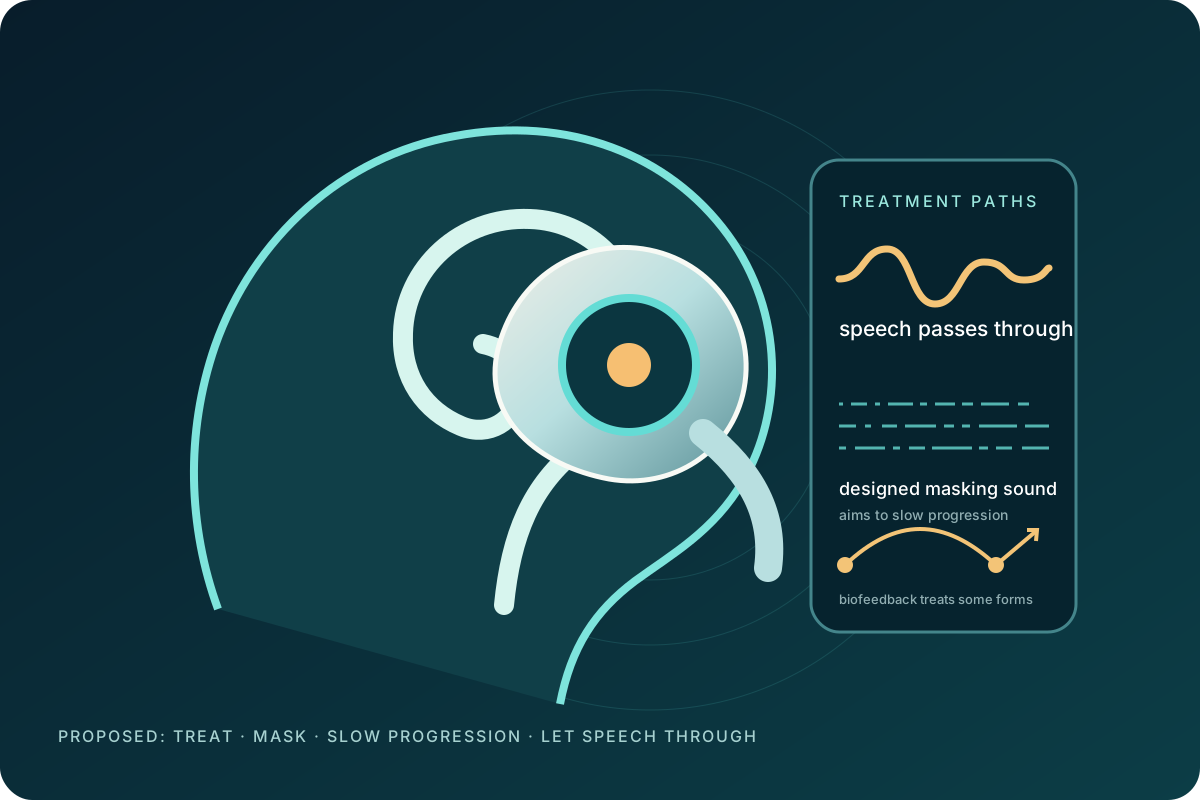
Proposed device: biofeedback treatment and designed masking sound share one earpiece with a separate path for live speech.
Relief that fits into a day
Tinnitus is the perception of sound without an external source. It is not one uniform disease: the National Institute on Deafness and Other Communication Disorders describes different sounds, causes, and responses, estimates that 10–25% of adults experience it, and notes that severe cases can disrupt sleep, concentration, mood, and conversation. A useful daily device therefore has to do more than place another sound in the ear.
Three cooperative paths: biofeedback for responsive forms, designed sound for other forms, and live speech kept intelligible.
Keep the person in front of you audible
Masking can make tinnitus less prominent, but added noise competes with the signal a person is trying to hear. A controlled experiment found that tinnitus-masker noise substantially reduced speech discrimination in noisy backgrounds even when it caused little impairment in quiet (Spitzer et al.). Speech passthrough is therefore not an accessory. It is what permits treatment or masking to remain active during work, family life, and public conversation.
Three paths through one earpiece
Biofeedback loop
A measured physiological signal becomes feedback the wearer can learn to influence. A 130-participant randomized trial of biofeedback-based behavioral treatment reported durable improvements in tinnitus annoyance, diary loudness, and controllability; the earpiece asks whether that closed loop can be made continuous and wearable for responsive forms.
Designed sound
For forms that do not respond to the biofeedback path, an individually shaped sound reduces prominence. The hypothesis of slowing progression is the long-horizon claim: it must be tested separately from immediate masking rather than inferred because the tone seems quieter.
Speech channel
External microphones identify speech and mix it through above the therapeutic signal. The user does not have to choose between relief and understanding the person in front of them.
System integration
A masker that makes conversation harder may be removed exactly when daily life gets busy. The proposed earpiece treats the conversation as part of its operating environment: adapt the mix as the room changes, and preserve intelligibility throughout the session.
01
Characterize
Record the tinnitus phenotype, hearing profile, matched sound, context, and relevant biofeedback signal rather than treating every report as the same tone.
02
Treat or mask
Run the biofeedback treatment for responsive forms or the specially designed masking sound for the others.
03
Protect speech
Detect and pass conversation through continuously, changing the mix instead of requiring the wearer to remove the earpiece.
04
Learn longitudinally
Separate immediate relief from changes in tinnitus severity, hearing, and function across months.
Context-aware operation
Personalize by response
The branching treatment model acknowledges that a method helping one tinnitus form may be irrelevant to another.
Stay present in life
Speech passthrough makes adherence compatible with the moments—meetings, meals, transit, caregiving—when a sealed masker is least tolerable.
Distinguish relief from course
Masking is perceptual and immediate. Slowing progression is biological or functional and longitudinal. Measuring both prevents the first from impersonating the second.
Control the sound dose
Designed sound cannot become additional injury. The World Health Organization’s safe-listening guidance makes level and duration part of the prescription, so the device must log cumulative exposure while preserving speech.
Clinical outcomes and timescales
During a session, measure tinnitus prominence and speech intelligibility in quiet and noise. Across weeks, measure use time, distress, sleep, and concentration. Across months, compare tinnitus severity and hearing trajectories against an appropriate control. The study asks separately whether designed sound slows progression; it does not assume disease modification from short-term masking. The integrated device succeeds only if it can treat some forms with biofeedback, mask other forms with designed sound, keep speech understandable, and stay within a controlled listening dose.