Provision the box
The principal chooses what its cards can become: one petition, a durable contact, provisional access, or authority to create another box.
AMERICAN GUANXI · PROXIED ACCESS
QR-coded cards carry access through people who already know one another. The recipient sees the complete chain, configures how much referral is enough, and never publishes a private phone number.

Important people do not lack messages. They lack a way for a meaningful stranger to arrive with context. Publish an address and every warning, proposal, request, campaign, and solicitation enters the same queue. Keep the address private and access hardens around the people who already possess it.
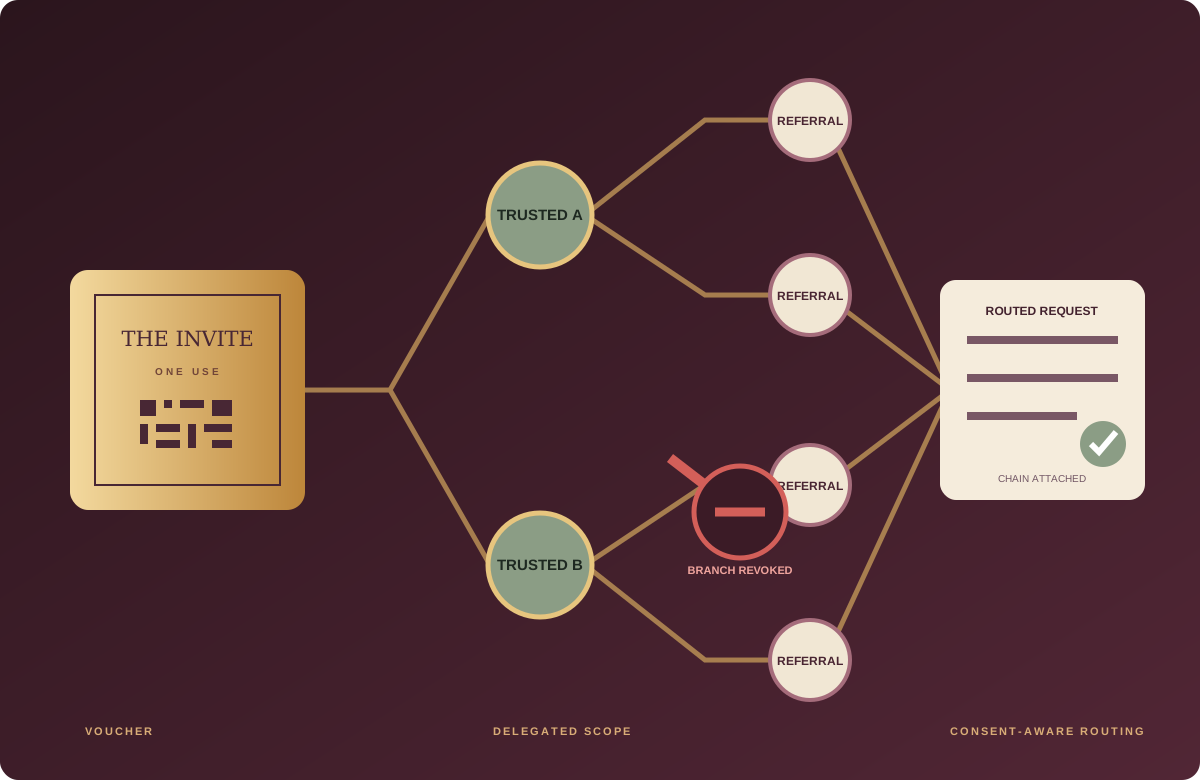
The Invite gives a private contact network controlled reach. A request arrives with the human route that carried it: who knew whom, who approved the attempt, and whose access is being spent. That is American guanxi—relationship, reputation, and introduction made into a contact system.
The principal defines the access policy once; each physical handoff then carries a small, attributable portion of that policy into the network.
The principal chooses what its cards can become: one petition, a durable contact, provisional access, or authority to create another box.
One scan activates the numbered cards inside. There is no reason to sign, enter, or individually configure thousands of tokens.
The cards are one-use identity vouchers: a physical handoff turns judgment into attributable permission. The principal keeps the rest of the box.
Only recipients with provisioned generation power can issue onward. Propagation is a policy, not an automatic viral rule.
The request does not expose the principal’s endpoint. It accumulates approvals along an inspectable chain and arrives as a petition opportunity.
You request access from the president’s AI and describe what you want to discuss.
The president has configured unknowns to receive possible call opportunities within the next six months.
The AI solicits referrals from your existing chain. Your mother approves. The governor approves.
You now have a petition opportunity: not the president’s phone number, but a routed chance to arrange a call.
The president may silently review the subject, permit scheduling into a calendar, delegate it, delete it, or make the contact durable afterward.
The principal may provision it for immediate, unvetted access.
One proxy or a light approval threshold may be enough.
The AI gathers recipient-configured approvals from people with existing trust relationships.
A one-petition or provisional card may become a durable contact if the principal chooses.
Require one second-level proxy, three independent third-level proxies, a particular parent, a role-qualified referrer, or a fluid AI judgment inside a fixed policy. Different principals can operate completely different networks.
Your mother can refuse to proxy your request without becoming a permanent veto. Several people who know the governor may independently approve you, satisfying the governor’s configured threshold and letting him proxy the call upward.
Each approval is attributable. A person who repeatedly sends valuable contacts may earn greater reach. A person who carries harassment, fraud, or excluded subjects can lose cards, generation power, or an entire branch. That attribution lets the principal terminate access for one person, a parent branch, or deeper descendants without publishing the endpoint or closing every route.
The chains overlap nearby. Vetting is mild. A few proximate people can proxy the introduction and he may reach her messages.
The recipient can require approvals from the stranger’s mother, father, or other proximally available people before the request travels inward.
Reachability therefore remains unequal in a useful way: the social route is visible, and the recipient decides how much evidence a distant route must carry.
Phone numbers made the physical Rolodex obsolete. Provisioned cards redeem it. The card is more valuable than a record of someone’s information because it contains a path through which that person may actually be reached.
A former intelligence operative may need to prove valuable experience to a multinational bank without identifying confidential employers or activities. An encrypted résumé is still merely a claim. Nested, authorized attestations can place cryptographically verifiable reputation behind the claim while keeping the underlying employer restricted.
That future combines references, authorization, cryptography, and identity into a much larger system. The world is not ready for the whole thing. It is ready for guanxi.
Give direct contacts provisioned cards, let a select few generate boxes, configure how unknowns earn a petition, and observe whether useful calls arrive through routes the principal could never have maintained personally. Success means distant human judgment reaches the endpoint while the endpoint stays private and manageable.