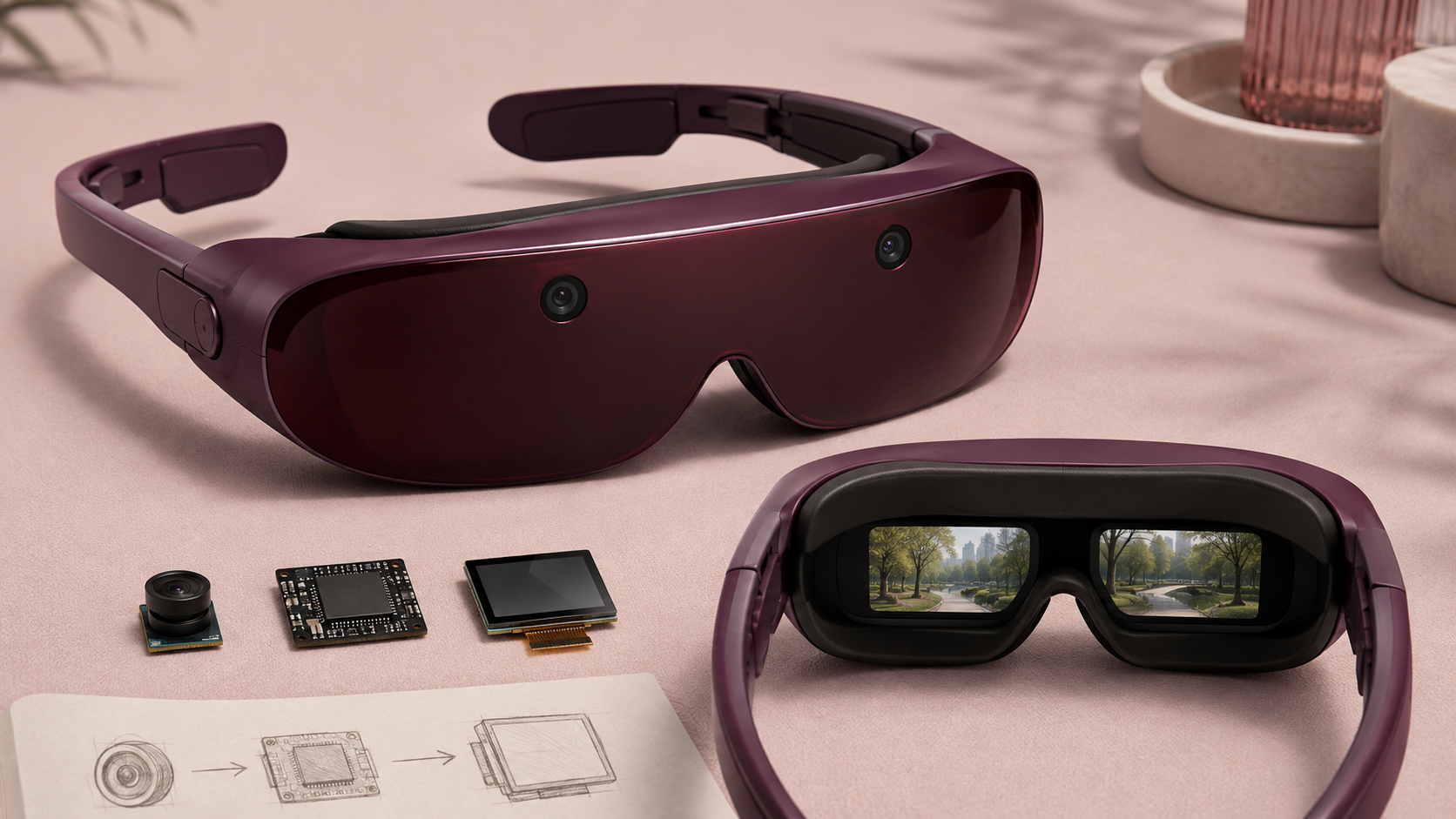
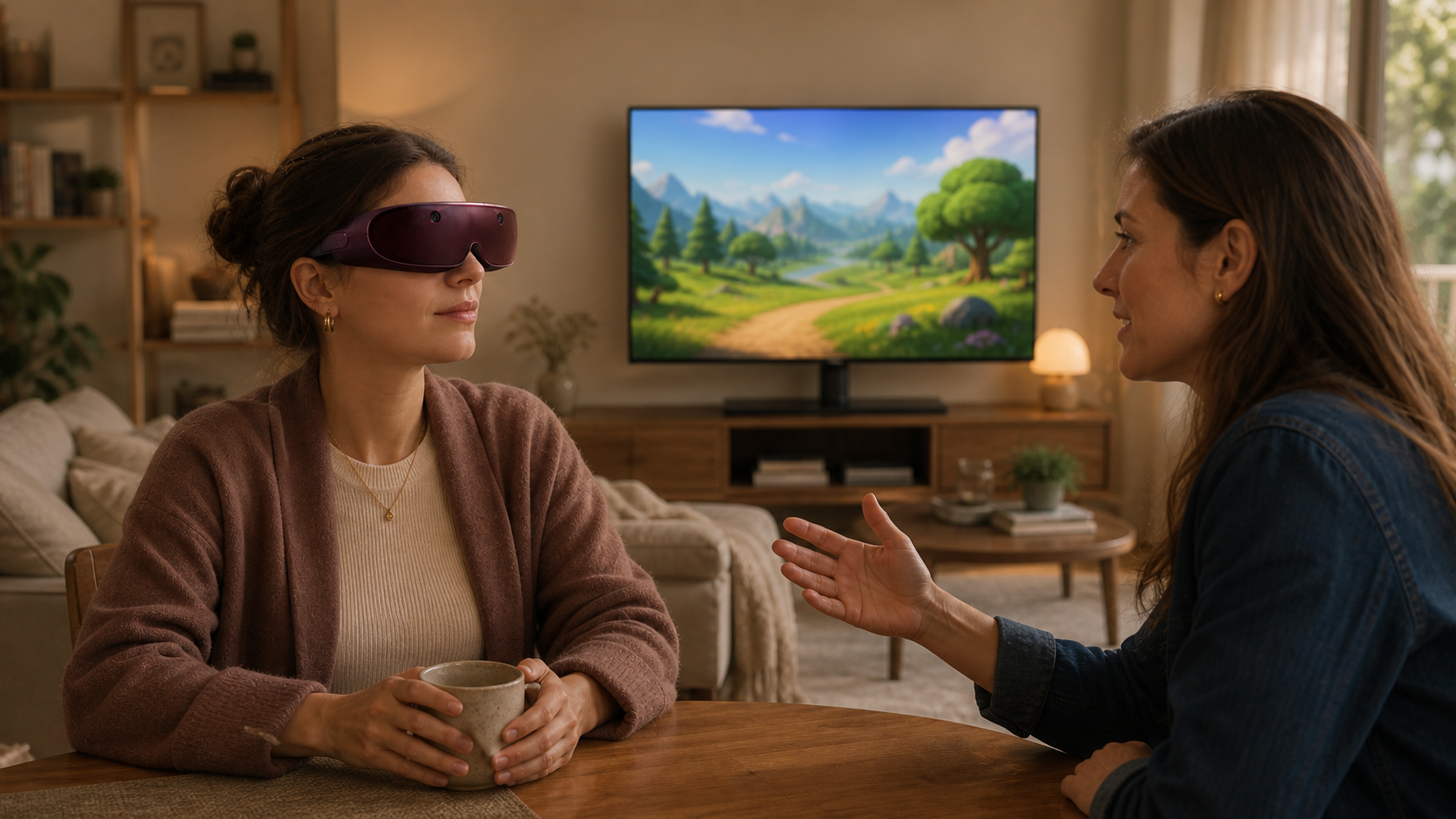
Electronic glasses that put a processing step between a visually provocative scene and the eyes. Cameras capture the world; paired displays present a moderated version, with photosensitive seizure-risk reduction as the clinical objective.
Camera-mediated vision: the wearer sees the internal displays. The opaque outer shield separates their light from the original scene.
A filter that travels with the viewer
A television can be adjusted. A passing emergency vehicle, another passenger’s screen or sunlight interrupted by roadside trees is harder to control. Steady Frame asks whether a wearable can preserve useful vision while reducing the particular visual changes that provoke a wearer’s photosensitive response.
Photosensitivity is not simply discomfort with bright light. Temporal modulation, color, spatial patterns and the portion of the visual field involved all matter. A 2022 review by Fisher and colleagues describes visually sensitive seizures and these interacting stimulus properties. The aim here is clinical risk reduction; a smoother-looking image alone is not evidence that the device achieves it.
Why cameras change the proposition
A transparent filter can remove light. A camera–display system can also supply a previously captured or reconstructed view when the source goes dark.
What transparent lenses can do
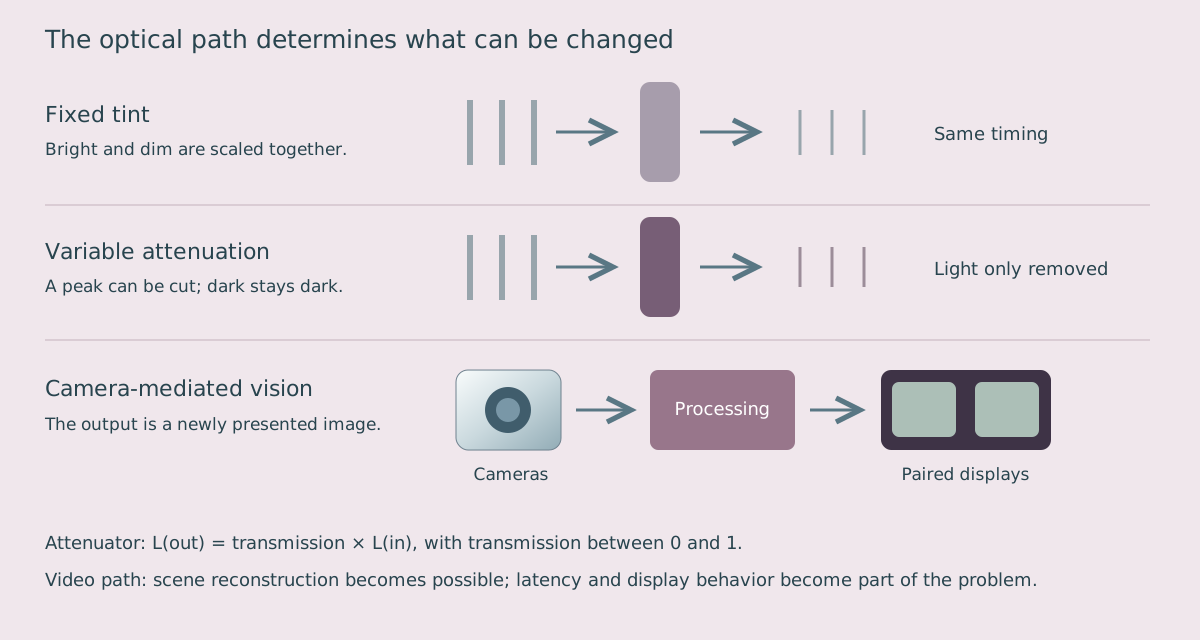
A neutral fixed tint scales bright and dim intervals together. It can reduce exposure, but it does not by itself remove their timing or normalized luminance contrast. Spectral lenses are different: selected wavelengths may be attenuated disproportionately, and some have clinical evidence.
A variable-transmission lens can suppress a peak. It cannot create scene information during a completely dark interval. For a passive attenuator, output light is input light multiplied by transmission between zero and one. If the input is zero, the output is zero too. Strongly clipping every bright interval down to a very dark minimum can also leave too little scene to navigate.
What a video path adds
With cameras and opaque binocular displays, the processor controls the delivered image. It can moderate local luminance changes, reduce color alternation, retain information between exposures and treat a provocative region differently from the rest of the view.
That freedom has costs. The view is delayed, camera dynamic range is finite, reconstruction can be wrong and a lost frame must not become a frozen obstacle map. Full HD resolution helps detail; it says little about latency, periphery, color accuracy or seizure protection.
The welding precedent is real.
SRI’s 2023 account of its XDR welding helmet describes fusing multiple camera exposures into a stereo display so bright arcs and dark surroundings can be viewed together. SRI reports no noticeable latency and says it licensed the technology to Kawada Technologies for commercialization.
That is useful evidence for camera-mediated seeing under difficult illumination. It supplies neither a quantified worst-case latency for this proposed device nor clinical evidence for epilepsy. Steady Frame would use related imaging capabilities toward a different endpoint: the light waveform actually reaching each eye.
There is clinical evidence to build from.
In Nomura and colleagues’ 2000 temporal-filter study, an unfiltered television sequence elicited generalized photoparoxysmal responses in 11 photosensitive patients; the filtered version elicited none in those tests. It was a small, specific display experiment, not a wearable or an everyday seizure-prevention trial.
In a 2006 multicenter study of Z1 blue lenses, the photoparoxysmal EEG response disappeared in 463 of 610 participants and was reduced in another 109. These results make an established spectral filter a meaningful comparator. They do not imply universal protection or validate an electronic visor.
A photoparoxysmal response, or PPR, is an EEG response. Reducing it in a test and reducing clinical seizures in daily life are related but distinct outcomes.
Inspect the signal without watching a strobe.
This static chart explores a simple temporal smoother. It shows why less modulation also means more delay and less temporal detail. There are no flashing stimuli or playback controls.
A deliberately limited filter study
Enable JavaScript to inspect the illustrative filter. The model does not predict seizure risk or certify a stimulus as safe.
One causal first-order low-pass filter, sampled at 120 Hz, acting on normalized linear luminance. Output is delayed by the entered capture–display time. This is an explanatory model, not a proposed clinical algorithm. Reducing frequency into another provocative range is not the goal.
The same device, different visual problems
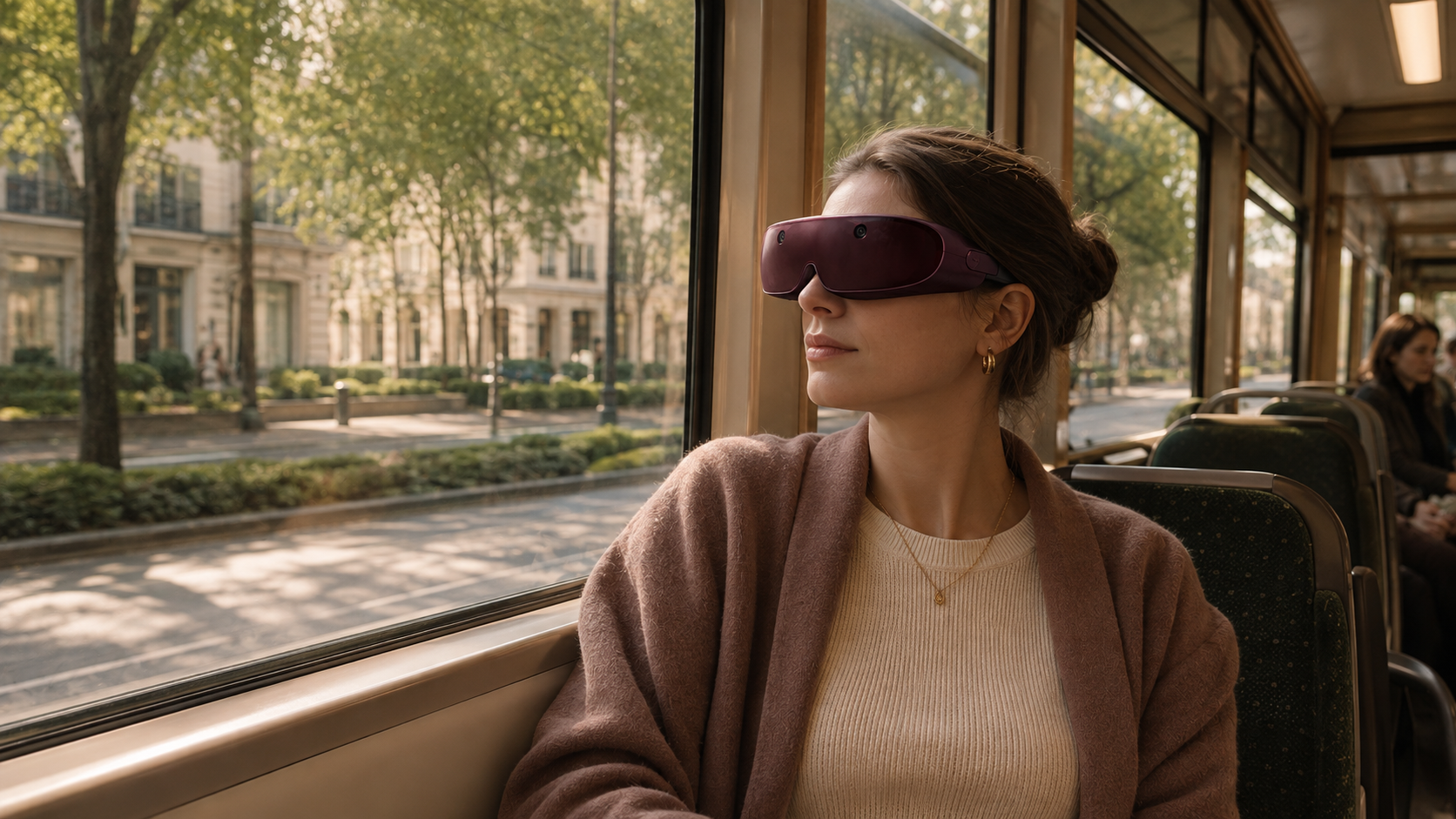
A seated passenger is one scenario for studying scene continuity as illumination changes outside. The illustration does not demonstrate protection.
Sunlight through trees
Changing illumination can affect a large part of the view. The research question is whether temporal moderation preserves scenery without blurring a passing cyclist or turning head movement into a delayed panorama. Motion-to-photon latency and motion reconstruction matter alongside flicker reduction.
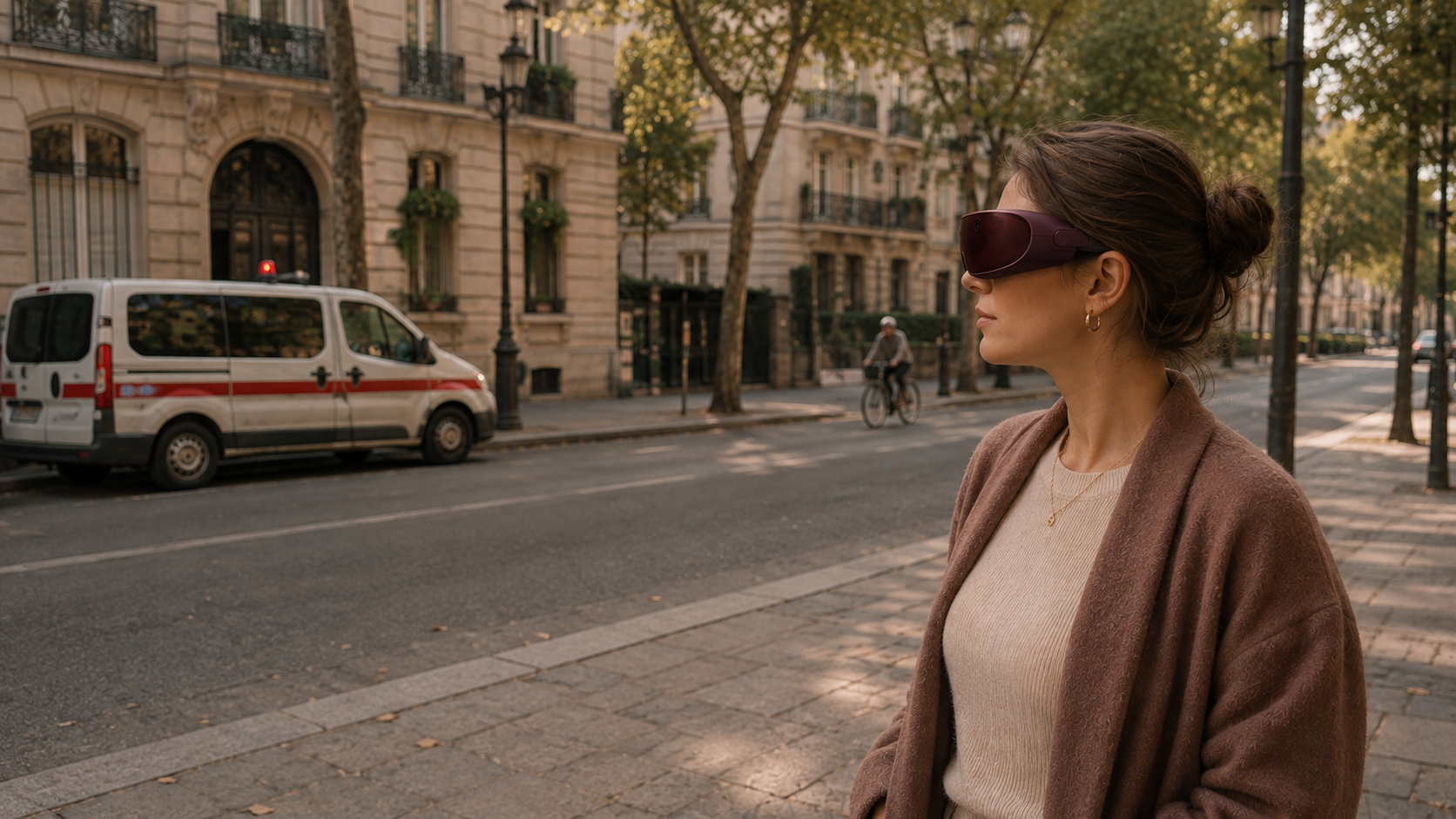
An emergency beacon across the street
A small bright source suggests local processing: moderate the beacon while keeping the pavement, curb and moving traffic legible. The display should preserve the fact and location of the warning. A device that erases meaningful signals to produce a calmer picture has lost essential information.
A game or screen in a shared room
Red alternation, changing patterns and luminance modulation can require different responses. The screen’s region might be treated more strongly than the surrounding faces. Fine text, gestures and color-coded information provide useful measures of what the intervention costs.
Moving through a doorway
A change from a bright street to a dim room tests exposure recovery and display behavior. A stale bright frame, sudden gain change or unsynchronized eye views can be a problem created by the device itself. Door edges and nearby steps test whether preserved imagery remains timely.
What the research must establish
Stage
What to measure
What it establishes
Optical bench
Independent photometry at both eye positions, including luminance, color, emission modulation, dropped frames and source-to-display delay.
What light the complete device delivers, including the displays’ own artifacts.
Visual function
Reading, contrast, peripheral detection, depth, head movement, motion sickness and navigation with controlled nonprovocative scenes.
The visual information and comfort lost in exchange for filtering.
Clinical comparison
Supervised EEG comparisons against appropriate clear, spectral and processed conditions under specialist control.
Whether PPR changes for the tested participants and stimulus classes.
Daily use
Clinical seizure outcomes, adherence, fatigue, unexpected exposure and usability over meaningful follow-up.
Whether laboratory benefit translates into daily risk reduction.
The display’s refresh rate is not a safety certificate. Emission modulation, low-persistence operation, automatic brightness changes and left/right synchronization must be measured in the delivered device.
A useful view is the real product.
Failure behavior is part of that view. A dead battery or frozen feed cannot safely be treated as an ordinary transparent lens; revealing the unfiltered scene may restore the original trigger, while blocking it may remove orientation. The design has to resolve that tradeoff for specific uses before claiming protection during independent movement.
Steady Frame is a research proposal, not protective equipment for driving or a replacement for epilepsy care. Its strongest version would offer an individually evaluated way to remain visually present: less provocative input, enough timely information to function, and evidence for both.