The road ends.
The mission doesn’t.
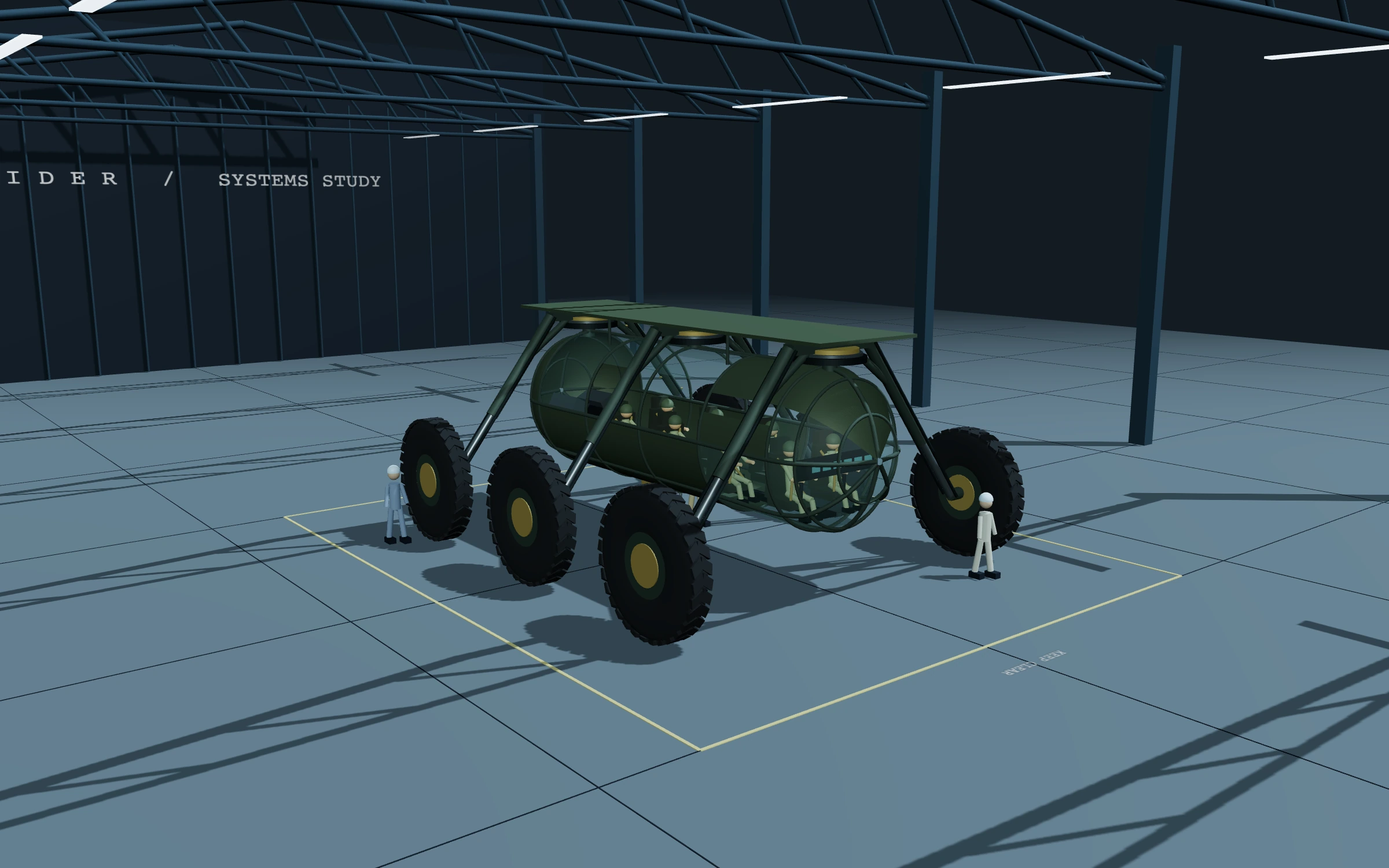
A long cocoon of seats, glass, and protective panels hangs beneath three overhead wheel assemblies. Six large, narrow tires run down among the rows. The people ride above them, with a helicopter-like view forward, sideways, and through the floor.
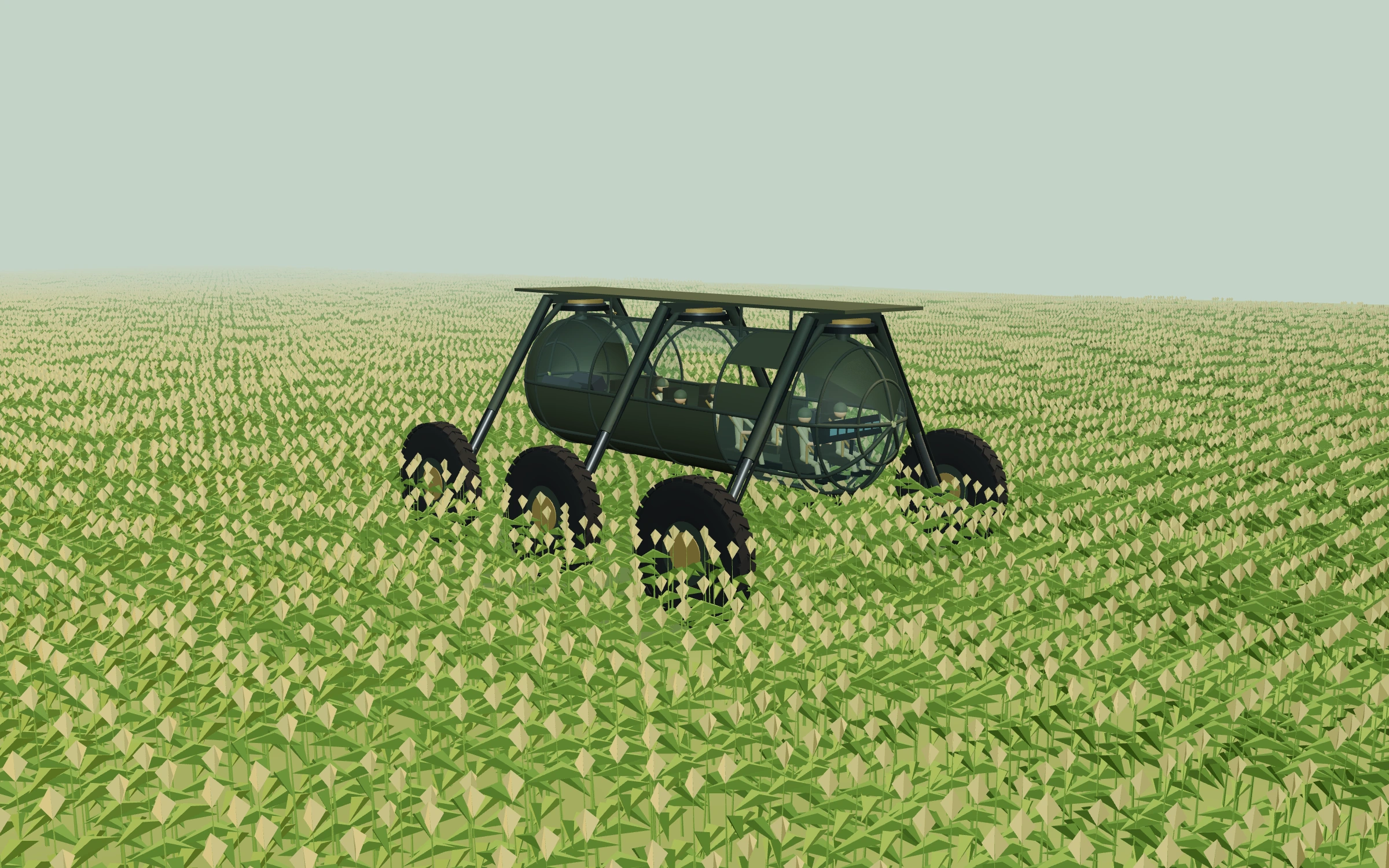
The Spider began as a vehicle in a dream: a rapid rural troop carrier that skimmed above the corn and carried its occupants across broken country. That same idea suggests a way to move rescue teams and firefighters into places beyond the road network.
An imagined future system, explored through a shared 3D model. The scenes and drawings show its geometry; they do not establish terrain capability, protection, or payload.
The chassis goes overhead
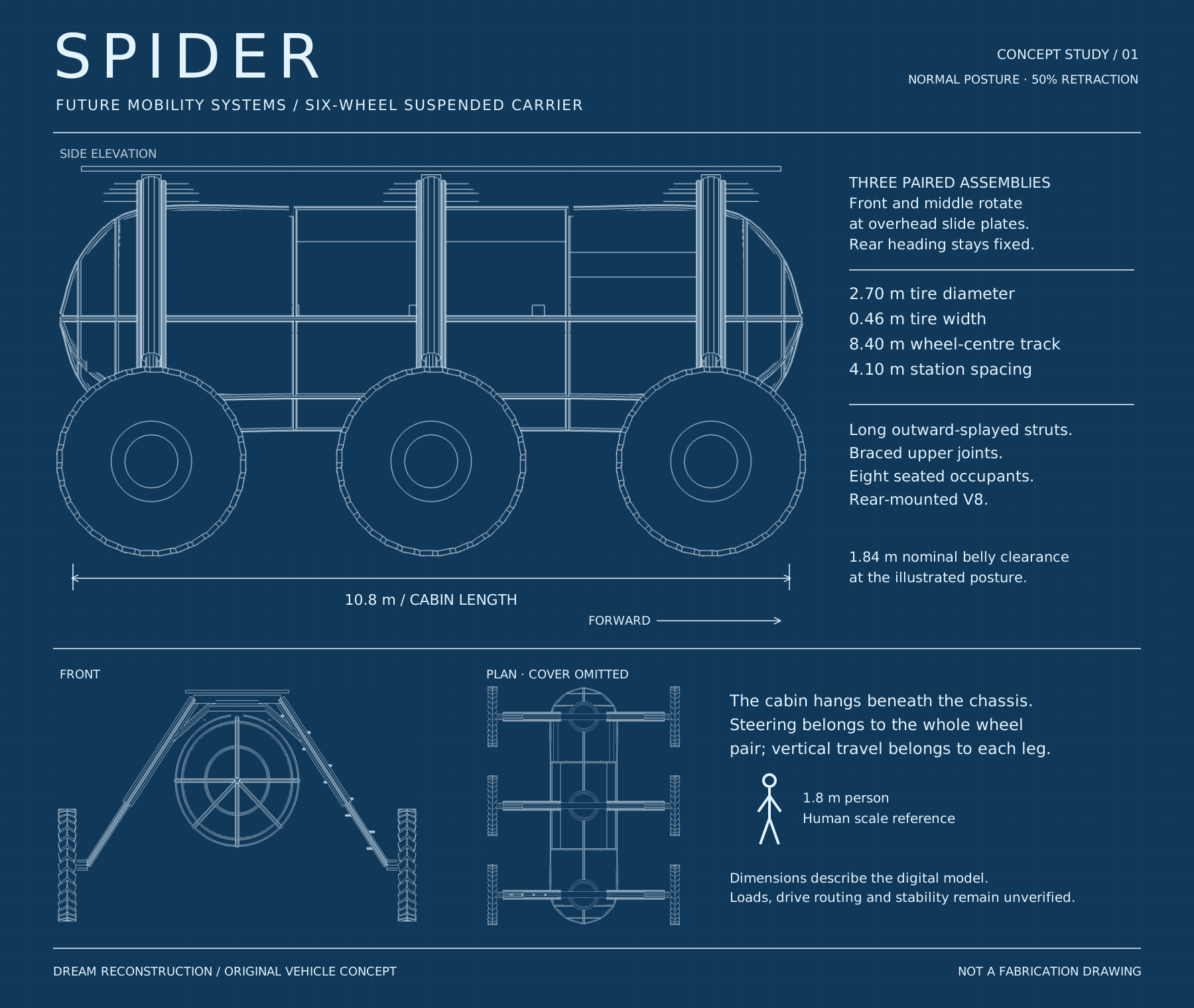
The front and middle crossbars turn on slide plates above the cabin. Each takes an entire left–right wheel pair through the same change of heading; the rear pair holds its heading. Within each pair, the long hydraulic legs retract independently to meet different ground heights. Short crossbars and diagonal upper braces leave the cabin room beneath the mechanism.
A continuous top plate covers the roof mechanisms. The rear cabin is enclosed, the middle has solid lower panels, and the nose keeps its view down and ahead beneath an upper shield. Side windows open above seat height. A large V8 sits behind the passengers.
For boarding, the legs retract and a ladder lowers from the underside hatch. Small alternating steps on one leg provide an emergency way up when the cabin is raised.
Six contacts with uneven country
One wheel can sit down in a cut while another rises onto the bank. The cabin’s downward view makes those differences visible to the crew. The dream gave the Spider the ability to cross gaps approaching four metres; the model explores the posture of such a machine without validating that remembered reach.
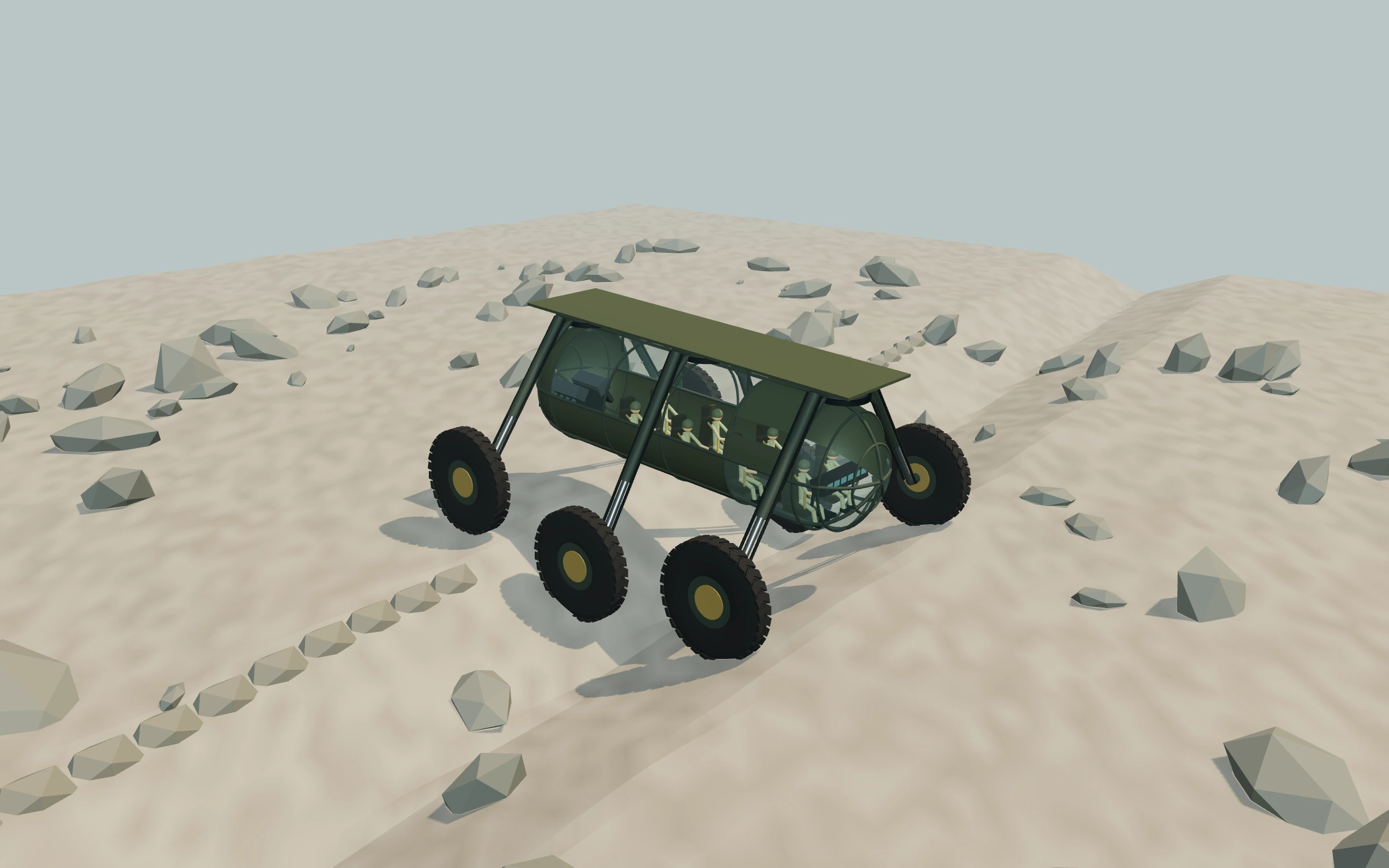
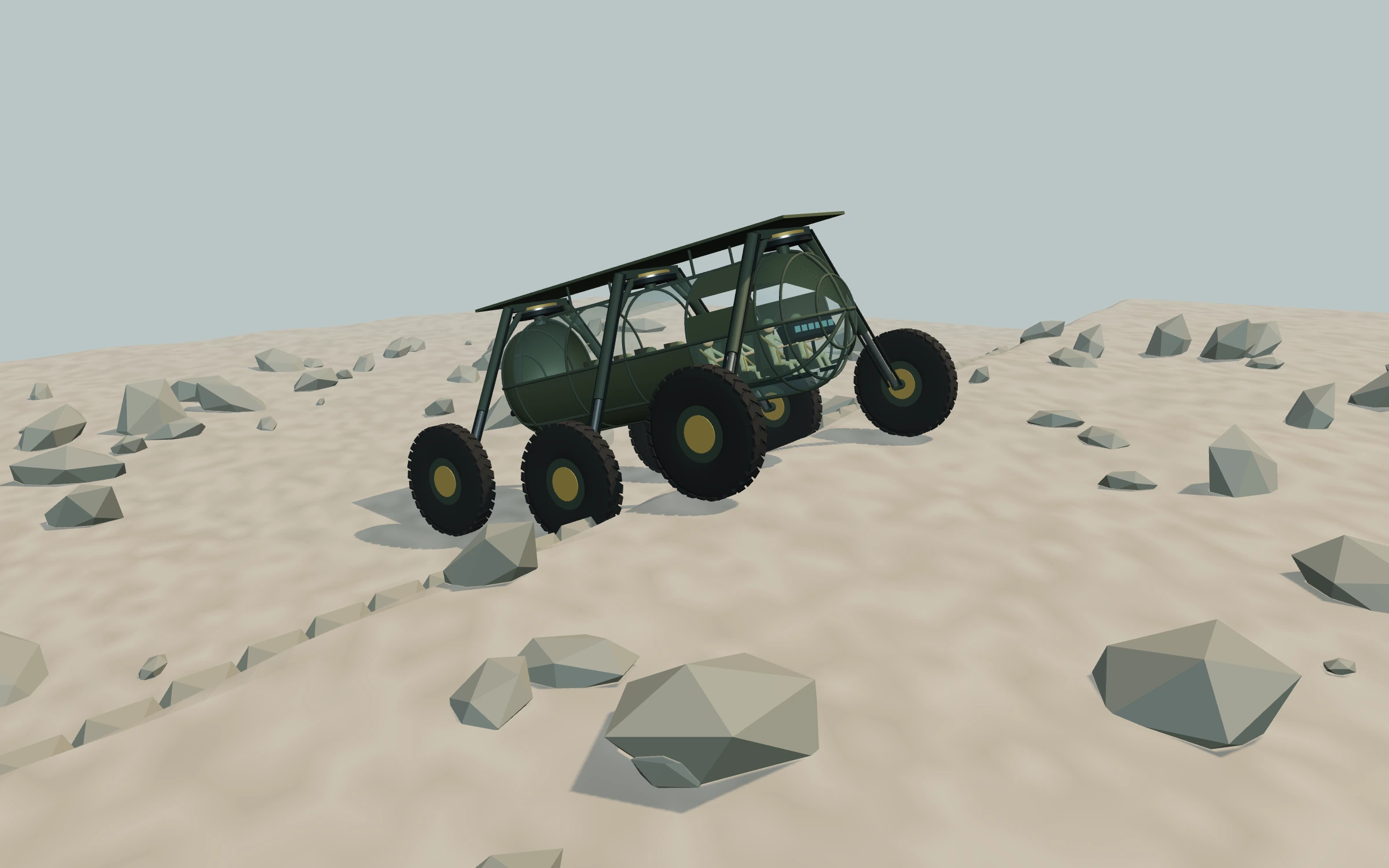
These are staged poses of the working model. Wheel heights follow the scene’s terrain surface; traction, tire contact patches, structural loads, and rollover dynamics are not simulated.
One carrier, different crews
- Rural troop transport
- Move a small team across fields and broken ground with a shared view of the route. The enclosed rear and lower side panels preserve the original transport layout.
- Wilderness rescue
- Carry search teams and recovery equipment toward a casualty. A rescue interior would need dedicated patient access, restraint, and space in place of some passenger seats.
- Wildland firefighting
- Carry a crew and tools to remote work areas, with a water-carrying variant for support. Heat exposure, evacuation routes, and crew protection would govern its use.
What the platform could carry
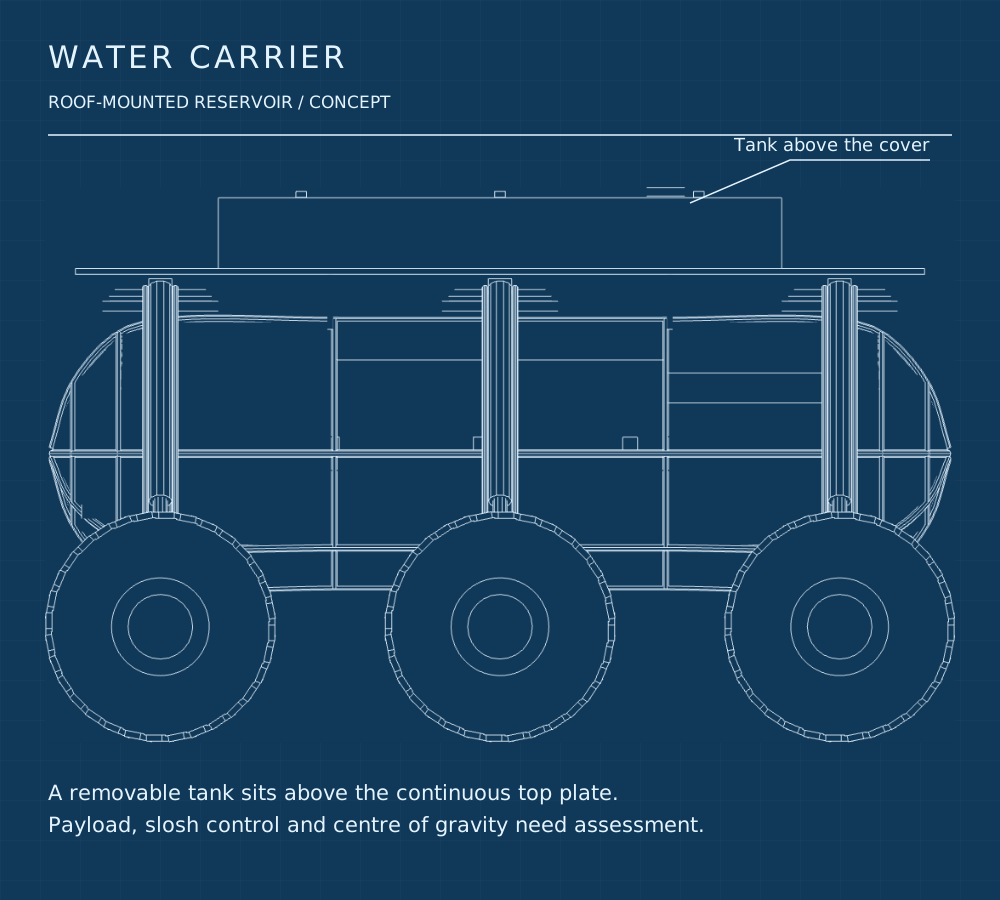
Water above the top plate
A removable reservoir occupies the space above the continuous cover, leaving the passenger cabin free for the crew. A firefighting support variant could bring water and equipment along the same route.
The drawing locates the tank only. Water mass, slosh, attachments, and the effect of raising the centre of gravity would determine whether this arrangement is practical.
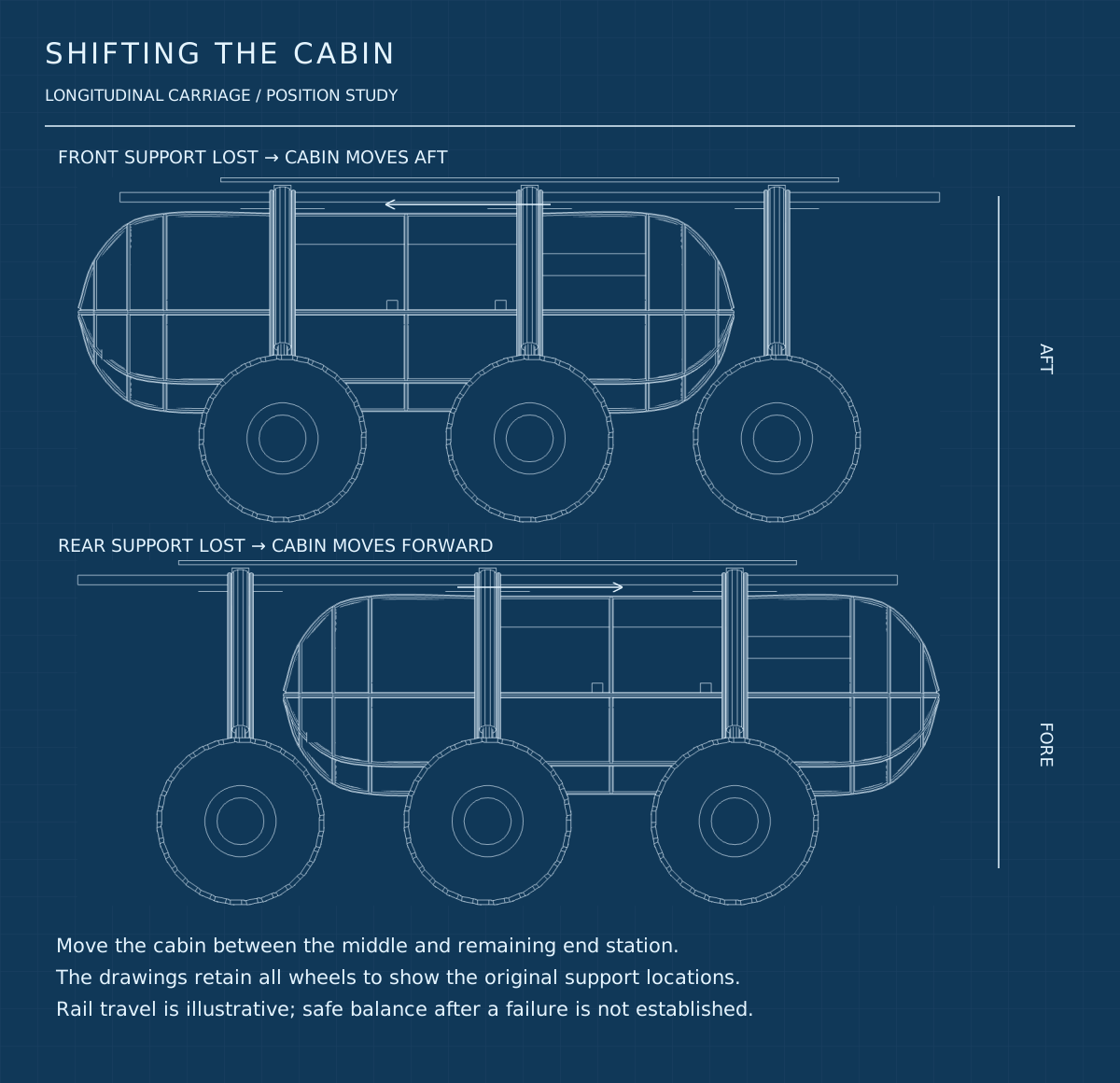
A cabin that can shift its weight
A longitudinal carriage would let the pod slide beneath the overhead structure. If the front support were lost, the cabin could move aft, centred between the middle and rear stations. Loss of the rear support would call for the opposite movement.
This is a position study for redistributing the cabin’s mass. A single failed leg also creates a sideways imbalance; fore–aft movement alone would not resolve every failure or prove the vehicle safe to continue.
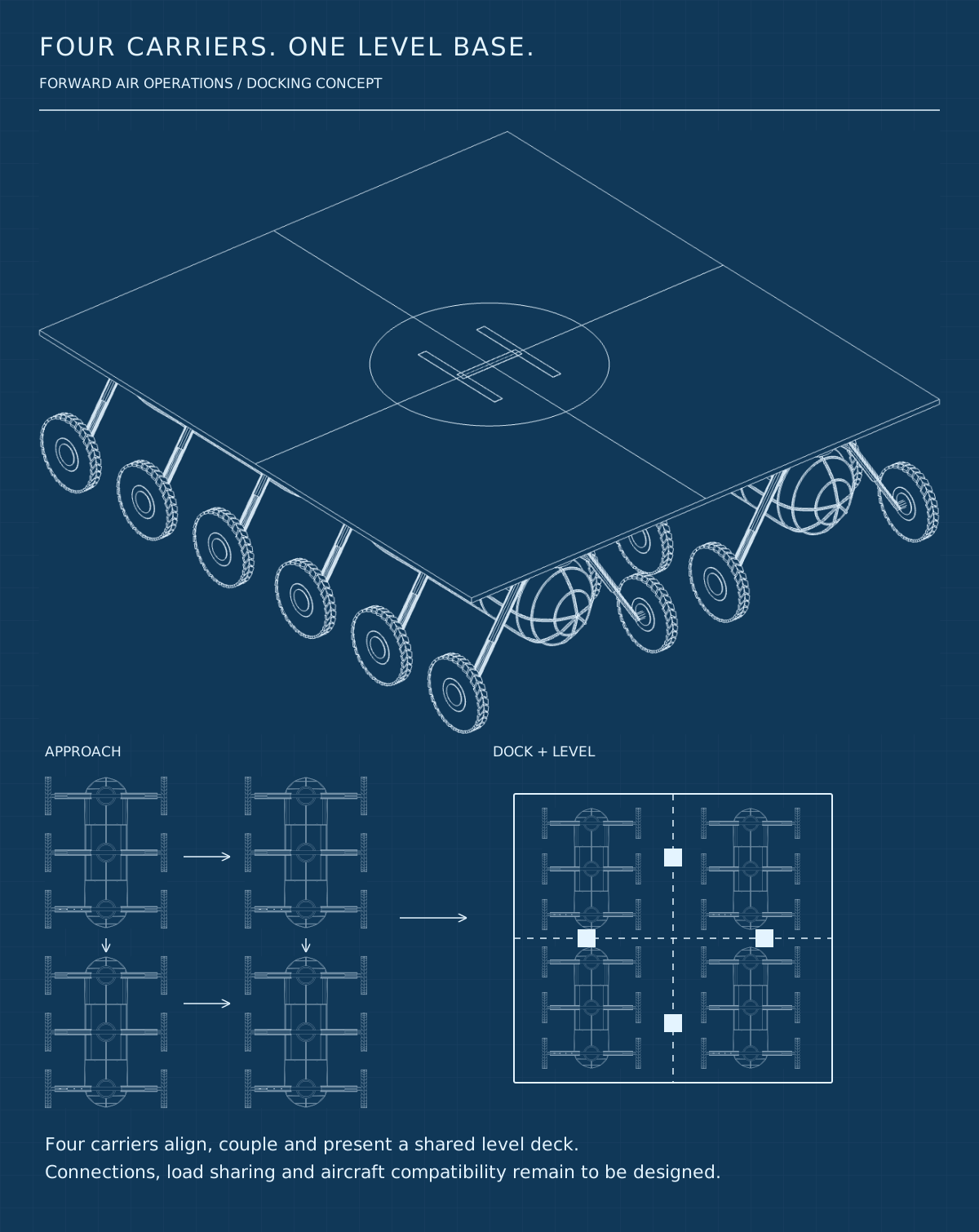
Four Spiders, a level base
Four carriers manoeuvre into a two-by-two arrangement, align their upper interfaces, and lock together beneath a shared deck. Their independent legs suggest a way to establish a level base for a forward air facility on uneven ground.
The deck could become a place for airborne logistics, rescue support, and field servicing. Coupling, coordinated levelling, deck deployment, ground bearing, and aircraft loads remain open design questions. No aircraft capacity is assigned to this concept.
Take the long way across
The carrier travels continuously through fields, woodland, roads, gullies, and hills. Drive it yourself through an open world of towns, creeks, forests, and high country. Change the camera to ride with the crew, or open the geometry study to turn the paired assemblies and retract the legs yourself.
The way out
Years ago, I dreamed I had been conscripted. We were trainees exercising in the yard of a military base, with barbed wire around the perimeter. We were also captives. I found a long ladder, climbed over the fence into the depot, and took the staff sergeant’s vehicle.
I climbed through the hatch into a cockpit of bucket seats, cage, and glass. I drove above the corn, through gullies, across fields, onto roads and off them again. In the desert I found a city, and in the city a warehouse. I hid the Spider there.
The clearest part is still the view from the seat: up in the glass, with the country moving underneath.