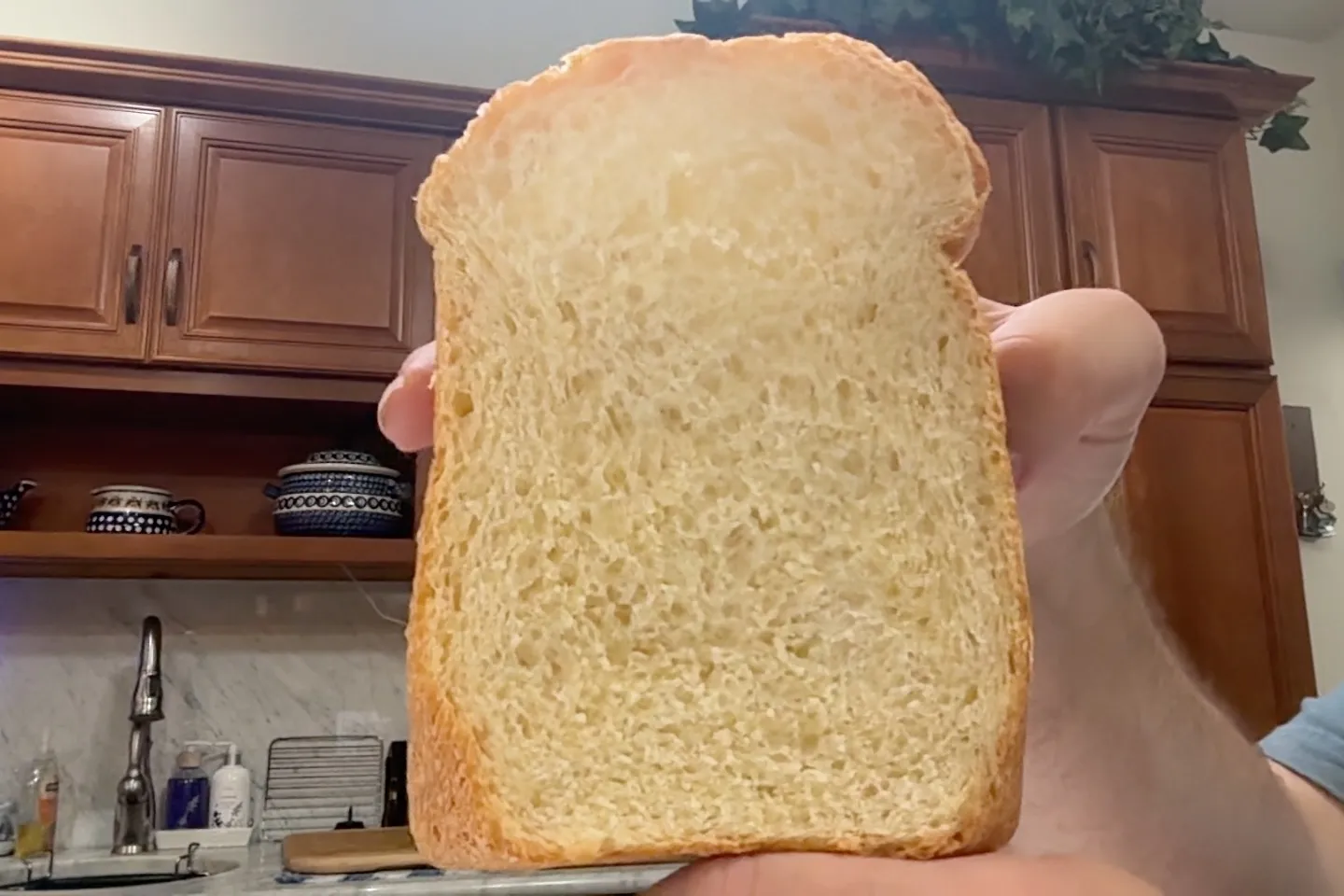
A tall slice of soft white bread held up in a kitchen, its crumb fine and even from crust to crust

Soft Bread

Can we have our cake and eat it?

As good as the bread on the shelf

I wanted a homemade loaf as good as commercial bread: as nutritious as the enriched sandwich loaf in the bread aisle, as tender as a Rhodes roll from the freezer case. Bread now costs about five dollars for twelve slices.

Commercial bread stays soft because of what goes into it. Reading the labels meant learning DATEM, the lactylates, ammonium salts and the rest of the industrial baker’s kit. Some of it a home loaf does not need. Some of it I would rather not eat. So I chose my own set: guar gum and sunflower lecithin for a tender, even crumb; Fibersol, inulin and potato to hold moisture; calcium and a trace of ascorbic acid to strengthen the dough; barley malt to feed the yeast.

I wanted the bread to be good for me, but I also wanted it to not taste weird, and I think I’ve got a recipe that works for that.

My chosen flour is Gold Medal all-purpose. It is the flour I have always used, and the bag already carries the enzymes a commercial baker would add. People who take their bread seriously are expected to reach for King Arthur. I won’t. A flour company has no business lending its name to political stunts, and I would rather not pay for them.

Soft Bread

Gold Medal flour

01Pan.

  • 330 gLukewarm water
  • 10 gDry milk
  • 10 gFibersol
  • 10 gPotato flakes
  • 5 gSalt
  • 5 gBarley malt syrup
  • 15 gGreek yogurt
  • 2 dropsButter extract
  • 2 dropsVanilla extract
  • 1 gSunflower lecithin
  • 20 mgAscorbic acid only a very tiny amount is needed

Mix these ingredients with the water until the salt dissolves.

Note: cold water will cost you more loaf rise than you realize, if you choose to skip the rest cycle.

02Flour.

  • 300 gGold Medal AP flour

Layer the plain flour first, over the liquids.

  • 35 gVirgin olive oil

Pour the oil over the plain flour, not into the water.

  • 230 gGold Medal AP flour
  • 40 gTurbinado sugar
  • 10 gInulin
  • 6 gGefen instant yeast
  • 1 gGuar gum
  • 1 gCalcium lactate gluconate

Mix the powders, sugar and yeast thoroughly into the other half of the flour. Place this enriched flour last, on top. The salt stays in the water, away from the yeast.

03Bake.

  • White bread setting

Use your machine’s white bread setting and bake.

Eight loaves

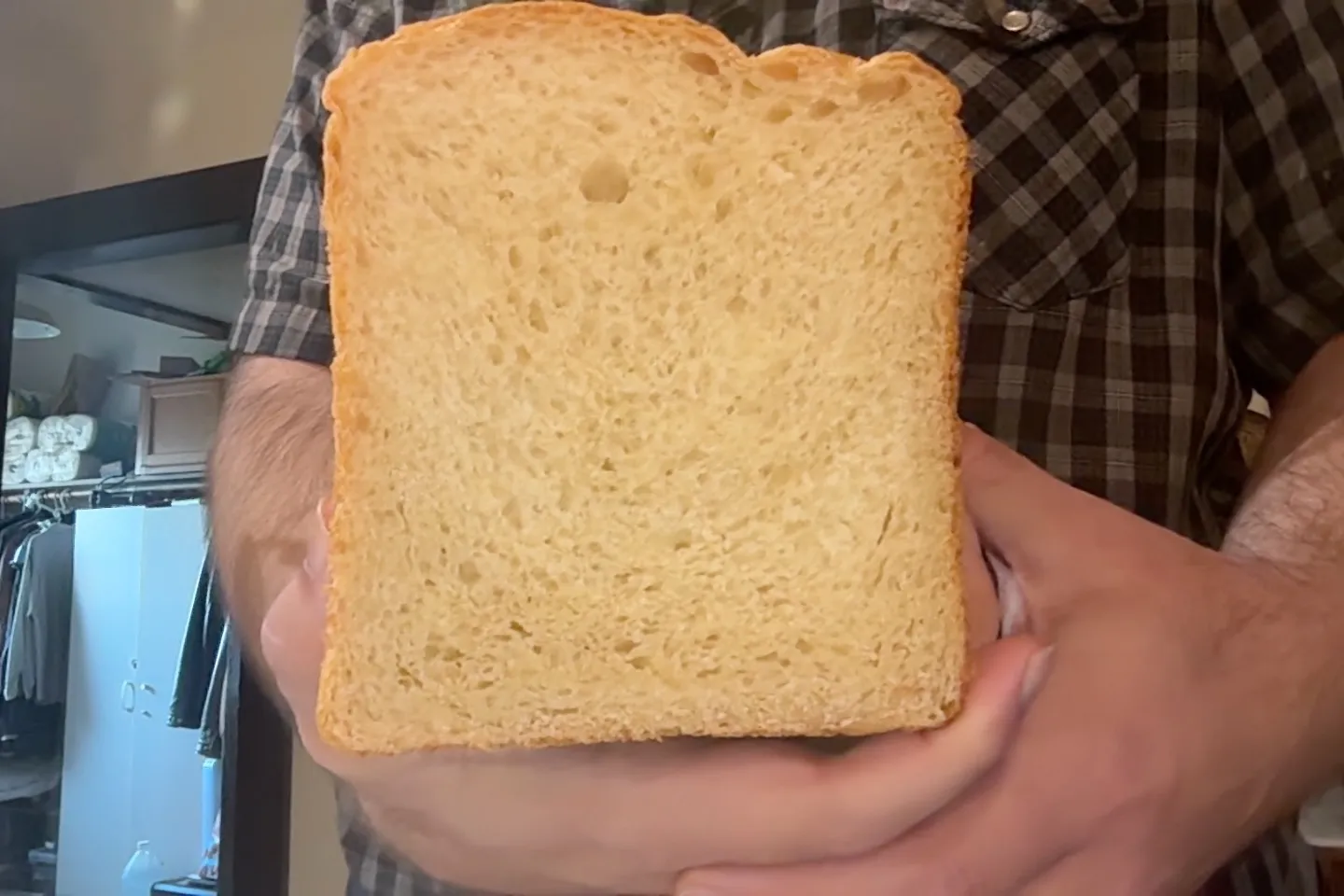
A tall slice held against a plaid shirt, golden and fine-grained with a few small holes near the top
Baked 17th of October. The book recipe with olive oil for butter and the first additions. A bit dense, but resembled the book.
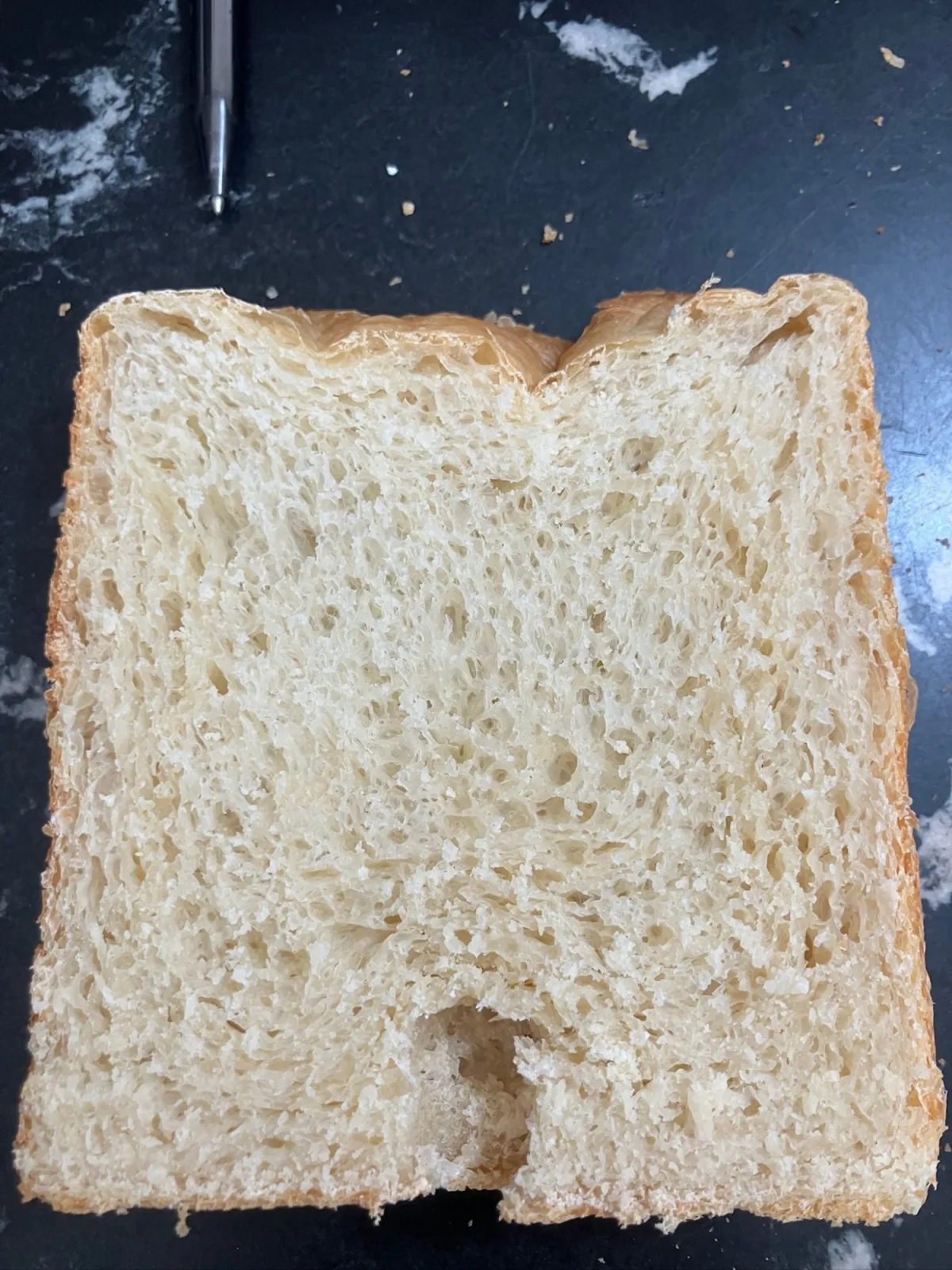
A slice lying on a dark counter, pale and open-crumbed, with a tunnel near the base
Baked 19th of October. Decided the Japanese chefs who made the bread might have a different idea of “good” bread from mine, and it was up to me to adjust. More water, less salt, 5% less flour, with ascorbic acid, inulin and yogurt. A good loaf, but a bit under-raised.
A slice held up in a kitchen, soft and even from crust to crust
22 October. The recipe on the page: 530 g flour, some potato flakes, and I forgot allulose. Most of the behavior of the second loaf, but with proper lift.
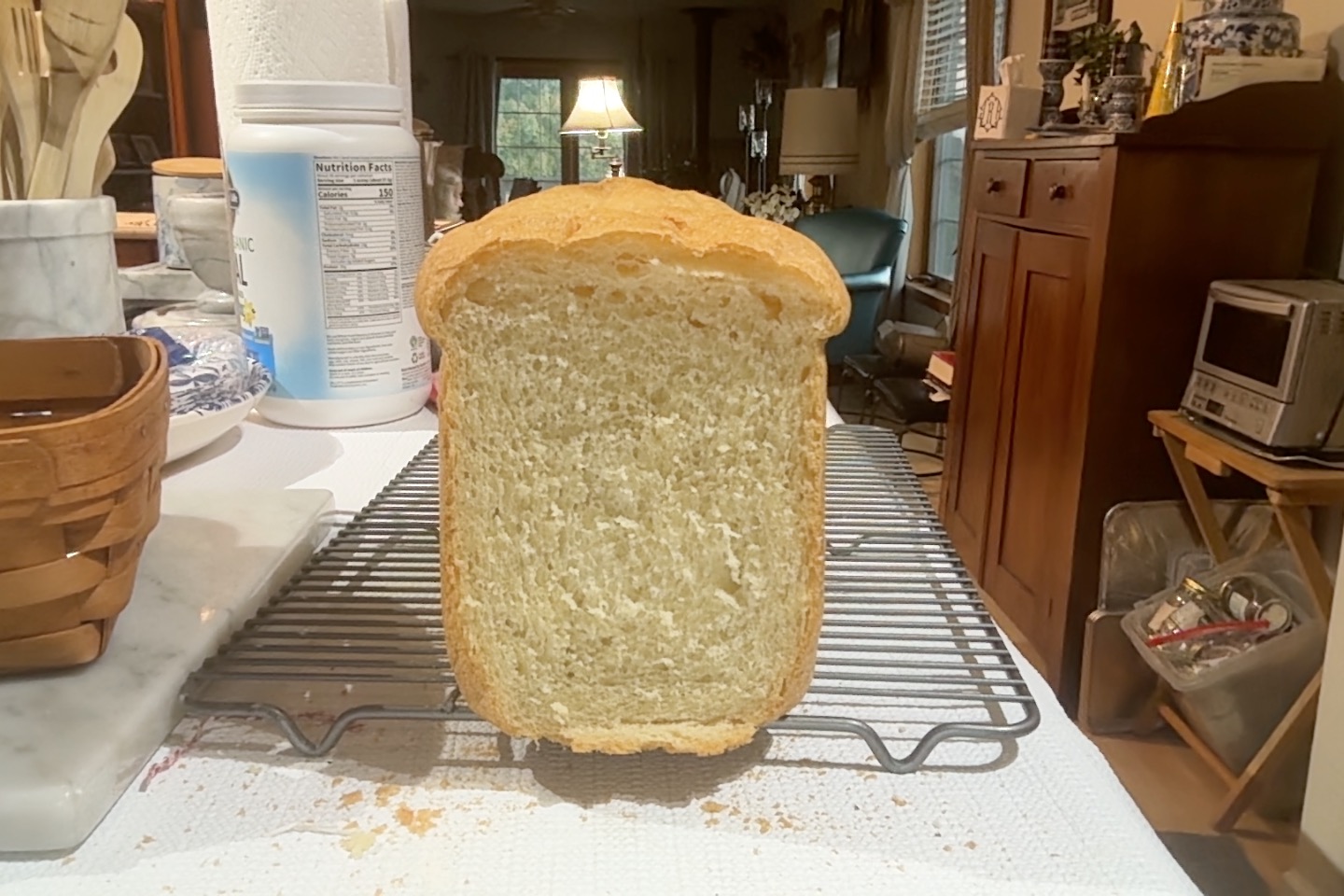
A half loaf standing cut side out on a cooling rack, tall and pale with a fine, even crumb
28 October. The same recipe again, with the same result.
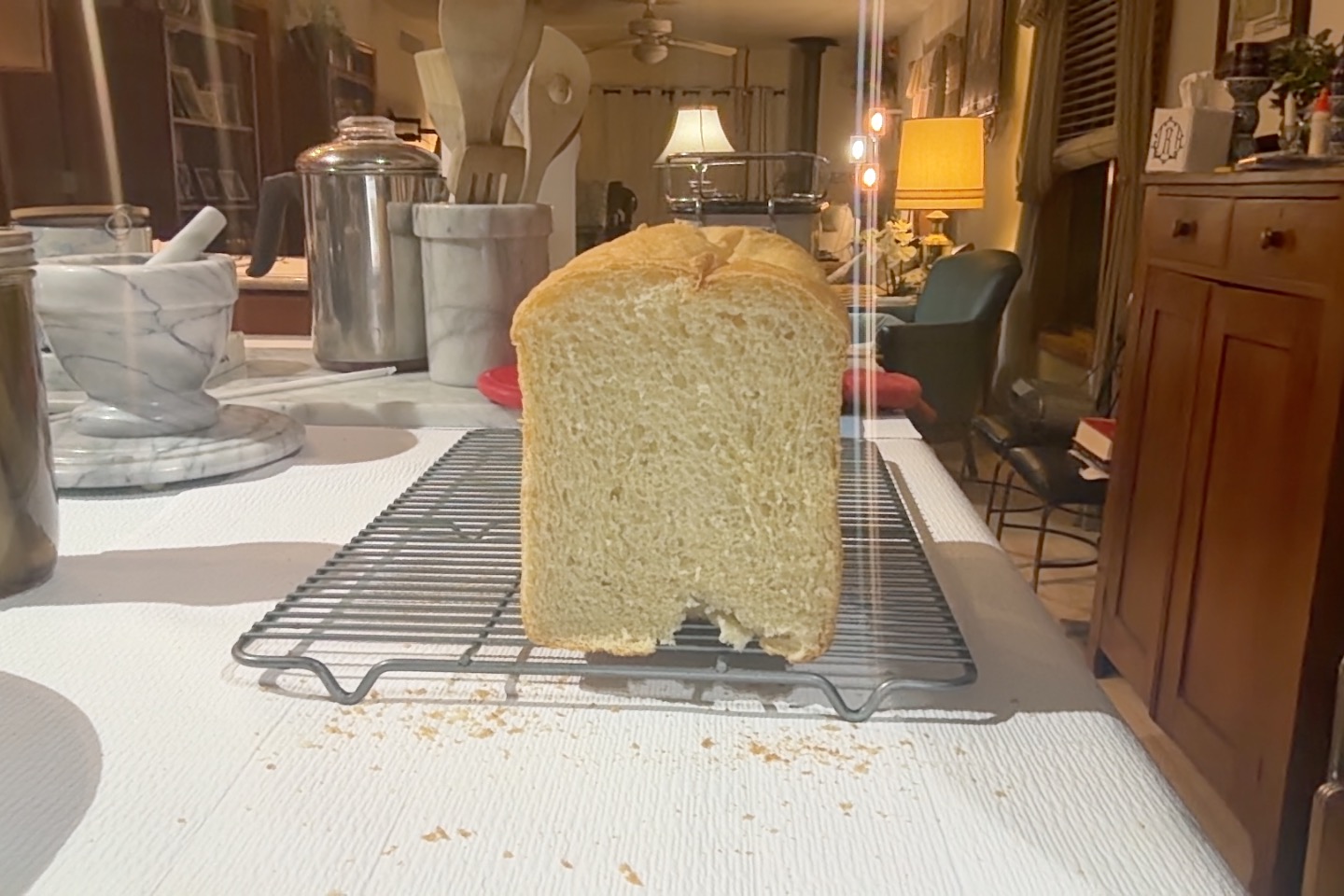
A half loaf standing cut side out on a cooling rack in a lamplit room, tall and pale with a fine, even crumb
1 November. Sour cream and a little vanilla in place of the yogurt, a little less oil, and a drop of McCormick butter extract. Much the same bread, but a bit more flavorful.
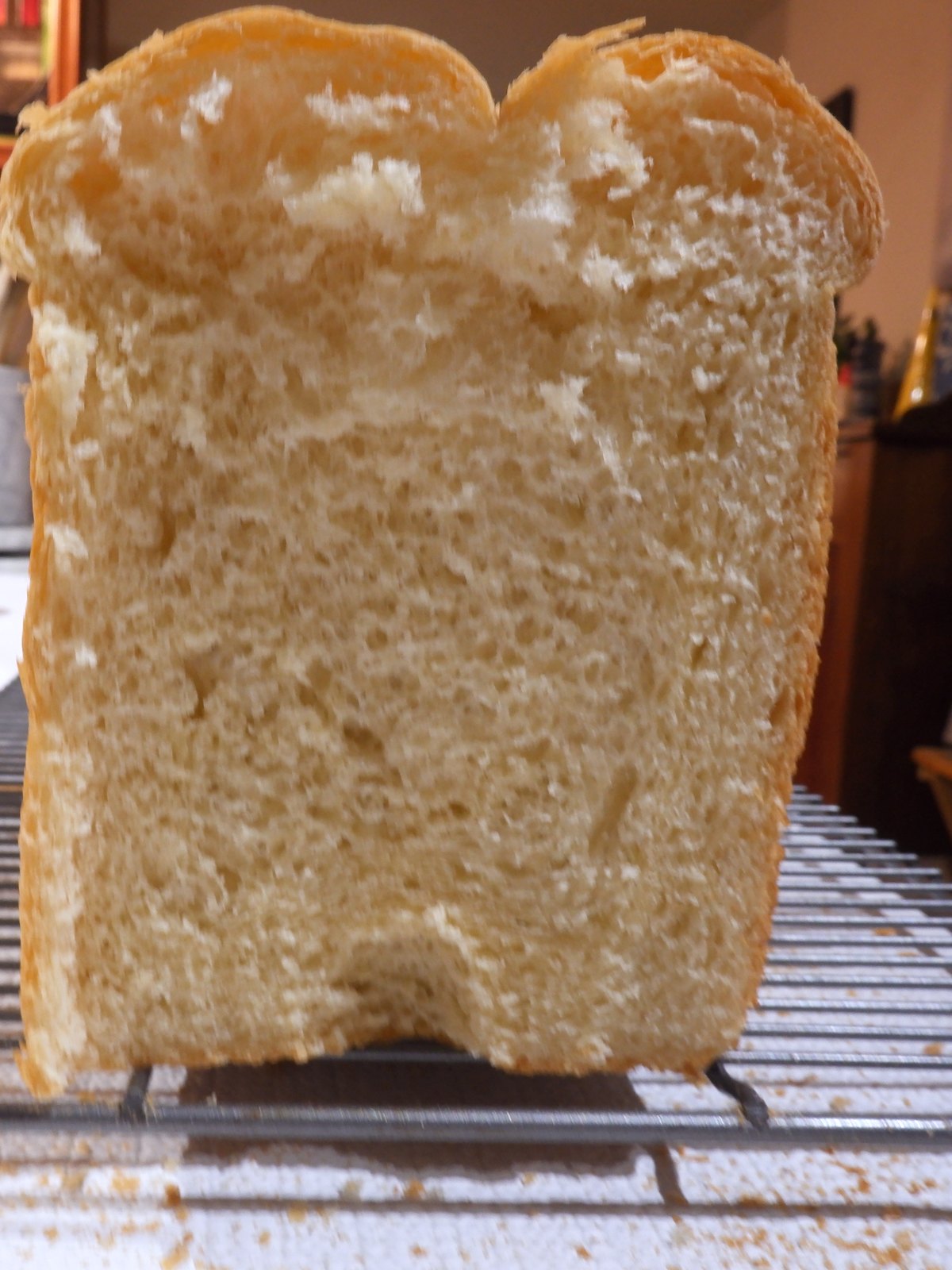
A half loaf standing cut side out on a cooling rack, tall with a split crown and a fine, even crumb
4 November. Greek yogurt and the exact proportions on the card, with water, oil and flour weighed to the gram. Essentially the 28 October loaf, but with an even better rise. The ascorbic acid may have run closer to 40 mg; I did not measure it exactly.
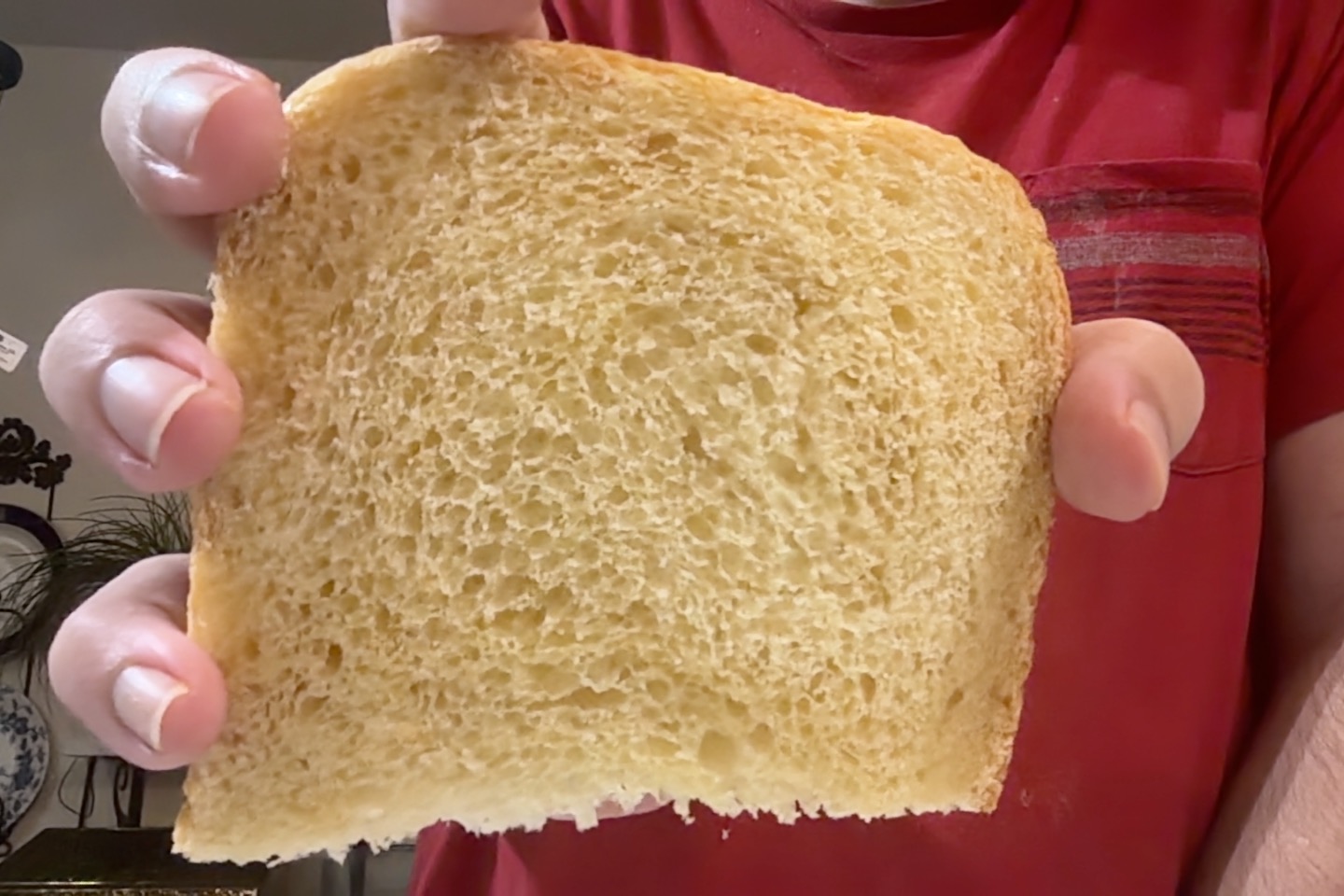
A slice held up in a hand against a red shirt, golden with a fine, open, even crumb
11 November. A scoop of butter powder; maybe softer, otherwise the same. A solid result.
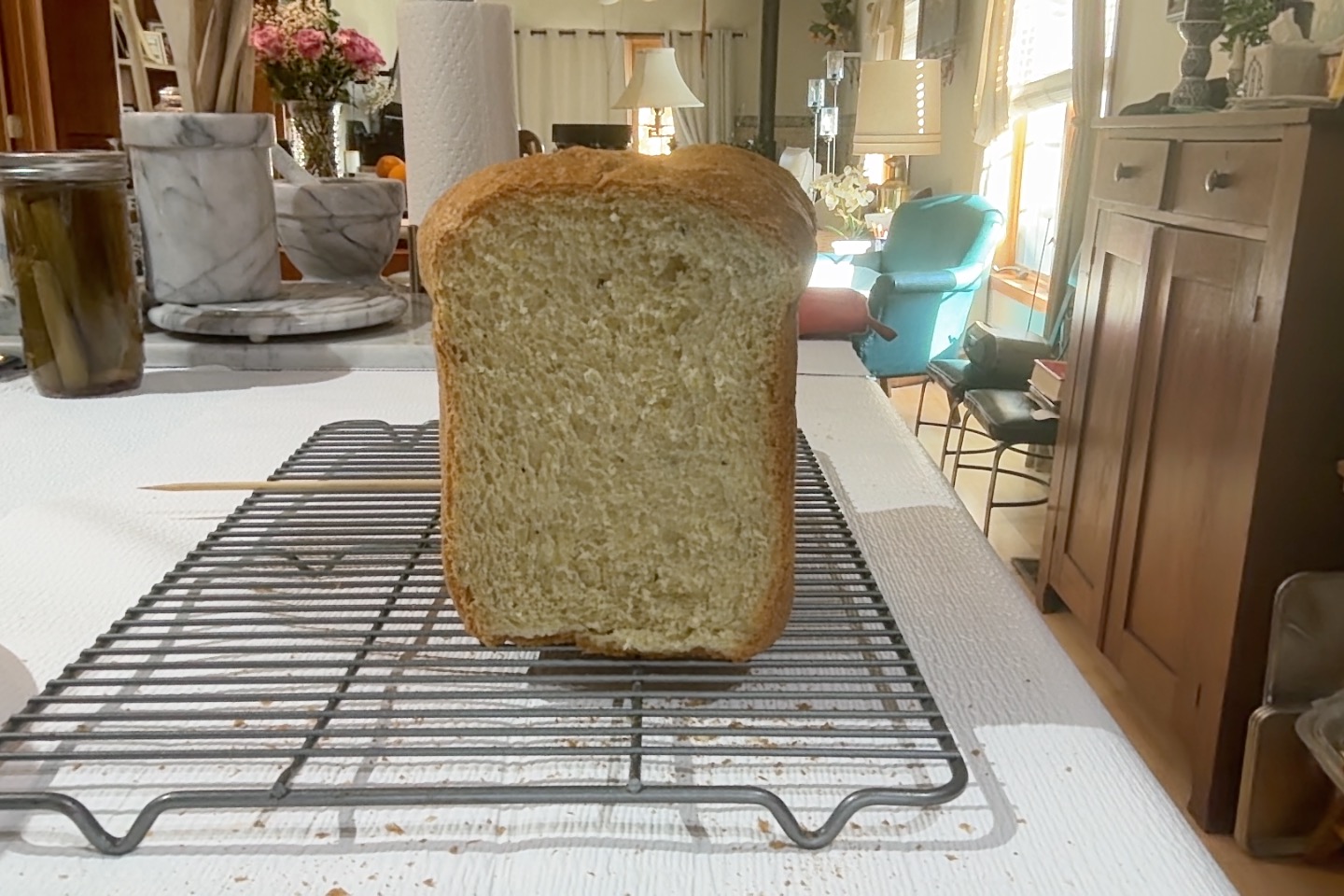
A half loaf standing cut side out on a cooling rack in daylight, tall with a fine, even crumb faintly tinted green
13 November. Zucchini: 170 g puréed with 170 g water, an egg, 10 g butter, 40 g oil and nutmeg. It does not taste like zucchini bread, which takes far more oil and sugar. The crumb is the same as the last loaf, with a flavor I can’t quite place.

The bread of kings

Rhodes frozen white bread is a bread I always remember fondly: a soft, even, puffy crumb and a rich flavor. My grandfather loved to take it, form it into dumplings, and fry them in corn oil, seasoning with cinnamon and sugar to make fried bread. Rhodes gets their signature strong inflation despite being frozen with the help of sodium stearoyl lactylate, a dough conditioner, and ammonium chloride as a yeast nutrient, in addition to other possible ingredients they don’t disclose. The strange names give me concern. In a 2020 laboratory study, a trace of sodium stearoyl lactylate shifted cultured human gut bacteria away from the species that make butyrate and toward a more inflammatory mix. Supermarket sandwich loaves also usually add DATEM, an emulsifier many people consider a similar concern. I wanted the outcome, but not the ingredients. My hunt for the ideal loaf was on.

Having it both ways

I eat a lot of bread. And, it turns out, the bread I eat matters. Americans get more of their sodium from bread and rolls than from almost any other food (CDC, 2012). Only about one in twenty meets the recommendation for fiber (Quagliani, 2017). White bread digests pretty fast, with a glycemic index near 75 (Atkinson, 2008). I think if I’m going to make my own bread, I could try to improve these factors.

Salt: essential for life and for commercial foodstuff success, apparently. Most commercial foods have just too much salt. Why are we putting salt in the bread AND the butter? I tried 6 in the second loaf, and then 5 grams in the latest loaf. It is moderately noticeable. The change gives about 100 mg of sodium per 50 g of dough, against 240 mg in the reference recipe and various commercial breads. But when you put the butter on the bread, it tastes about the same.

Weighed the same way Rhodes labels a serving, 50 g of dough, the two compare like this.

Per 50 g of doughThis loafRhodes
Sodium101 mg240 mg
Carbohydrate24 g24 g
Fiber1.8 g1 g
Sugar2.6 g1 g

This loaf’s figures are worked out from the ingredient labels before baking; yeast eats some of the sugar during the rise.

Fiber: is it just for old people? Two slices of this enriched custom loaf carry about six grams, a fifth of the 25 to 29 grams a day at which the largest review of the evidence found 15 to 30 percent less early death, heart disease, stroke, type 2 diabetes and colorectal cancer (Reynolds, 2019). Much of it is inulin, the best-studied prebiotic: five grams a day reliably feeds the gut’s bifidobacteria (Kolida, 2007; So, 2018). The rest is resistant maltodextrin, which at six to ten grams lowers the rise in blood sugar after a meal and raises the hormones that make us feel full (Livesey, 2009; Ye, 2015). I eat around 3–4 slices of bread a day, and with these proportions, along with other dietary sources, there is a modestly beneficial improvement in the amount I have of what I need and a reduction of what I do not.

The added fiber has another benefit: it changes how fast the bread is digested. Fiber added to food lowers its glycemic response in proportion to the dose (Livesey, 2009), and viscous guar flattens the glucose curve (Jenkins, 1978). Protein and fat eaten alongside slow it further (Moghaddam, 2006), as does a splash of vinegar (Östman, 2005). The loaf principally contributes a canvas that is reasonable alone for meals that never intended it to be the only ingredient.

As previously mentioned, commercial breads use a lot of secondary ingredients to change how they rise, their texture and their stability. Many of the emulsifiers and conditioners in bread keep turning up in research on the gut. DATEM irreversibly thinned human gut bacteria in a laboratory model (Naimi, 2021). A cohort of more than 100,000 French adults linked mono- and diglycerides to heart disease and cancer (Sellem, 2023; Sellem, 2024). Calcium propionate, the common mold inhibitor, raised glucagon and briefly impaired insulin action in people (Tirosh, 2019). Most of these results come from non-bread-related studies in a laboratory, but when in doubt, throw it out. My somewhat safer replacements may not work quite the same, but the difference is, to my taste buds, marginal.

Any baker trying to emulate a commercial bread does a much easier job if they have emulsifiers to maximize the strength of gluten and to enrich bubble formation. My choices at this time are guar gum and sunflower lecithin. Guar holds water and strengthens the gluten network, and its long record in feeding studies is of lowering the rise in blood sugar (Jenkins, 1978; Samarghandian, 2012). Lecithin softens the crumb and showed no link to heart disease in a large French cohort (Sellem, 2023). Both arrive alongside inulin, which in mice protected the gut lining from emulsifier damage (Bekar, 2024).

For strength and a steady rise, commercial bakers reach for oxidizers and yeast foods like potassium bromate and ammonium chloride. I use a trace of ascorbic acid in the ballpark of what the chemistry calls for, and calcium lactate gluconate is sufficient and readily available from baking suppliers.

For optimal flavor, a long, slow rise is the time-tested standard: hours of fermentation leave lactic and acetic acids and richer and even more unpronounceable compounds, but time is the one ingredient that nobody has enough of. A spoonful of yogurt helps to substitute, giving lactic acid. Barley malt syrup adds malty sweetness, and potato compounds brown in a few other ways that can yield flavor and increase hydration flexibility.

A healthy diet is based on whole foods and proper balanced nutrition. A good bread supports that mission. With the additive portfolio used, you can have much of the result of a commercial loaf without the risks it comes with.

I must warn, however, that this recipe remains a principled attempt at the unprincipled art of going all in, i.e., throwing things at the wall to see what sticks. Only the ratio of flour to water and the potato flakes have been tested one against another.
What a loaf costs

I get about twelveteen slices to the loaf, and I offer a compelling argument for baking your own bread being wholly economical if you eat a lot of bread, are frugal on ingredient costs and amortize the cost of a good machine over the life you intend to use it.

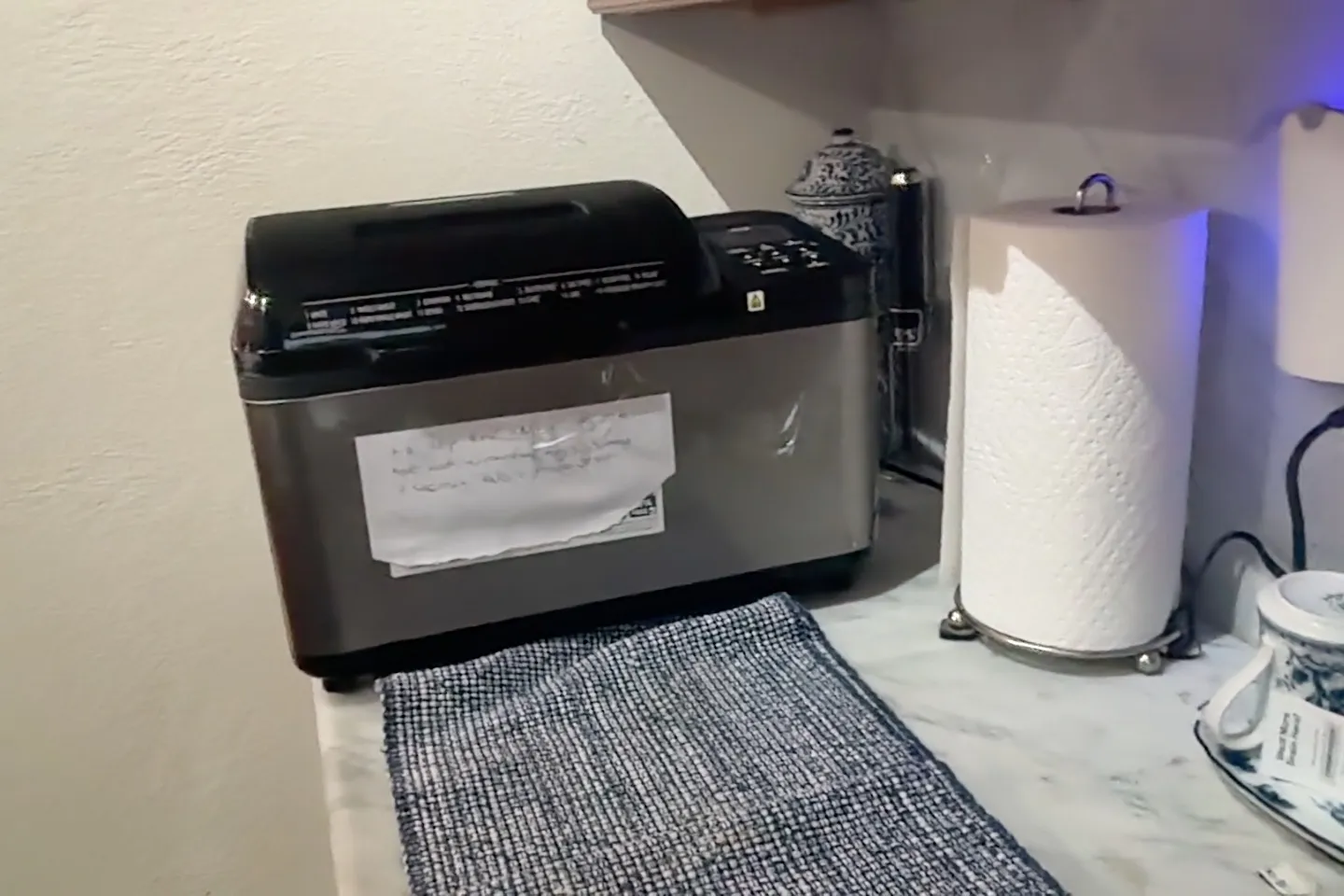
A Zojirushi Home Bakery Virtuoso Plus breadmaker on a marble counter beside a paper towel stand

I shopped around and decided that I really needed the Zojirushi Virtuoso Plus with a ceramic, non-Teflon bread pan, the only breadmaker that has this feature. Other perks I care less about: it kneads with two paddles and heats from the lid as well as the base, so a tall loaf bakes evenly through, and it has up to three custom recipes and many convenient settings. It cost me about $460. I have amortized it in the cost basis below to survive 10 years of baking, but I expect it to survive around 20, perhaps more with a replacement pan.

Per loafFromCost
Iliada olive oil35 g of a 3 L tin at $59.49$0.76
Gold Medal Hotel & Restaurant flour530 g of a 50-lb bag at 55¢ a pound$0.64
Nutricost inulin10 g of 1 lb at $21.95$0.48
NOW Fibersol10 g of 12 oz at $14.69$0.43
Dry milk10 g at about 60¢ an ounce$0.21
Calcium lactate gluconate1 g of 50 g at $9.99$0.20
Eden barley malt syrup5 g of 20 oz at $12.75$0.11
Gefen instant yeast6 g of 1 lb at $9.69$0.13
Turbinado sugar40 g at about $1.20 a pound$0.11
Potato flakes10 g of a 40-lb bag at $163.99$0.09
Kate Naturals sunflower lecithin1 g of 4 oz at $9.99$0.09
Greek Gods plain Greek yogurt15 g of a 32-oz tub at $7.00$0.12
McCormick butter extract2 drops of a 1-fl-oz bottle at $2.38$0.01
McCormick pure vanilla extract2 drops of a 16-fl-oz bottle at $20.96under $0.01
It’s Just guar gum1 g of 8 oz at $8.99$0.04
Morton salt5 g of 64 oz at $10$0.03
Ascorbic acid20 mg of 50 g at $8.99$0.00
Ingredients$3.40
Electricity0.7 kWh at 18.3¢$0.13
My timeinvaluable$infinity
The machine$460 over 520 loaves$0.88
One loaf$4.47
One slice$0.37
One slice of $5 shelf bread$0.42

A questionable sourcing arrangement

None of these are affiliate links.