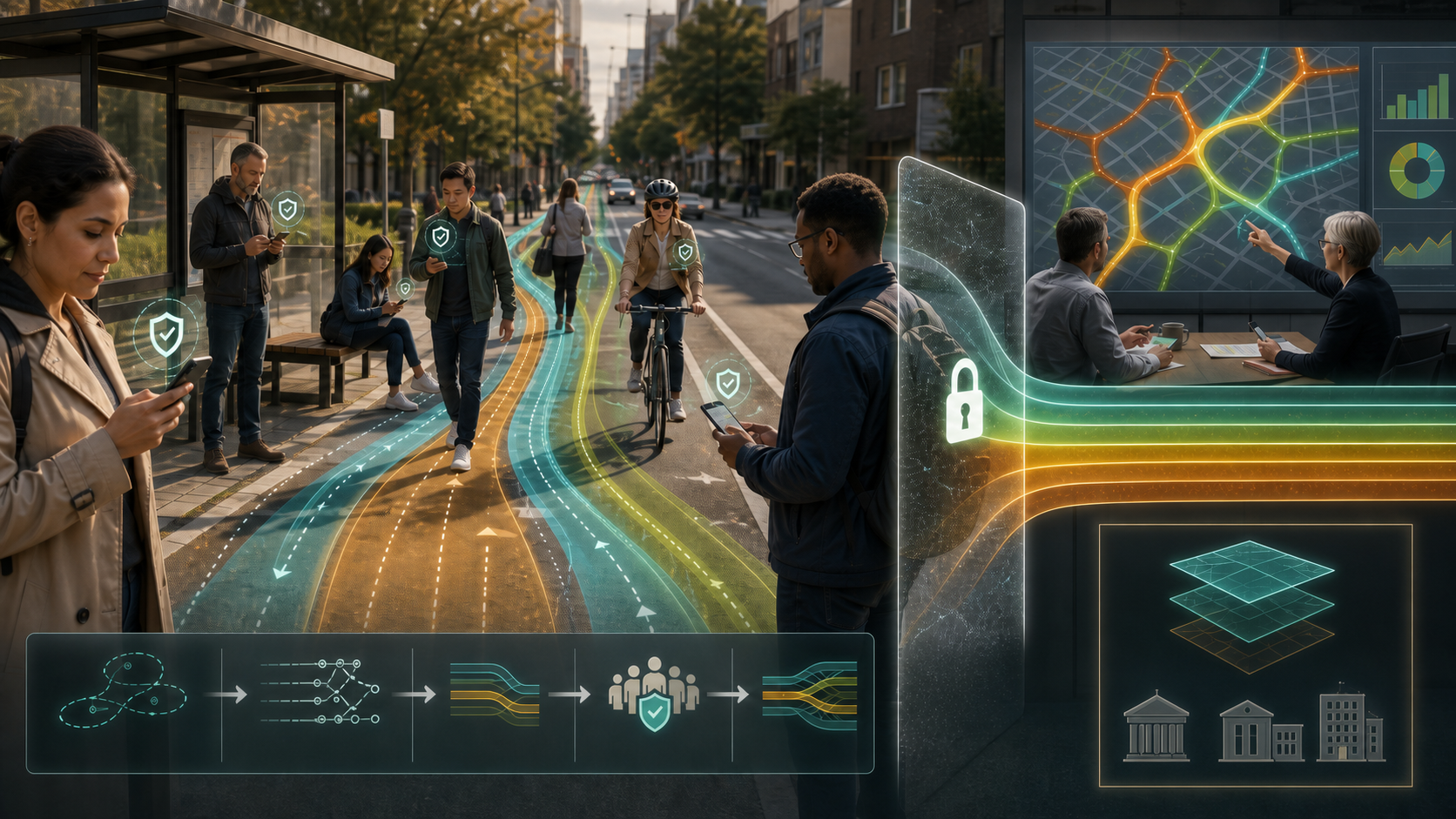
Verified phone users sharing persistent neighborhood route corridors without live-location dots, with protected aggregated route bands flowing onward to traffic and civic planning analysis

VERIFIED USERS · AUTOMATIC MOTION · PERSISTENT ROUTES

Routes

“I am traveling from X to Y.”

Register availability or need on a common system without announcing where you are.

THE SOCIAL PROBLEM

The coordination gap

Every morning, empty seats pass people who need to travel along nearly the same corridor. The useful fact is not that somebody can be dispatched right now; it is that a verified neighbor reliably goes from X to Y on Tuesdays and Thursdays and may be willing to cooperate. That durable overlap is normally invisible unless the two people already know one another.

The cost of that invisibility is not evenly distributed. The Bureau of Transportation Statistics reports that Americans with travel-limiting disabilities make fewer daily trips, are less likely to have a vehicle, and often compensate by asking others for rides or limiting when they travel. A missed route match can therefore become a missed shift, appointment, class, or relationship.

Routes is a mobile social network for verified users. It records motion data automatically and, after the same trip occurs several times, asks whether it is a regular route. The user can register availability or need as “I am traveling from X to Y”, letting the service compare persistent routes without announcing anyone’s live location.
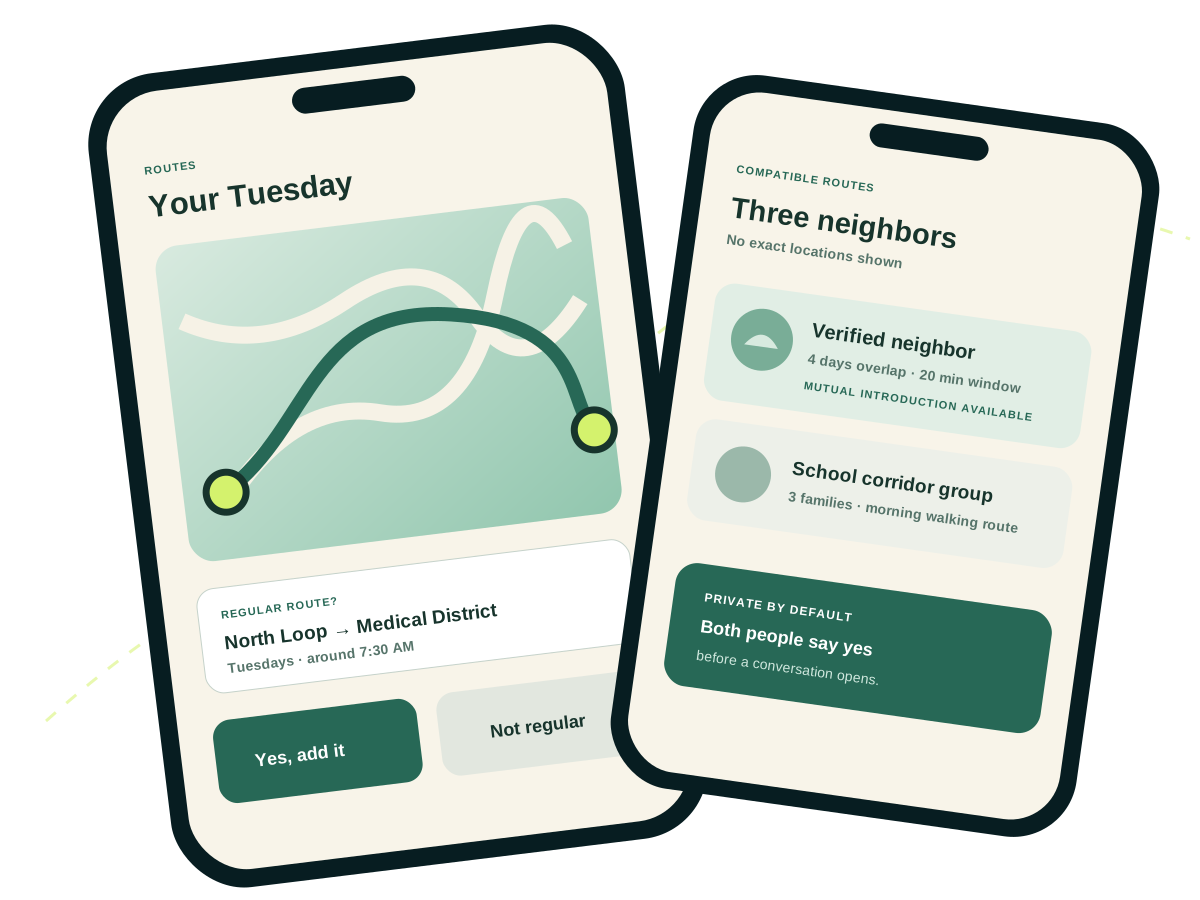
Two mobile screens showing a private recurring route, compatible neighbors, and a consent-based introduction
Areas and flexible windows stay coarse until both verified people choose an introduction.

ONE CORRIDOR · TWO TIMELINES

Existing motion as capacity

WITHOUT ROUTES

Two routines pass without meeting.

Sam drives from the north edge of town to the hospital district four mornings a week. Three streets away, Elena stops accepting an early physical-therapy appointment because the bus connection is unreliable and a commercial ride twice a week would consume too much of her fixed income. Sam would gladly discuss a regular neighborly arrangement, but neither person knows the overlap exists. The empty seat and the unmet need repeat for months.

WITH ROUTES

Repetition becomes common knowledge.

After several trips, Sam’s phone asks whether this is a regular X-to-Y route. Elena registers recurring need along the same corridor and time window. Routes reveals a compatible verified person—not a moving dot—and the two choose an introduction. They work out their own arrangement. No ride is requested, no driver is dispatched, and no fare passes through the network.

THE ROUTE LOOP

Route inference and registration

  1. 01Record motionThe phone records the user’s movement data automatically and securely.
  2. 02Detect repetitionSeveral similar trips establish that a journey may be persistent.
  3. 03Ask intelligentlyThe app asks whether this is a regular route rather than registering it silently.
  4. 04Register X to YThe verified user records availability or need on the common system.
  5. 05Connect routesCompatible people can cooperate without broadcasting their current locations.

WHAT PEOPLE CAN DO

Network functions

Routes is deliberately social infrastructure rather than a transport transaction. It makes compatible routines discoverable, then leaves verified people room to form a rideshare, a recurring favor, a walking group, or another holistic arrangement that a fare-and-dispatch product would never recognize.

RIDESHARE

Share the commute

Two coworkers discover that their flexible morning corridors overlap four days a week.

NEIGHBOR HELP

Make the regular favor visible

A verified neighbor already passing a clinic can discuss recurring assistance with another household.

GROUP ROUTE

Walk or cycle together

Families on the same school corridor form a recurring walking or bike group.

COMMUNITY

Notice missing links

A nonprofit sees an opt-in cluster of unmet corridor needs without receiving household identities.

PRODUCT BOUNDARY

Product boundary

The absence of a transaction is functional. A request button would recast every available neighbor as an on-demand driver; payment would force the network to price favors and relationships it was meant only to reveal.

NO live public location

NO “request ride” button

NO fare, tip, or payment

THE BUSINESS MODEL

Revenue from aggregate route data

Public planning depends on origin, destination, time, and purpose patterns; the Federal Highway Administration’s National Household Travel Survey exists to collect exactly that broad picture. Routes could produce a more continuous view of recurring corridors while financing the social network that makes those corridors useful to individuals.

AUTOMATIC INPUT

Motion data

The network collects the repeated movement information needed to infer persistent routes.

→
SECURE BUNDLE

Route aggregation

Individual journeys are grouped into traffic information rather than exposed as live user locations.

→
PAID OUTPUT

Traffic and planning use

Traffic-information-using entities and planning entities buy the bundled picture of recurring movement.

TRUST ARCHITECTURE

Privacy and verification