6,542 gallons
Annual irrigation avoided in the underwriting case: 28 applied inches × 0.623 gallons per inch-foot × 37.5% reduction.
≈ $92 at 1.4¢ / gallon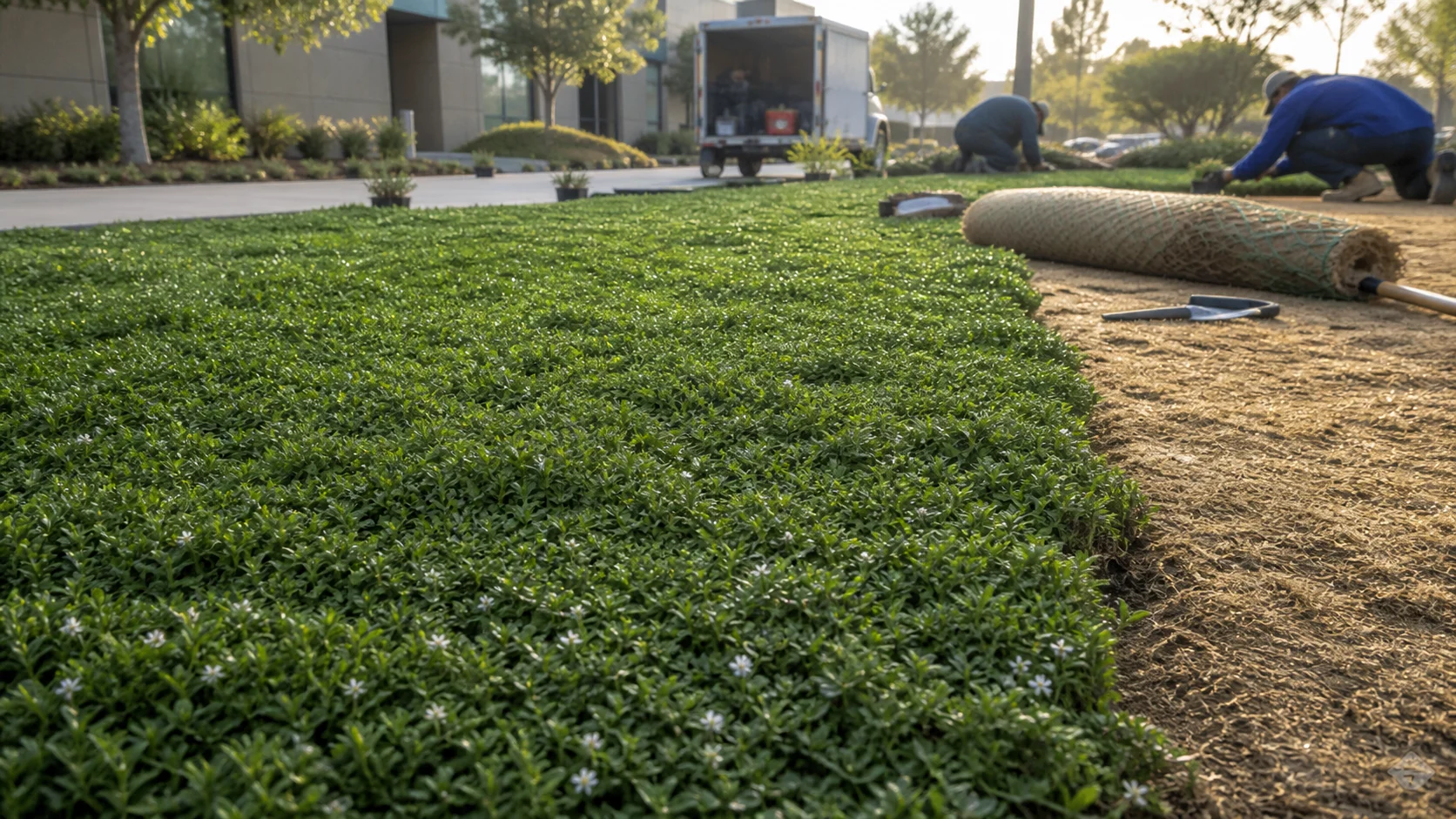
A local planting company can make lower-input living groundcover an ordinary capital project: quote the whole conversion, verify the savings, and let each profitable crew finance the next place.
Concept image. Each real site still needs climate, irrigation, traffic, pollinator, and maintenance review.
Kurapia is a low-growing broadleaf groundcover, not a grass. It reaches roughly three to six inches and does not require mowing. In warm regions it can preserve a green, walkable-looking surface with less irrigation and without the scheduled cutting of a conventional lawn. That makes the business proposition larger than sod: remove an expensive maintenance regime and install a different one.
The first customers should be owners with ornamental turf they pay other people to maintain—homeowner associations, multifamily properties, schools, retail centers, offices, and municipal edges. Sports fields, heavy-play lawns, cold sites, and properties unwilling to change irrigation schedules do not belong in the opening market.
Every line is shown in 2026 real dollars. Local disposal fees, union or prevailing wages, soil repair, access, irrigation condition, and the chosen sod-or-plug method can move the quote substantially.
The $2.90 is not net profit. It must pay estimating, insurance, administration, sales, local management, debt service, expansion capital, taxes, and any owner distribution.
The value calculation distinguishes physical savings from bill savings. The physical quantities are portable; prices and labor contracts are local.
Annual irrigation avoided in the underwriting case: 28 applied inches × 0.623 gallons per inch-foot × 37.5% reduction.
≈ $92 at 1.4¢ / gallonKurapia requires no mowing. Cutting it to suppress flowers or impose a manicured height is an optional aesthetic choice, not plant maintenance.
≈ $648 at $18 marginal / visitA previously fertilized site can avoid the full planning rate. The portfolio model applies it to 50% of converted area, for an expected 1.5 pounds per 1,000 square feet.
≈ $22 expected · $43 ceilingNo carbon-credit revenue, maintenance subscription revenue, owner time value, water rebate, tax credit, or avoided irrigation repair is used in the business forecast. They may improve an individual sale, but a lender should not need them for repayment.
The base case begins with one crew, holds the first territory for six years, and opens a new locality only after retained operating cash can support equipment and working capital. Values are real 2026 dollars; inflation is excluded from both price and cost.
Expansion rule: retain 60% of operating cash after debt service. Budget $70,000 for each additional crew package and $85,000 for each new-locality launch. The forecast is a capacity path, not a promise that demand appears on schedule.
Download the base model as CSVEvery installed cohort stays in the total. The curves below measure the annual water, nitrogen, and mower fuel that no longer have to be consumed anywhere in the world because the business keeps replacing conventional turf. By year 20, the base case has converted 15.4 million square feet—about 354 acres.
The best federal order-of-magnitude estimate is not 45,000 tons. EPA’s Science Advisory Board estimated 1.11 million metric tonnes of nitrogen applied to U.S. turf annually, while also noting that roughly half of lawns may receive none. The estimate is old and not a current census, but it is the strongest national benchmark located. One percent of it is approximately 12,236 U.S. tons of nitrogen per year. At 3 pounds per 1,000 square feet and an 80% verified prior-fertilization rate, reaching that reduction requires roughly 234,000 converted acres.
| Twenty-year structure | Converted acres | Water avoided / year | Nitrogen avoided / year | Mower fuel avoided / year | Share of U.S. turf nitrogen |
|---|---|---|---|---|---|
| One founder business 50% previously fertilized | 354 | 101 million gal | 11.6 U.S. tons | 8,920 gal | 0.00095% |
| 30 charter operators 15% annual network growth · 80% targeted | 23,383 | 6.66 billion gal | 1,222 U.S. tons | 589,000 gal | 0.10% |
| 300 charter operators 15% annual network growth · 80% targeted | 233,826 | 66.6 billion gal | 12,223 U.S. tons | 5.89 million gal | ≈ 1.00% |
The 1% case is an industry-building program, not an ambitious landscaping company. It starts with $51 million of capitalization across 300 independently accountable operators, grows the operator network 15% annually, and reaches about 4,270 operators and 36,100 active installation crews in year 20. Approximately $726 million of cumulative operator-launch capital and $16.7 billion of year-20 customer billings pass through the network. Those conditions require standardized training, audited savings, nursery supply contracts, property-portfolio sales, utility or municipal program partners, and a licensing, cooperative, or franchise structure capable of reproducing quality without one headquarters owning every truck.
The capital request buys a productive crew and enough time to sell its calendar. It does not finance speculative branches.
Illustrative amortization: 10 years at 10.75%, approximately $1,841 monthly and $22,087 annually. This is a stressable planning rate, not a lender quote.
($78,000 fixed cost + $22,087 debt service) ÷ $2.90 contribution.
$38,000 operating income ÷ $22,087 scheduled debt service.
Protect payroll and establishment callbacks while commercial invoices age.
A real application should add three years of owner tax returns, personal financial statements, licenses, insurance certificates, supplier letters, signed bids or letters of intent, a twelve-month monthly cash-flow forecast, equipment quotes, and a downside case. An SBA 7(a) structure may fit, subject to eligibility, collateral, guarantee, lender underwriting, and current program terms. In California residential work, payment schedules must also follow state home-improvement-contract limits; plant purchases cannot simply be financed by demanding a large deposit.
Reject heavy-play, poorly drained, cold, invasive-risk, or irrigation-neglected sites before the proposal. Record climate zone, sunlight, soil, slope, existing turf, water bills, mowing contract, and utility rebates.
Removal, disposal, grade, soil correction, plant material, irrigation conversion, establishment watering, edge containment, and a 90-day inspection sit in one job. Exclusions remain visible.
Install or read a dedicated irrigation meter where practical. Photograph coverage, record controller schedules, fertilizer inputs, service visits, callbacks, and customer bills at 30, 90, and 365 days.
Promote a trained crew lead, pre-sell a six-month route, secure local supply and disposal partners, then release the crew package and launch reserve. Headquarters owns estimating standards, data, brand, and purchasing.
Kurapia is not a universal lawn. Cold injury, traffic, shade, drainage, bees around flowers, edge spread, and local ecological rules can disqualify a site. Written horticultural acceptance criteria protect both customer and warranty reserve.
Inadequate turf removal, weeds, poor soil contact, irrigation gaps, or late-season installation can turn ninety days into repeated unpaid visits. Crew incentives should include twelve-month survival and callback cost, not only installed footage.
If buyers compare only installed square-foot price, ordinary sod wins. The sales packet must show current bills, a conservative operating ledger, site-specific exclusions, and measured post-install results. Never book a rebate until the program has approved the exact planting plan; some turf-removal programs reject turf-like replacements.
Payroll arrives before many commercial invoices. New territories should be gated by cash reserve, trained supervision, supplier terms, and signed backlog. The model’s attractive later years do not excuse an underfunded second year.
All sales, price, cost, productivity, fertilizer, conventional mowing, fuel, repayment, and expansion figures are planning assumptions—not observed results, bids, promises, or professional agronomic, tax, legal, accounting, or lending advice. Replace them with local quotes and a twelve-month pilot ledger before borrowing or opening a second locality.