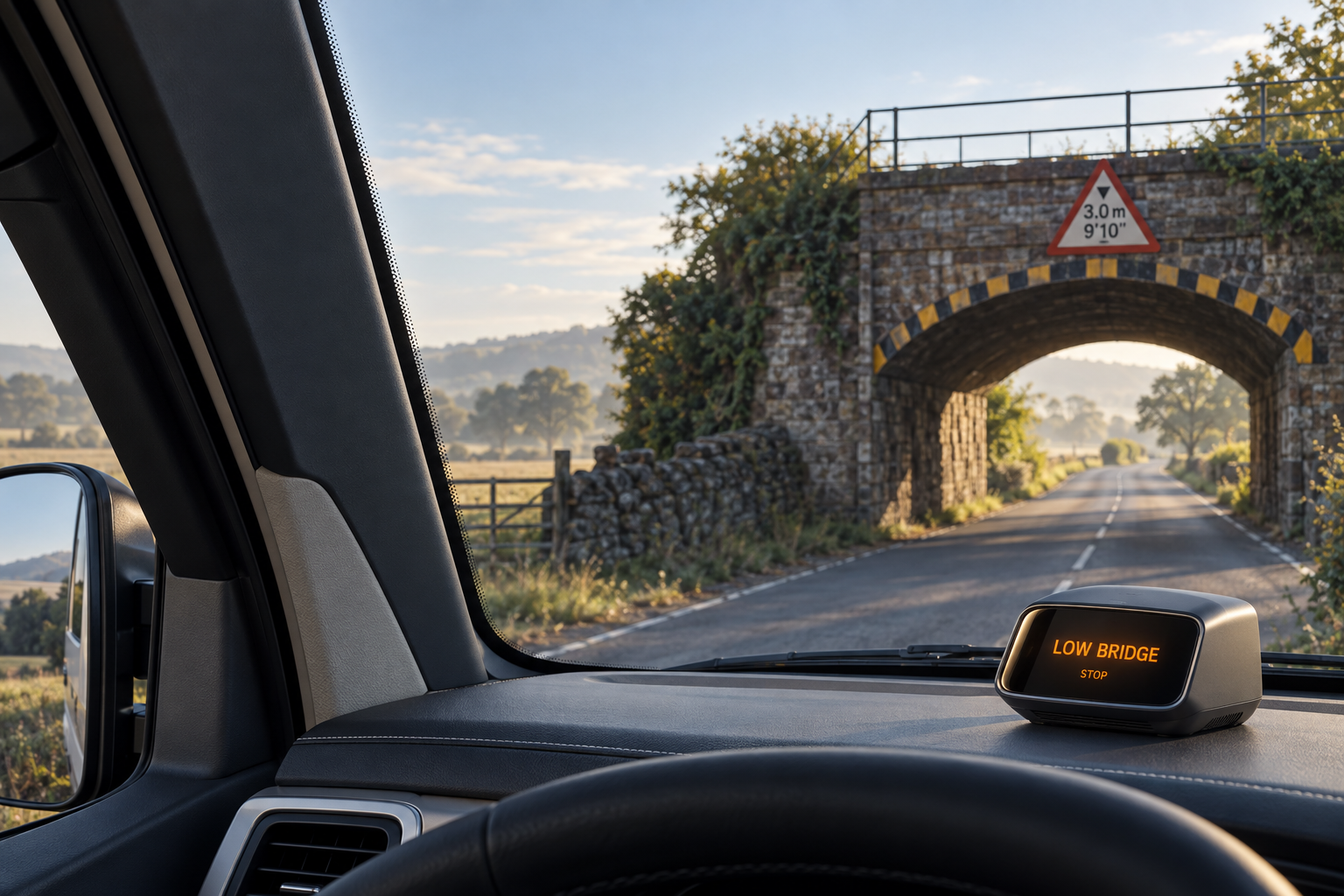
A small instrument on the dashboard. Or a slender bow over the roof. Two ways to make a tall vehicle’s invisible boundary visible before the expensive part arrives.
The driver sits below the problem
A truck cab fits. Its box does not. An RV’s windshield passes beneath an entrance while the air conditioner on its roof is heading straight for it. The driver has to remember a dimension they cannot see, interpret a sign, and judge an opening from several feet below the point that matters.
Headroom asks whether clearance awareness could become an ordinary accessory: something beside the dash cameras and tire gauges, bought before a rental-truck move or a first motorhome trip. The ambition is to eliminate these collisions. The first task is to give that ambition two concrete objects, and test exactly where each can help.
A scanner for less than $100
Set the vehicle’s measured overall height, including roof equipment and cargo. A palm-sized module on the dashboard continuously scans the road ahead with laser ranging or suitably capable radar, estimates the opening beneath a bridge, and compares it with the vehicle’s height plus a chosen margin. A loud warning and a large, simple display bring the hazard into the cab.
The imagined everyday routine is short: measure the vehicle, save its height in feet and inches or metres, secure the module, and confirm its view. Recheck the height when the load or roof equipment changes. An adhesive or removable mount and a vehicle power cable belong in the box. The system should remember calibration, detect a shifted mount, and make loss of sensing conspicuous.
WATCHINGHeight saved · view available
LOW OPENINGAudible warning · stop and assess
VIEW UNAVAILABLEDirty glass, obstruction, or uncertain data
“Watching” is a sensor status, never a promise that the road is clear. A missing reflection must not become permission to proceed.
How much warning is enough?
Change the opening and the approach. This simplified model separates a height conflict from the distance needed to stop.
Illustrative level-road model: 0.15 m height margin; 1.5 s total sensing and driver delay; constant 3 m/s² deceleration. Stopping distance = speed × delay + speed² ÷ (2 × deceleration). No grade, tire, weather, load, or brake variation. Detection distance is an input assumption, not a demonstrated sensor specification. Geometry is schematic; the distance bar spans 100 m.
The difficult part is finding the underside
A distance reading alone does not give bridge clearance. The device must locate the underside across the vehicle’s intended path, relate it to the road underneath, and account for its own mounting height and pitch. In a simple level-road geometry, a return at range r and elevation angle θ lies at sensor height + r sin θ. A bridge fascia, an arch’s centre, and the lowest point above the truck’s outer corner are different targets.
Cheap laser ranging makes an appealing starting point. But the TFmini-S manual, for example, specifies a narrow 2° field of view and a nominal range up to 12 m under stated target conditions. That is a single measuring direction, not a road-wide clearance image. A scanning mechanism or multiple sensing directions would add coverage, cost, and failure modes. Sunlight, dark surfaces, rain, contamination, and windshield reflections need measurement in the actual installation.
Radar is another candidate, but “radar” is not itself a solution to height. Elevation resolution and antenna geometry matter. Texas Instruments’ imaging-radar discussion illustrates the hardware complexity involved in improving angular resolution. A cheap range-only radar could detect the bridge while failing to resolve the opening beneath it.
At 30 m, a 1° pointing error corresponds to roughly 0.52 m of vertical error near the horizon. Mount stability, road grade, and attitude estimation are central to the idea. A dashboard installation also has to prove optical or radio compatibility with real windshields. If an exterior sensor becomes necessary, it changes installation and cost; the self-contained dash unit remains the design goal.
Imagine finding it on a shelf
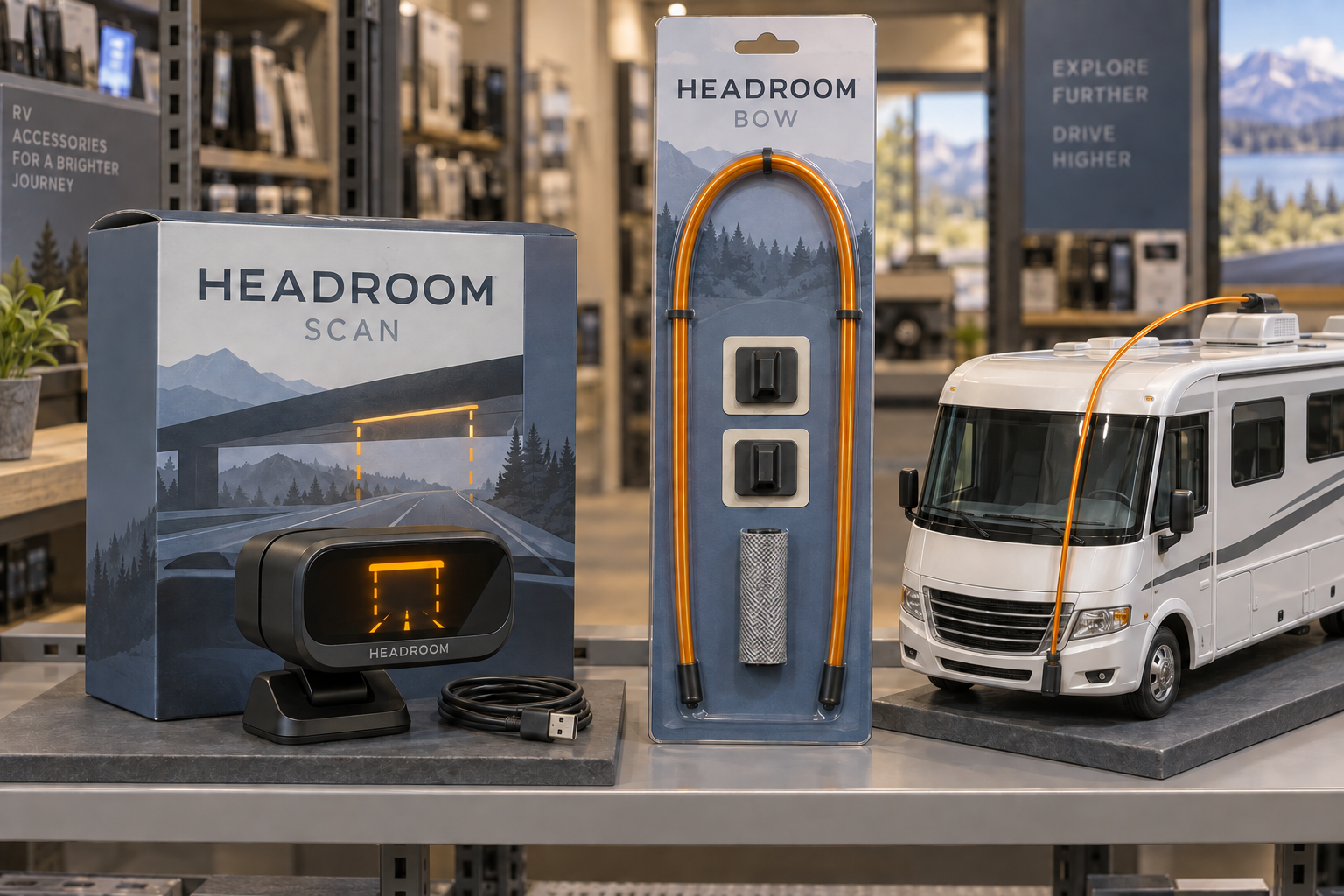
Imagined packaging and product forms. These are generated concept images; neither product is offered for sale.
Headroom Scan
Target retail: below $100
Dashboard clearance awareness for trucks, RVs, and tall vans. Saved vehicle height, continuous forward sensing, an audible low-opening warning, and an unmistakable unavailable state.
Proposed box contents: scanner, secure mount, vehicle power cable, and a height-measurement guide. Range and operating-speed claims await testing.
Headroom Bow
Target retail: below $50
A visible fiberglass feeler running from the front of the vehicle up and over its highest point. Two bonded holders, a flexible rod, and a bright witness section visible from the cab.
Proposed box contents: sectional rod, two surface-compatible adhesive brackets, reflective sleeve, and a fitting guide. Slow-approach concept; no electronics or subscription.
A bow that touches first
The cheaper substitute is deliberately physical. One end of a fiberglass rod is taped or secured in a small glued-on holder at the front of the vehicle. The rod rises ahead of the windshield, curves up and over the vehicle’s highest point, and terminates in a second glued-on bracket there. Its upper curve sits above the expensive equipment. A bright section makes deflection visible to the driver.
The intended rule is immediate: if the bow moves during an approach, stop and check the clearance. Contact should reach the rod before it reaches the roof. Wind and vibration can also move it, so motion is a conservative cue rather than proof of a low opening. Equally, no movement cannot prove clearance: an off-centre obstruction can miss a single rod.
Two brackets. One visible warning.
The bow stands above the roof equipment. Its front attachment and visible curve are part of the same rod.
Concept geometry only. Rod curvature, visibility, adhesive strength, breakaway behaviour, and contact lead distance require physical tests. A centreline bow does not cover the vehicle’s full width.
Contact only helps if there is room to stop
The bow is most plausible for a very slow, controlled approach to an entrance or garage. It has only the distance between its first contact point and the vulnerable part of the vehicle to buy time. In the same illustrative braking model, 1 mph needs about 0.70 m to stop; 5 mph needs about 4.19 m. Even walking pace may consume more distance than a short bow provides. Neither figure establishes a safe operating speed for a real installation.
A maker would need to establish a visible, repeatable movement before roof contact, then test different vehicle shapes and driver sightlines. The rod must not snag an edge and pull a bracket into the windshield, shed sharp fibres, damage a roof seal, or strike someone nearby. Adhesion depends on the vehicle’s surface, temperature, weathering, and load. The mounting kit needs a tested retention and release strategy, not an assumption that any tape will hold.
A narrow feeler also cannot describe a whole arched opening, a sideways lean, or a branch over one corner. Its value is a cheap additional cue that brings a hidden height into view. Its packaging must explain that scope as plainly as it shows the attractive price.
Design backward from the price tag
These are proposed cost allowances per unit at volume, not supplier quotes. They expose the budget a manufacturer would have to meet. Tooling, development, certification, and channel economics still have to fit the business.
Illustrative factory-cost ceilings in US dollars
Cost allowance
Scan
Bow
Sensing / fiberglass rod
$20
$6
Compute, attitude sensing, power / holders
$9
$4
Display and sound / adhesive and witness sleeve
$5
$3
Enclosure, mount, cable / packaging
$6
$3
Assembly and quality checks
$5
$3
Proposed factory-cost budget
$45
$19
At hypothetical $99 and $49 shelf prices, the remaining $54 and $30 would have to cover freight, distribution, retail margin, returns, warranty, development recovery, and profit. The scanner’s $20 sensing allowance is the largest unresolved feasibility question: inexpensive distance measurement is available, but useful road-wide clearance measurement at sufficient range has not been established here.
Give a maker a problem they can actually test
Start with a measured mock opening and a stationary vehicle. Record the lowest obstruction across the full vehicle path, compare it with the sensor’s estimate, and vary road slope, mount angle, surface reflectivity, and windshield type. Move to a closed course only after that geometry works. Log missed hazards, late warnings, nuisance alarms, and unavailable states separately. A beep in one demonstration is not a performance envelope.
For the bow, measure when the driver can first see deflection, how much distance remains before the roof reaches the obstacle, and what happens if the rod catches instead of sliding. Test bracket ageing and release on representative surfaces. Publish the mounting limits and approach conditions the tests actually support.
The appealing future is ordinary: a rental counter offering a height-aware accessory, an RV owner setting a saved roof height, a garage entrance meeting a replaceable feeler before it meets an air conditioner. The under-$100 scanner and under-$50 bow make that future tangible. The next achievement is to earn the warning time their users would depend on.