Long human lives
The concept assumes lifecycle extension far beyond current medicine, or another credible multi-generation social architecture. Neither is a solved subsystem.
OPTIONAL EXPEDITION · ALPHA CENTAURI · ROUND TRIP
The George Washington is not a colony ship. It is a proposal for human reconnaissance: cross the distance, examine a candidate neighboring system directly, and return people, instruments, samples, and hard-earned judgment to Earth.
THE DECISION BEFORE THE DESIGN
Alpha Centauri is about 4.3 light-years away—roughly 25 trillion miles, according to NASA’s distance guide. At that scale, a crew cannot call for parts, food, or rescue. Remote observatories—especially a mature solar gravitational-lens program such as Panoptes—should rank targets before people are committed.
The societal choice is not “exploration or cowardice.” It is whether knowledge worth bringing home justifies a mission whose travelers and support systems must survive far beyond a normal hardware generation. Survey, choose, then decide whether human judgment adds evidence a robot cannot.
A SHIP THAT EXPECTS THE MEDIUM
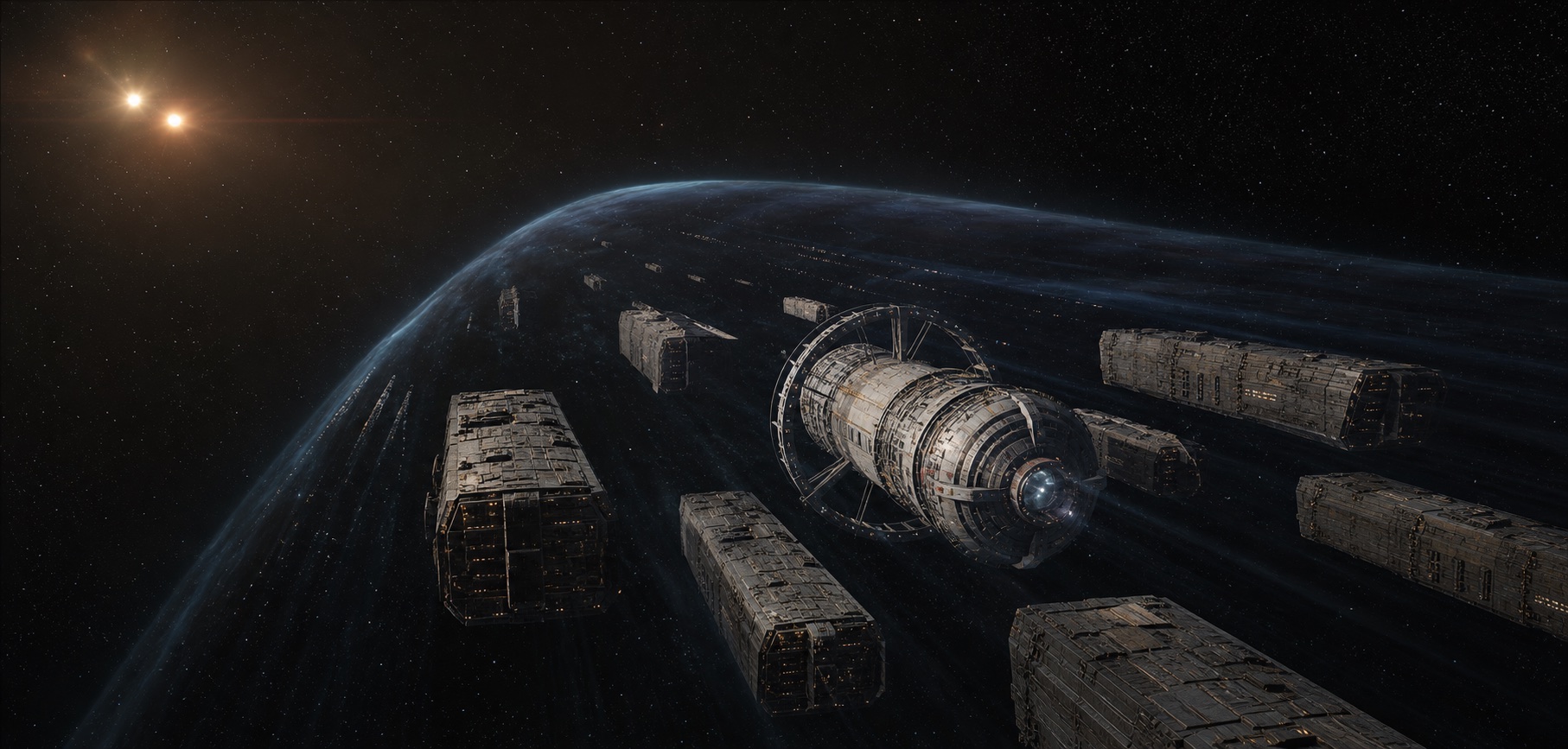
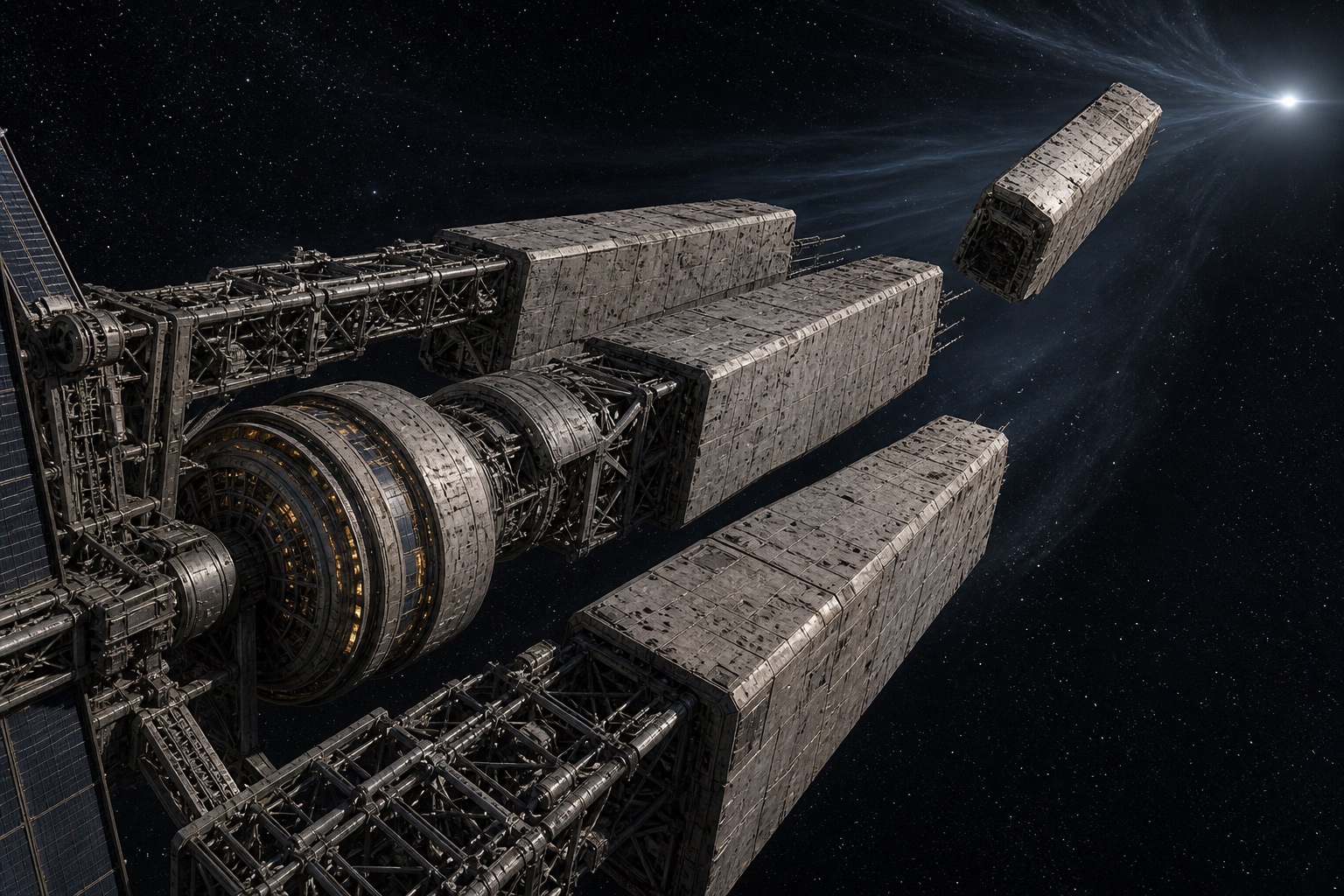
At interstellar cruise speed, dust and charged particles become a primary design problem. The concept separates the precious living volume from expendable mass: a central rotating habitat travels inside a coordinated formation of thick rectangular bulwark craft—the deliberately plain “blocks of cheese.”
Large, replaceable blocks take erosion and impact damage before it reaches the crewed core. A primary study of a 0.2c Alpha Centauri trajectory found gas and dust can erode, melt, and crater exposed material, making shielding a measured consumable rather than decorative armor. Read Hoang et al.
An actively maintained charged-particle structure ahead of the formation is explored as a complementary defense. It cannot substitute for physical shielding against neutral dust.
The human environment rotates to provide sustained artificial gravity, while non-rotating trusses carry radiators, propulsion, sensor booms, spares, and docking structures.
Robotic fabrication, inspection, and reconfiguration are not accessories. A craft intended to outlive ordinary hardware cycles must continually remake itself.
THE OVERLOOKED CONSTRAINT
Outbound, the bulwarks face the velocity vector. Braking at Alpha Centauri, surveying, accelerating home, and braking at Earth change where dust arrives from and where thrust must act. A formation that protects only one direction is a one-way vehicle even if the habitat itself survives.
The rescue architecture carries enough useful shielding to reconfigure around each velocity phase, and treats every released block as a tracked object that cannot cross a planet, future flight path, or inhabited system.
The mission architecture is organized around a long continuous push, with trajectory and velocity treated as design targets rather than settled performance claims.
During deceleration, linked shielding elements may be repositioned or released as their protection and propulsion roles change. No discarded craft is allowed to endanger the destination.
WHY SEND PEOPLE?
The payload is a field laboratory: autonomous probes, landing vehicles, atmospheric and geological instruments, deep sample storage, and enough mobility to follow unexpected findings. Its human crew is there to improvise over years of observation—and to bring direct witnesses home.
Colonization asks whether we can stay. Reconnaissance asks whether we understand what is there.
THE MISSION IS NOT YET AN ANSWER
The concept assumes lifecycle extension far beyond current medicine, or another credible multi-generation social architecture. Neither is a solved subsystem.
Continuous acceleration, power, waste heat, propellant, and protection must close as one mass-and-energy budget. Illustrations are not performance evidence.
Food, water, air, microbes, medicine, reproduction, governance, and machine tooling must stay healthy through unfamiliar failure modes and no rescue. NASA notes that today’s ISS system remains only partly closed and resupplied.
A round trip doubles the navigational and reliability problem but creates the central public value: knowledge returns to the civilization that paid for it.
TWO MISSION HISTORIES
TECHNICAL GROUNDING