Vertical ionization proxy
About 0.38 eV above the P1 parent in the PBE0 calculation: a reason to test whether stray one-electron donation becomes harder, not an autoxidation rate.
F2-RC1 · COMPUTATIONAL CANDIDATE · NOT FOR USE
A blocked tetrahydropterin proposed to carry reducing power to ferric heme, return through QDPR, and leave less collateral chemistry behind.
F2-RC1 is intended to move reducing equivalents between a cellular reductase and an oxidized heme. Repeated completion of that specific circuit would make the molecule a recyclable mediator; a generic antioxidant effect would not establish the mechanism.
The proposed reduced molecule would donate an electron to ferric methemoglobin. Its resulting quinonoid state would then, if the enzyme accepts it, be returned to the reduced state by dihydropteridine reductase—QDPR—using NADH. The full hypothesis is therefore a loop:
NADH→QDPR→reduced F2-RC1→ferric heme
Every arrow remains conditional. No synthesis, enzyme turnover, red-cell uptake, therapeutic effect, dose, formulation, or safety result exists. This is a structure selected for experiment.
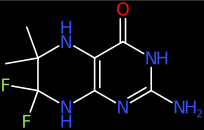
Programmatically rendered from the exact modeled SMILES by the Chemistry Development Kit. This is a connectivity depiction, not evidence for the physiological tautomer, protonation state, conformation, salt, or crystal form.
The descriptors suggest a polar, hydrogen-bonding heterocycle with limited passive membrane and brain penetration. They do not establish solubility, absorption, red-cell entry, renal clearance, or half-life.
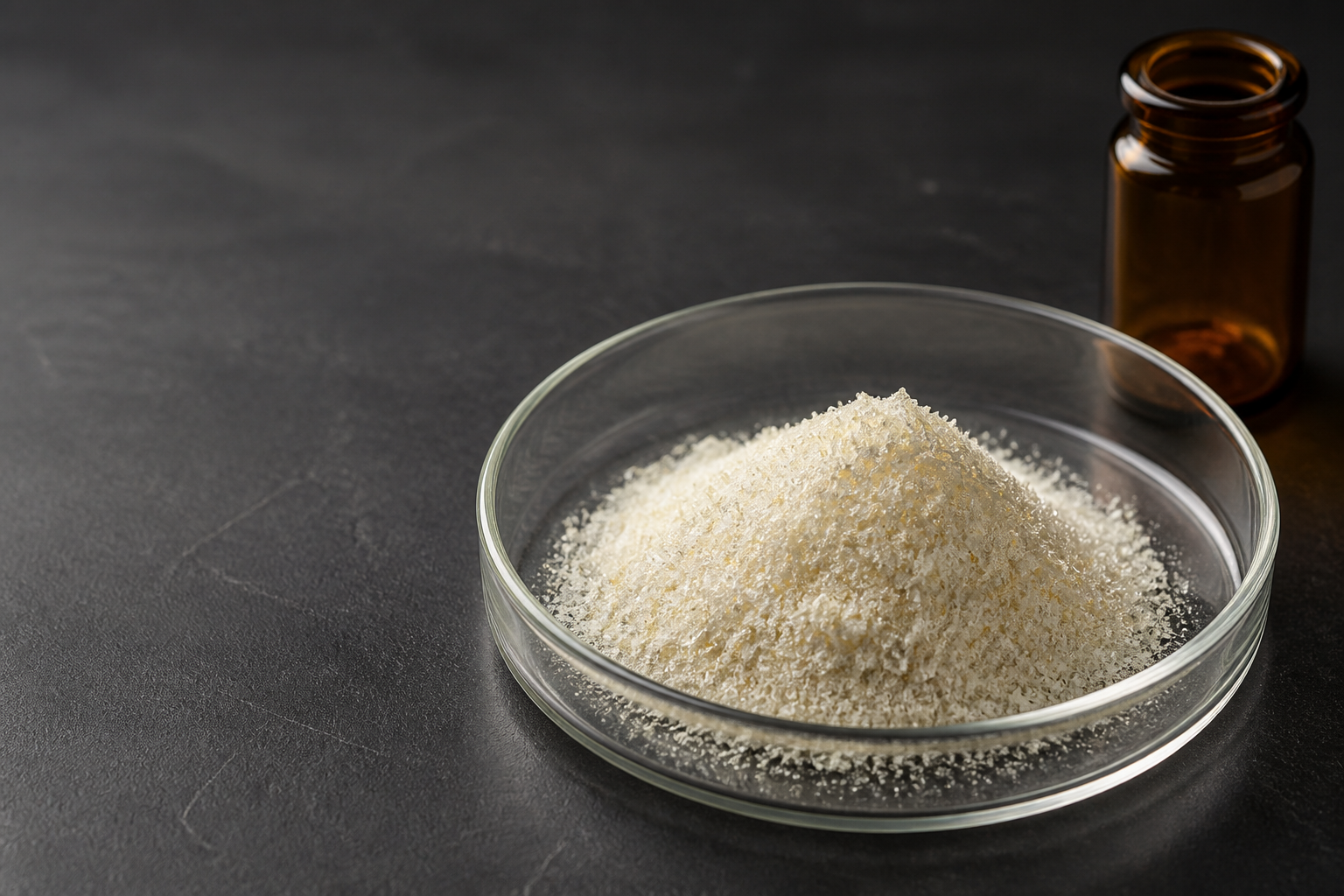
The best honest estimate for purified, reduced F2-RC1 is a white crystalline solid or an off-white, very pale straw powder. A soluble assay preparation would probably be clear and colorless at ordinary concentration. It should not be pictured blue.
This is an analogy, not a measurement. Close tetrahydropterins absorb mainly in the ultraviolet; 6,6-dimethyltetrahydropterin has been described as crystallizable in a completely colorless form, while marketed sapropterin drug substance is officially white to pale yellow. Fluorine does not create a visible chromophore by itself. But the exact candidate’s spectrum, solid form, impurities, and oxidized products are unknown.
The first vial must answer with data: diffuse-reflectance and UV–visible spectra, NMR, LC-HRMS, water content, purity, salt form, polymorph, and time-resolved color under air and light.
About 0.38 eV above the P1 parent in the PBE0 calculation: a reason to test whether stray one-electron donation becomes harder, not an autoxidation rate.
Near P1’s +106 mV reference, with at least roughly ±75 mV uncertainty. It does not prove a favorable one-electron rate to heme.
Higher than the modeled parents. This is not triplet yield, photostability, or proof of low photosensitization.
Higher than P1’s 3.12 eV. Water, hydroxide, glutathione, cysteine, or proteins might attack the very state QDPR would need to recycle.
These are model outputs for one drawn neutral microstate, not measured physical properties. The calculation prioritized F2-RC1 for synthesis; it did not pronounce the molecule useful.
Each proposed advantage has a neighboring failure mode, so every experiment needs a useful readout and a measurement capable of ending the program.
What supports the question: hemoglobin needs ferrous Fe²⁺ to bind oxygen normally. Related tetrahydropterins can reduce ferric haemoproteins, including methemoglobin, in vitro.
What could defeat it: the transfer is a one-electron collision, while the headline candidate potential is a two-electron average. Slow transfer, radical loss, no red-cell entry, or reduction of cytochrome c and other ferric hemes would end the therapeutic argument.
Decisive readout · purified metHb kinetics, product balance, and intact oxygenated human erythrocytesWhat supports the question: human erythrocytes contain QDPR with a strong kinetic preference for NADH over NADPH. Drosophila also has a characterized, conserved DHPR.
What could defeat it: the blocked and fluorinated ring may not fit either enzyme, may bind without turning over, or may tax NADH and interfere with the ordinary red-cell repair economy.
Decisive readout · human and fly enzyme Km, kcat, stoichiometry, product release, and repeated full-cycle turnoverWhat supports the question: the higher computed ionization proxy and triplet energy make F2-RC1 a rational probe for quieter one-electron and excited-state behavior.
What could defeat it: those proxies do not predict physiological oxygen kinetics. The candidate may consume oxygen, generate superoxide or H₂O₂, or create a persistent radical even while its average redox potential looks suitable.
Decisive readout · O₂ consumption plus superoxide, H₂O₂, radical, and degradation-product mass balanceWhat supports the question: the 2-amino-pteridinone family resembles the BH₄ chemistry handled by QDPR and pterin-dependent enzymes.
What could defeat it: F2-RC1 could inhibit or miscouple phenylalanine, tyrosine, or tryptophan hydroxylase; nitric-oxide synthases; or alkylglycerol monooxygenase. That could disturb phenylalanine handling, catecholamines, serotonin, nitric oxide, or lipid metabolism.
Decisive readout · PAH, TH, TPH1/2, NOS1/2/3, AGMO and folate-enzyme counterscreensWhat supports the question: its small mass and moderate calculated lipophilicity do not obviously preclude circulation, while its polarity may limit nonspecific tissue distribution.
What could defeat it: a crystalline free base could be poorly soluble; the electrophilic quinonoid could consume GSH or adduct proteins; C–F bonds may persist while the pterin ring degrades; transporters and renal handling are wholly unknown.
Decisive readout · pKa, solubility, permeability, plasma stability, thiol adducts, protein binding, transport and excretionThe possible benefit is one substitution: an alternative way to repair methemoglobin and restore oxygen-carrying capacity.
Every benefit remains conditional on those measurements. Current evidence supports no use for cognition, aging, mitochondria, inflammation, wellness, or generalized antioxidant support, and it establishes no comparative safety, G6PD safety, staining behavior, or therapeutic effect.
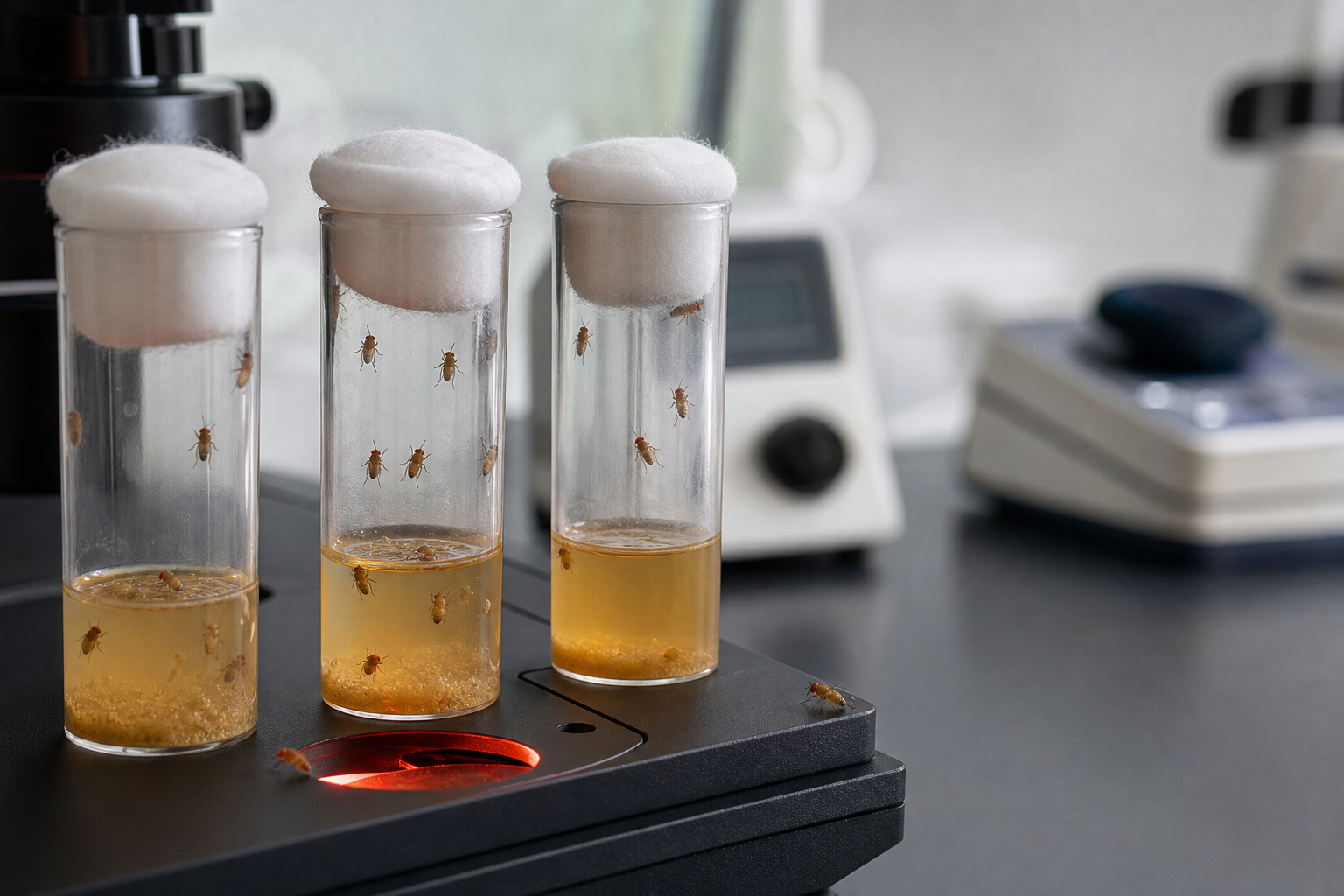
After synthesis and minimum cell-free identity, stability, and enzyme checks, begin whole-organism work in Drosophila melanogaster. Flies have a characterized DHPR related to human QDPR, genetically tractable dopamine, serotonin and nitric-oxide biology, measurable pterin pigments, short development, and tissue-resolved redox reporters.
That combination makes them an unusually sharp early warning system for a pterin-like molecule. A red-eyed, genetically matched background should be compared with controlled Dhpr reduction and rescue. The common white-mutant background should not stand alone: it changes pterin-precursor transport and can confound pigmentation, metabolism, and behavior.
Measure food stability and LC-HRMS-confirmed parent, quinonoid, and degradation products in whole flies and selected tissues. Nominal food concentration is not a dose.
Track acute survival, development, eclosion, lifespan, fecundity, feeding, climbing, spontaneous movement, sleep, and recovery in both sexes.
Use cytosolic and mitochondrial roGFP reporters alongside H₂O₂, GSH/GSSG, NADH/NAD⁺, NADPH/NADP⁺, ATP, respiration, lipid oxidation, and protein carbonyls.
Quantify BH₄/BH₂ and related pterins, eye-pigment spectra, amino acids, dopamine, serotonin, nitric-oxide products, and cuticle pigmentation.
Compare wild type with matched Dhpr knockdown, overexpression, and genetic rescue. A protective effect without verified exposure or mechanism does not count.
Only after a quiet baseline, preregister paraquat, hyperoxia, or peroxide challenges. Survival must agree with chemical exposure and tissue redox measurements.
Synthesis, purity, structure, pKa, solubility, electrochemistry, spectrum, oxygen/ROS balance, radical identity, hydrolysis, thiol attack, and degradation.
Human and fly QDPR turnover; repeated reduction/oxidation cycles; ferric-heme kinetics; PAH, TH, TPH, NOS, AGMO, folate and MAO counterscreens.
Exposure, tolerability, conserved pterin pathways, redox reporters, developmental effects, neurobehavior, excretion, and DHPR dependence.
Oxygenated human erythrocytes: metHb reversal, uptake, NADH burden, GSH, ATP, ROS, hemolysis, morphology, efflux, and approved G6PD-deficient-donor studies.
Stop if the candidate cannot be cleanly identified; reacts badly with air, water, or thiols; is not recycled by QDPR; creates net oxidant stress; disrupts native pterin enzymes; fails to enter red cells; reduces the wrong hemes; or damages erythrocytes near an active concentration.
F2-RC1 is an unsynthesized computational candidate. Nothing on this page is a recommendation to manufacture, possess, dose, ingest, inject, or self-experiment with it. No safety, efficacy, pharmacokinetic, formulation, or regulatory status exists.