The collision is coming.
Give it more distance.
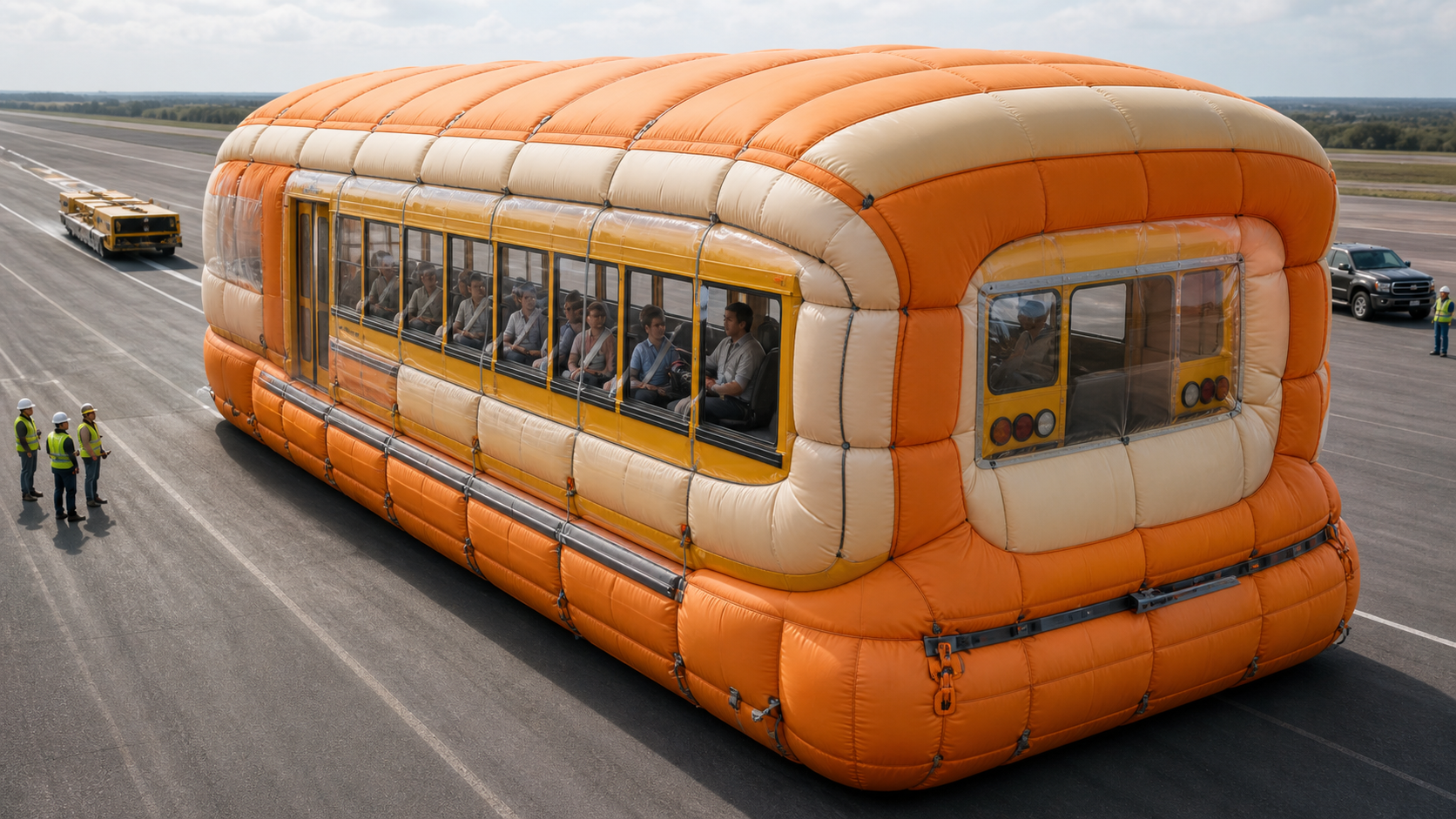
A manually triggered, one-time inflatable stored along a school bus’s side and rear expands around the entire vehicle. The ambition is a less destructive impact when the driver can no longer prevent the collision.
Buy a better crash.
A fully loaded freight truck has lost its brakes. The bus driver can see it coming, but cannot clear its path. Bus Bulwark asks whether the seconds left can be used to put a substantial sacrificial envelope between the two vehicles. The truck may still reach the bus. Reducing its relative speed, spreading the load and lengthening the impact could nevertheless change what happens inside.
The objective is to turn a potentially fatal collision into one more children survive, ideally with moderate injuries. That is the outcome to establish with crash measurements; it cannot be inferred from the size of the bag. The system begins with a manual trigger. No automatic deployment is assumed in the calculations below.
The last seconds have a budget.
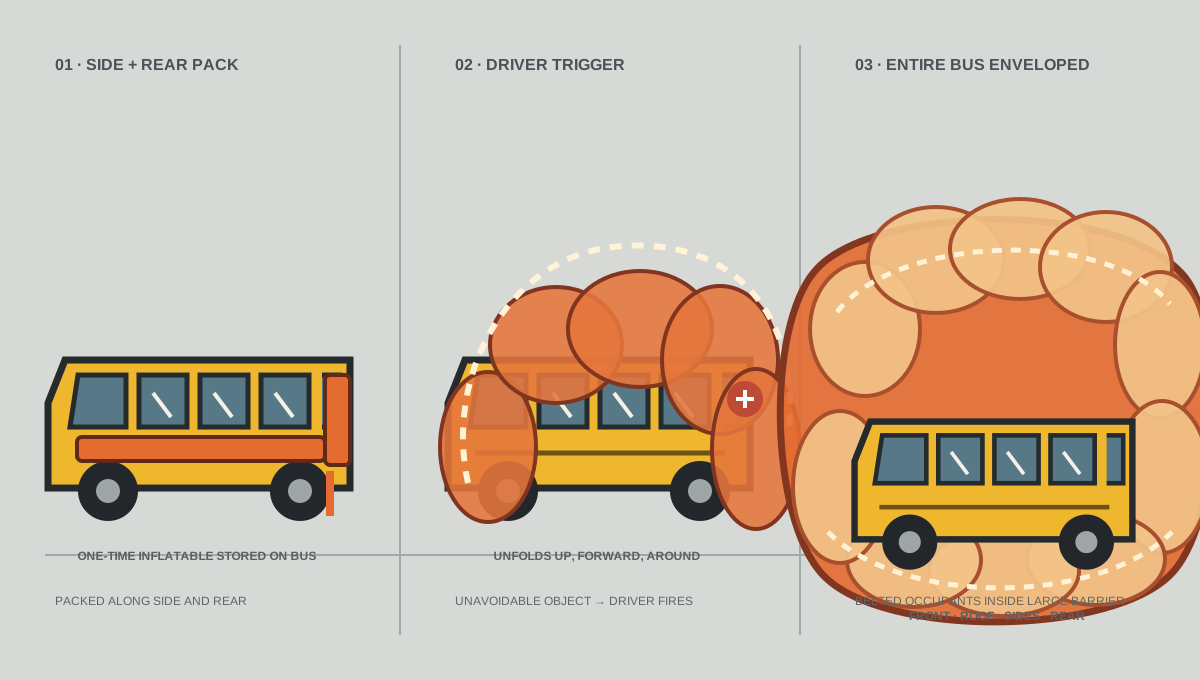
At 80 km/h, a truck covers 22.2 metres each second. A 50-metre gap to the bus is about 2.25 seconds to the body. A protective envelope extending 3 metres toward the truck is contacted earlier: after about 2.12 seconds.
An assumed 1.0-second decision-and-reach interval plus 0.5 seconds for inflation leaves about 0.62 seconds of reserve in that example. The same response at a 25-metre gap is too late for a complete envelope. These are timing requirements, not measured response or inflation performance.
Manual activation avoids having an algorithm decide to fire, but introduces attention, recognition, reach and hesitation. The driver may be watching another direction. A false manual trigger is also possible. The control’s practical value depends on how early a driver can actually recognize the unavoidable event.
External pre-crash airbags have a real precedent. ZF reported reduced injury severity in its passenger-car side-airbag tests. That supports studying extra exterior crush distance. It does not establish that a whole-bus envelope can inflate in the same time or survive a truck impact.
What does the extra distance buy?
Change the approach and assumed compression below. The bus is initially stationary and free to translate in the impact direction. The model transfers momentum between the two masses and removes energy through a constant assumed resisting force. It does not pin the bus to an imaginary wall.
Approach and compression study
Illustrative inputs. Envelope depth is also taken as usable compression stroke. Mean force is an assumed force–stroke law, not a specified gas pressure or demonstrated airbag capability. No truck braking, ground impulse, rotation or rebound is included.
Enable JavaScript to change the assumptions. At the default 36.3-tonne truck, 12-tonne bus and 80 km/h approach, relative-motion energy is about 2.23 MJ. Dissipating all of it would still leave both masses moving at about 60.1 km/h.
The truck can slow while the bus speeds up.
A 36.3-tonne truck traveling at 80 km/h carries about 8.96 MJ of kinetic energy. That mass approximates the 80,000-pound U.S. Interstate gross-weight limit; it is one reference case, not a universal loaded-truck weight.
Against a stationary 12-tonne bus, only about 2.23 MJ is energy of relative motion. In the ideal no-rebound limit, dissipating that relative energy brings the vehicles to a common speed of 60.1 km/h. The remaining energy is bulk motion. The bus has acquired a substantial velocity change even though the truck no longer closes on it.
That is why a lower truck speed alone cannot establish passenger survival. The pulse transmitted through the bus, intrusion into seating space, rotation, restraint loading and the next object the bus hits all matter.
A thick envelope has to spend its stroke.
Energy absorption is the area under a force–displacement curve: E = ∫F dx. Absorbing 2.23 MJ over 3 metres requires roughly 0.74 MN of average force. Spread over 6 metres, the same ideal work requires half that average force. Neither example specifies a workable fabric, pressure, vent or attachment.
Air that merely compresses and springs back stores energy. Useful dissipation requires a controlled irreversible process. A bag that bursts early, slides around the truck nose or bottoms out after a small fraction of its depth does not deliver the stroke its silhouette suggests.
NASA tested a deployable honeycomb energy absorber on a helicopter. It is a different mechanism and impact regime, but a useful precedent for testing a packed reserve as part of a complete vehicle rather than treating volume as evidence.
The train case is a different question.
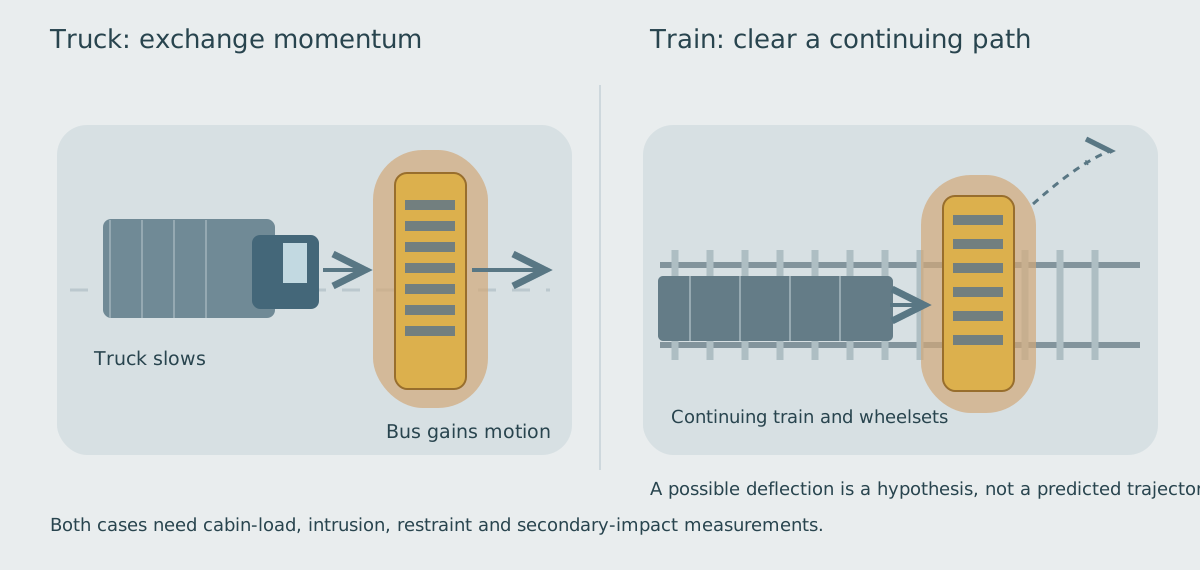
A sufficiently broad, load-spreading envelope might help a bus move away from an impact instead of allowing a narrow structure to cut into the cabin. That is a serious question to investigate. It is not equivalent to safely bouncing a bus off a freight train.
For scale, accelerating a 12-tonne bus from rest to 20 m/s takes 2.4 MJ and 240 kN·s of impulse. Delivering that velocity change over 0.2 seconds corresponds to roughly 10 g of average vehicle acceleration; over 0.5 seconds, about 4 g. Those are arithmetic examples, not survivable pulse limits, and they omit rotation, intrusion and landing.
The train must continue past the bus rather than drag, crush or overturn it. Wheelsets, couplers, the underbody, ground contact and the timing of clearance introduce failure modes a two-mass translation model cannot resolve. More fabric and gas alone do not establish a sublethal train collision. This branch needs multibody impact and clearance analysis before any occupant claim is credible.
Measure the improvement the children actually receive.
| Question | Demonstration | Decision it supports |
|---|---|---|
| Can it be ready? | Instrumented manual recognition trials and full-size deployments, including aged packs, temperature, mirrors and roof equipment. | A measured activation envelope with a defined margin before first contact. |
| Does the envelope do useful work? | Load, displacement, tearing, venting and rebound measurements under representative impact shapes. | An actual force–stroke law, usable stroke and energy capacity to replace assumptions in the model. |
| Does the bus remain protective? | Matched protected and unprotected full-scale impact cases, measuring cabin intrusion, acceleration, rotation and secondary contacts. | Whether the exterior reserve reduces damage without transferring a worse pulse or rollover problem inside. |
| Do restrained children benefit? | Instrumented child-size occupants across seating positions, with head, neck, chest and excursion measures. | Injury-risk comparisons specific to each tested crash condition. |
| Can people get out afterward? | Post-impact door, emergency-exit and rescue-access demonstrations with the envelope damaged or partly inflated. | A protective system that still permits evacuation. |
The outside and the inside are one system.
The exterior reserve changes how the bus receives the collision. Seatbelts and energy-absorbing seats determine how occupants follow that motion. The NTSB’s investigation of the 2020 Decatur truck–school-bus crash found that properly worn lap-and-shoulder belts would have reduced injuries and reiterated its recommendation for them in new large school buses.
The useful result for Bus Bulwark would be a repeatable reduction in injury risk across specified, unavoidable collisions. A successful demonstration would show the measured deployment margin, energy absorbed, cabin preserved and occupant loads reduced—all in the same event.