Why does so much cycling leave so little behind?
The ocean exchanges enormous quantities of carbon with the atmosphere in both directions. The IPCC carbon budget places natural gross exchange at roughly 54 billion tonnes of carbon per year in each direction. Against that traffic, the Global Carbon Budget 2025 estimates a net ocean sink of 3.2 ± 0.4 billion tonnes of carbon per year over 2015–2024. The periods differ, but the scale distinction is clear: annual exchange is well over ten times the net sink. These are carbon flows, not volumes of seawater.
The small difference between two large flows is no simple measure of capture efficiency. Much of the exchange belongs to a system near equilibrium. Yet the disparity opens a productive question: what would allow more of the carbon entering the ocean to remain there, and what chemical capacity is being spent as that happens?
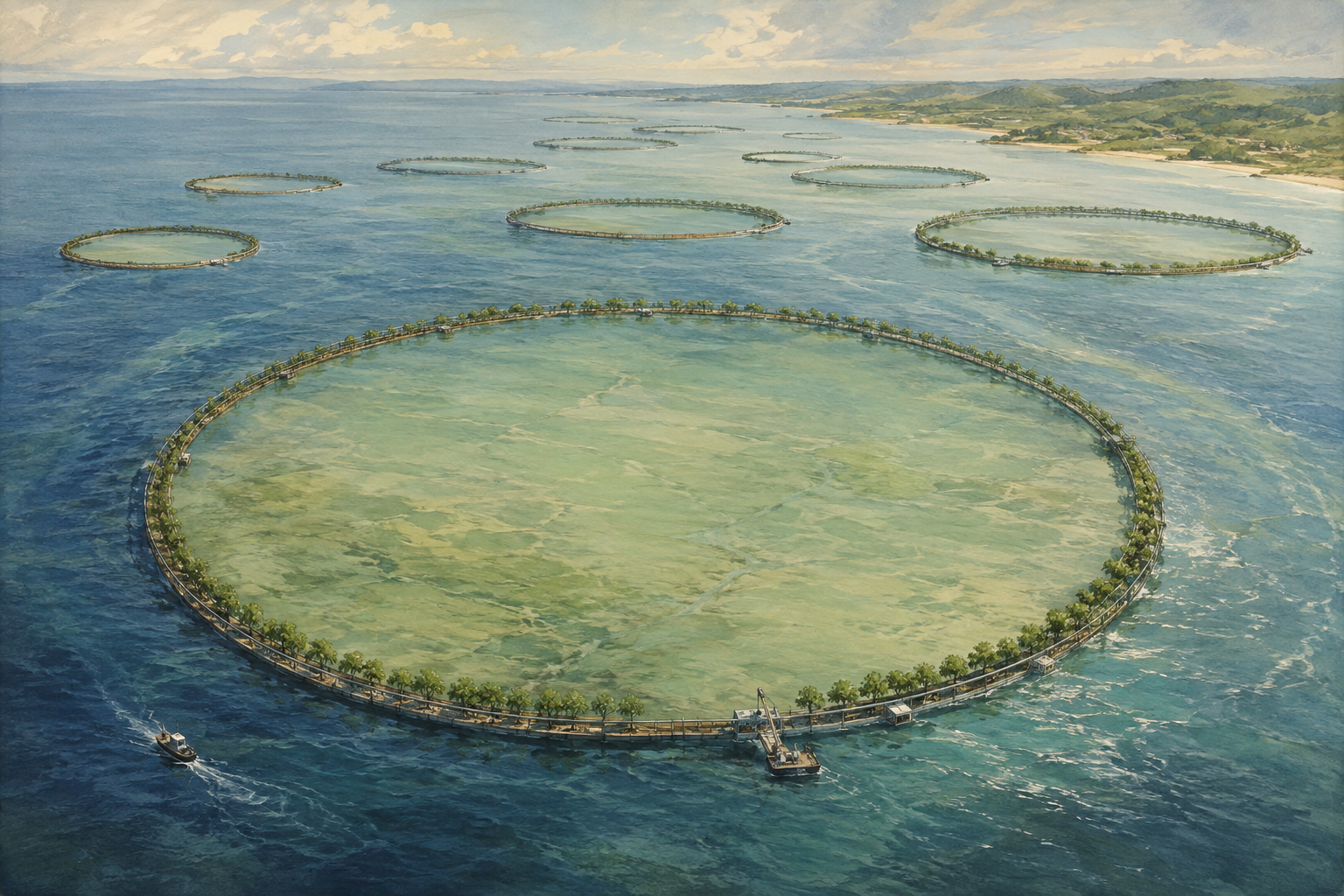
Bring Back the Swamps proposes a large area of managed living water above the sea: shallow, partly enclosed cells with a cultivation surface, mineral contact, and controlled exchange. The ambition reaches beyond carbon. A million square kilometres of growing habitat could support algae, roots, crustaceans, and other marine life; its surfaces could become a continuing supply of material for underwater habitat. The chemistry, cultivation, and second life of that material have to work together.
The buffer changes as it fills
Most dissolved inorganic carbon in seawater is bicarbonate, with smaller pools of carbonate and dissolved CO₂. As additional CO₂ enters, the balance shifts: CO₂ + H₂O + CO₃²⁻ ⇌ 2 HCO₃⁻. Carbonate helps accommodate the incoming carbon, but its concentration falls. Adding CO₂ increases dissolved inorganic carbon without adding total alkalinity, the water’s acid-neutralizing capacity.
The consequence is measured by the Revelle factor: the fractional increase in seawater CO₂ pressure divided by the fractional increase in dissolved inorganic carbon at fixed alkalinity and other conditions. A higher factor means a smaller carbon addition raises CO₂ pressure more sharply. That pressure approaches the atmosphere’s sooner, reducing the driving force for further uptake. Warming and circulation also affect the sink; this carbonate response is one specific part of the problem.
A battery is a useful analogy for finite buffering headroom. As carbon loading changes the chemistry, less favorable conditions confront the next increment. The ocean does not become abruptly full, and exchange does not stop. Its absolute uptake can still grow under rising atmospheric CO₂ even while its chemical capacity per increment deteriorates. A global model and observation synthesis estimates a mean surface Revelle factor rising from about 9.6 in 1750 to 10.8 in 2010, with further change depending strongly on emissions.
The intervention therefore asks whether a small manufactured environment can replenish useful chemical capacity before returning its water to the ocean. Photosynthesis, higher pH, and a visible bloom are clues to activity. Lasting additional carbon uptake depends on what survives the complete cycle.
| One parcel of seawater | pH | CO₂ pressure | Revelle factor |
|---|---|---|---|
| Starting equilibrium | 8.026 | 420 µatm | 9.80 |
| Add 100 µmol/kg dissolved inorganic carbon, hold alkalinity fixed | 7.833 | 711 µatm | 12.13 |
| Add 100 µmol/kg alkalinity instead, then equilibrate with the same air | 8.042 | 420 µatm | 9.74 |
These illustrative PyCO2SYS calculations use 25°C, salinity 35, initial alkalinity 2,300 µmol/kg, and an assumed atmospheric CO₂ pressure of 420 µatm. They describe carbonate equilibrium, not a simulated tropical cell. The alkalinity-only addition permits about 81.7 µmol/kg of extra atmospheric carbon after equilibration. If carbonate rock supplies the same alkalinity while also adding 50 µmol/kg of mineral carbon, the additional atmospheric contribution is about 31.7 µmol/kg. The source of the alkalinity matters as much as its amount.
A warm pool is a chemical reactor
Could biological activity create localized conditions that make inexpensive mineral material dissolve, while slow water exchange exports a lasting chemical benefit? A shallow tropical pool, less saline than the ocean beneath it, offers a place to investigate that question. Sunlight, living surfaces, thin mineral sheets, and residence time become interacting design variables.
The proposed warm case approaches 100°F, about 38°C. That is a condition to investigate with organisms suited to it, rather than an assumed optimum for algae, mangroves, or corals. Warm water can accelerate some reactions but holds less dissolved gas, and heat stress can erase biological gains. Freshwater supply, evaporation, leakage, and overtopping determine whether a subsaline pool can persist at all.
Within a biofilm, respiration and organic acids can create small acidic zones even when surrounding water is less acidic. Those zones may encourage mineral dissolution; photosynthesis elsewhere changes the balance again. Modeling of carbonate additions to marine sediments examines this coupling between organic-matter breakdown, mineral dissolution, and alkalinity export; it is a useful precedent for the mechanism, not a validation of floating sheets. Thin, replaceable sheets would expose material to these local conditions while keeping it accessible for inspection. Useful throughput depends on mineral composition, saturation, surface area, coatings, and the time water remains in contact. A sheet is a consumable mineral feedstock when it dissolves.
Slow exchange could give reactions time to proceed while carrying dissolved products outward. Too little exchange can exhaust nutrients, accumulate heat, or allow oxygen depletion. Too much can wash away the local conditions the cell was built to maintain. The sought result is a sustained export of useful chemistry per unit of area, mineral consumed, and energy—not merely an unusually high or low pH inside the pool.
A small solar-powered electrolytic unit could supplement that process, creating a useful local chemical environment or assisting mineral dissolution. Its size would follow the measured demand. Electrochemical alkalinity methods can produce an acid counterpart, and some seawater processes have other consequential coproducts. Their handling belongs in the same material and energy balance as the exported benefit.
Air–sea equilibration depends on location and transport. Exported alkalinity need not immediately be consumed elsewhere: it can remain dissolved and allow additional carbon uptake as water exchanges with the atmosphere. Conversely, carbonate precipitation can remove an apparent alkalinity gain. The receiving water is part of the reactor’s performance.
Different waters, different living communities
Brackish beds could support farmable red algae as well as a planted wetland fringe. Gracilaria pond cultivation provides a practical precedent, including the need to manage nutrients, salinity, water exchange, and overheating. Species selection must follow the actual temperature and salinity range. A hot mineral-dissolving compartment and a productive crop bed may need to occupy different parts of the system.
Other floating beds could remain fully marine and support kelp cultivation in climates suited to the chosen kelp. They need not inherit the tropical heat or freshwater demands of the brackish reactor. The family resemblance is physical: accessible floating support, large illuminated growing area, and repeatable servicing. Their biological and chemical operating conditions differ.
Growing algae can create food, feedstocks, shelter, and surfaces for associated animals. Those are useful outputs even when their carbon returns through consumption or decay. Durable organic-carbon storage requires an additional pathway that keeps that return from occurring on the claimed timescale. Calcium-carbonate shells and mineral coatings require a different account again.
Iron fertilization addresses a separate bottleneck: nutrient limitation in suitable waters. A tanker carrying iron shavings suggests a cheap distribution system, but distribution alone does not establish dissolution, ecological response, or durable removal. An iron-fertilized diatom bloom has produced deep carbon export; that result does not establish shavings along shipping routes as the most efficient sequestration method. The floating-cell proposal instead seeks control over the conditions and fate of its outputs.
Carbonate can build habitat while changing the carbon balance
Calcium carbonate is an intended product here. A mineral-rich growing sheet could acquire texture, weight, and material familiar to reef-building organisms. Shells and coatings could turn a temporary cultivation surface into a useful substrate. That habitat purpose gives local mineral formation a role even when maximum dissolved alkalinity export would favor leaving the mineral unformed.
But forming CaCO₃ consumes two equivalents of alkalinity for every mole of dissolved inorganic carbon transferred into the solid. In bicarbonate notation, Ca²⁺ + 2 HCO₃⁻ → CaCO₃ + CO₂ + H₂O. The amount ultimately exchanged with the atmosphere depends on seawater buffering and gas exchange; the reaction does not mean exactly one mole escapes as gas. It does explain why calcification can raise seawater CO₂ pressure despite placing carbon in a solid. This is the carbonate counter-pump.
Sinking a carbonate-rich membrane therefore establishes a transfer of solid carbon, not automatically net atmospheric removal. The full account includes where its carbon and alkalinity came from, the energy and minerals consumed, any CO₂ released during formation, accompanying organic carbon, and whether the solid persists or dissolves at depth. Dissolving a carbonate rock and reprecipitating it elsewhere can relocate the mineral without creating a new atmospheric sink.
The design can pursue several outputs together: persistent dissolved alkalinity, durable organic carbon, solid carbonate, and living habitat. They should remain separate in the ledger. The question is which combination delivers the greatest lasting benefit from the same surface and resources.
A million wet cells
Consider a manufacturing ambition: a million cells, mass-produced in China at a target purchase price of one million US dollars each, deployed across suitable waters worldwide. That is a trillion-dollar cell fleet. Keeping the proposed mile-wide diameter gives roughly two million square kilometres of enclosed water. The significance of that area depends on a sustained surplus per square metre.
Illustrative arithmetic · These inputs are assumptions, not measured yields, supplier quotations, or a deployment forecast.
Enter a valid number in every field within its stated range.
- Enclosed water area
- 2,034,172 km²
- Cell purchases
- $1.00 trillion
- Additional alkalinity export
- 7.425 Tmol / year
- Atmospheric uptake before project emissions
- 261.4 Mt CO₂ / year
The purchase target allocates $0.49 per square metre of enclosed water to the complete cell.
At that area and an assumed uptake factor of 0.8, export rates of 1, 10, and 100 mmol per square metre per day correspond to approximately 26, 261, and 2,614 million tonnes of CO₂ uptake a year before project emissions. These are sensitivity cases, not an expected range. No experiment has established which rate, if any, these cells can sustain.
The export input means additional alkalinity that remains after baseline subtraction, downstream reactions and precipitation—not a high pH measured inside the pool. The effective uptake factor must account for co-exported dissolved carbon and air–sea exchange; 0.8 is only an illustration. A wetland’s export could deliver little atmospheric removal or even promote outgassing. The calculator permits zero and negative outcomes.
The arithmetic uses circular area × cell count × daily export × 365, converts millimoles to moles, then multiplies by the uptake factor and 44 grams per mole of CO₂. It assumes an annual average over the whole enclosed area: if only a small fraction contacts mineral or supports an active bed, its local yield must be scaled down accordingly. Materials, electricity, freshwater supply, transport, servicing, replacement, and greenhouse-gas emissions remain to be priced and subtracted.
The million-dollar target is especially demanding for a mile-wide cell: it must cover about five kilometres of perimeter and two square kilometres of working surface at less than fifty cents per square metre of enclosure. Smaller cells may fit industrial production more readily, but reducing diameter also reduces active area quadratically. The controls make that tradeoff explicit.
The apparatus
- Diameter
- 1 mile
- Enclosed area
- 2.03 km²
- Perimeter
- 5.06 km
Circular geometry for a one-mile diameter, before space for access, supports, and equipment.
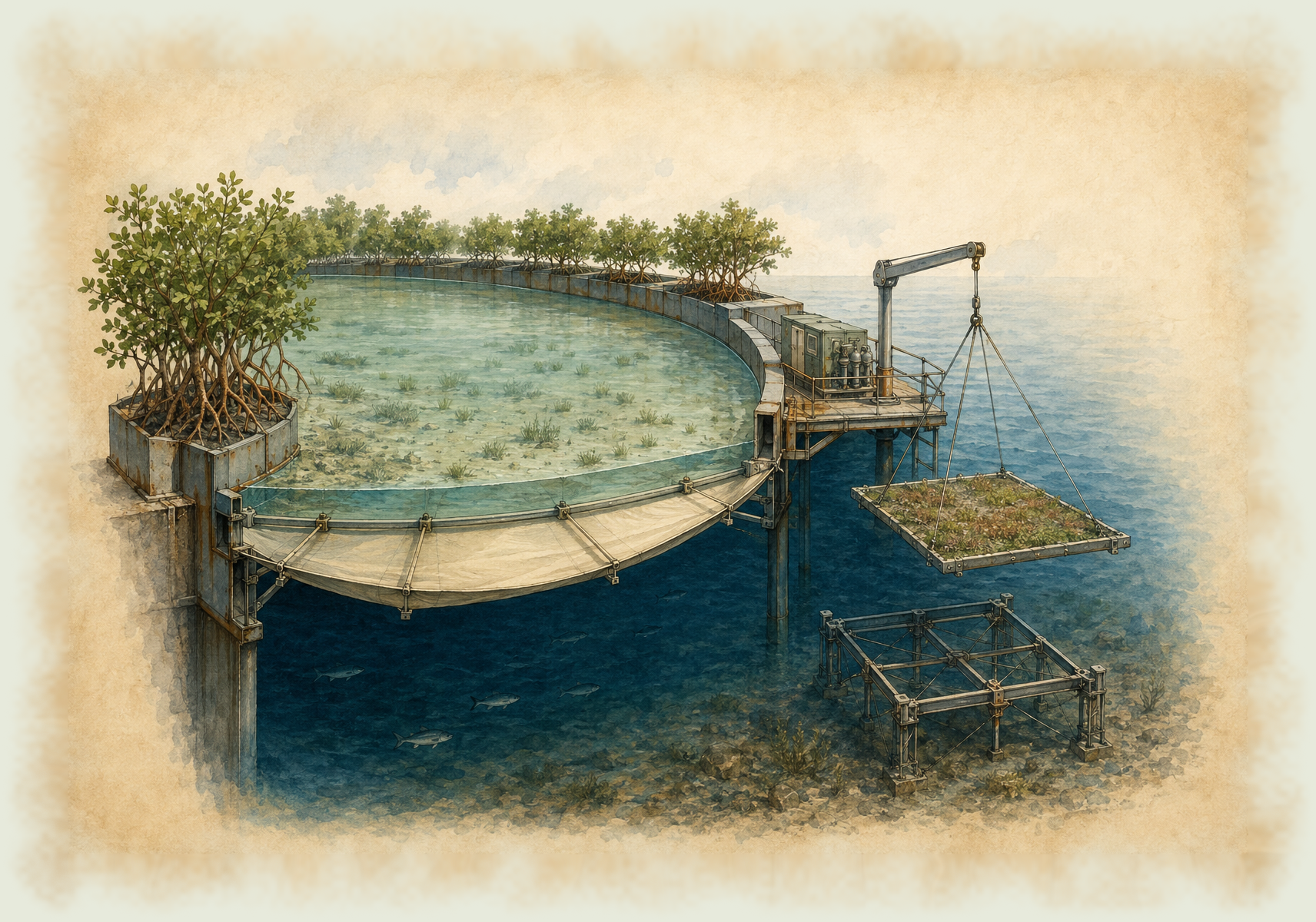
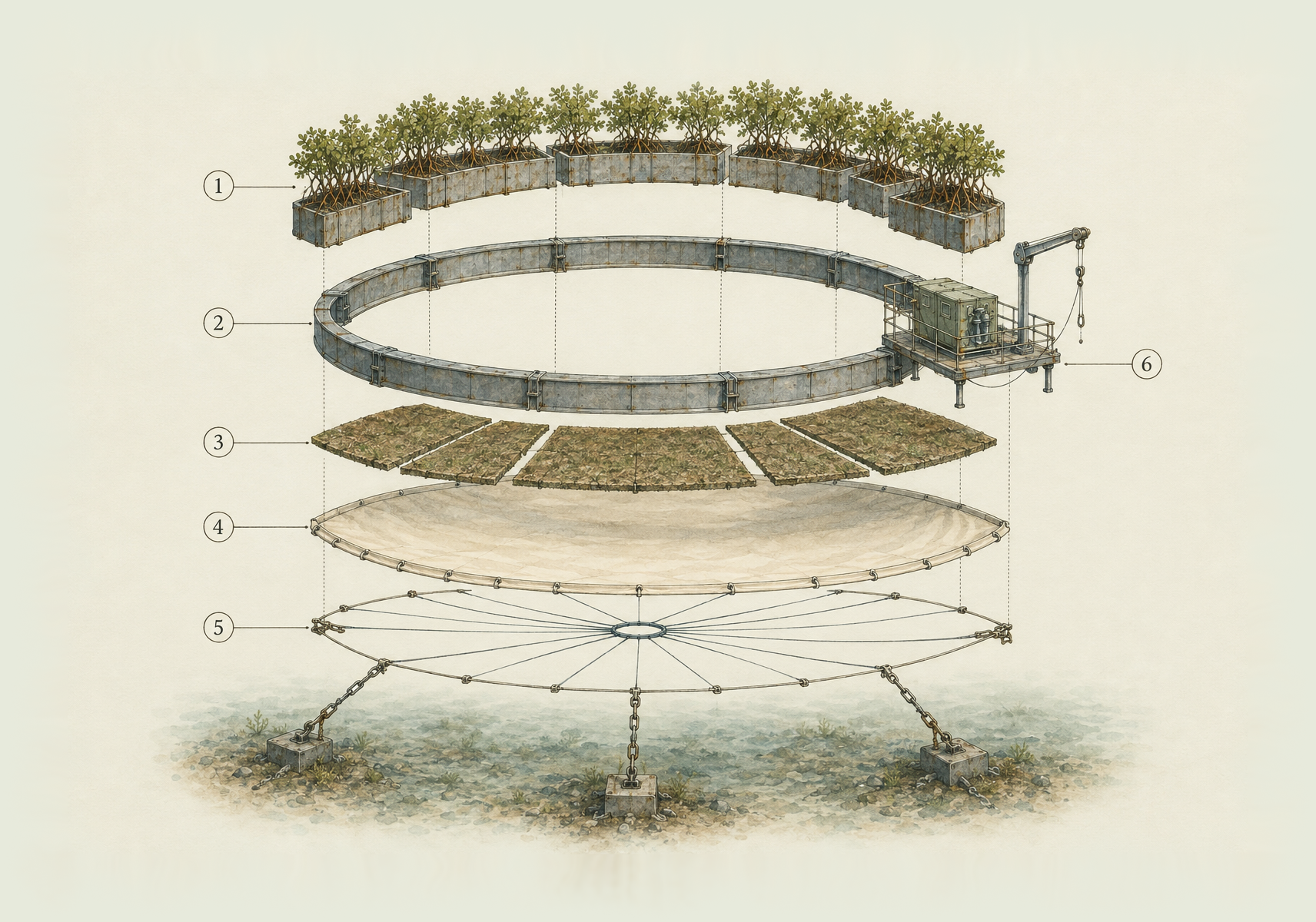
- 1 Mangrove planters
- Perimeter troughs hold the wetland fringe, its roots, and its growing substrate.
- 2 Steel ring
- A segmented perimeter carries the planters, access, and attachments for the suspended surfaces.
- 3 Cultivation sheet
- A removable surface carries sacrificial growth. The spent fibrous material becomes the candidate reef covering.
- 4 Salt barrier
- The impermeable liner holds the working water apart from seawater beneath it. Separating this liner from the growing skin would allow material recovery without sacrificing the pool’s barrier.
- 5 Supports & moorings
- Supporting cables carry the submerged surface; moorings keep the floating assembly on station.
- 6 Service platform
- Panel handling and proposed solar-powered electrochemical equipment sit at the perimeter. Replaceable mineral sheets would be serviced here; they are not shown in these concept drawings.
The barrier alone cannot set salinity: rain, evaporation, overtopping, leakage, and water exchange still matter. At a mile across, membrane loads, storm response, and servicing remain substantial engineering questions.
Grow a sheet. Give it another life.
Imagine the fleet as a dispersed nursery of small atoll-like habitats. Cultivation builds structure into a removable fabric, potentially including mineral coatings and associated marine life. Late in its working life, a sheet could be lowered and anchored onto a stable receiving skeleton, adding a surface for an underwater community to inhabit.

Cultivate
Growth accumulates on and within the removable sheet, producing a fibrous biological covering.
Recover & anchor
The first community is spent. Reuse its material by securing the sheet to a stable skeleton on the seabed.
Biodegrade & inhabit
The covering gradually breaks down. The skeleton remains, providing lasting support as a coral habitat develops.
A surface shaped by growth could offer texture and shelter that fresh fabric lacks. Inoculation would use organisms native to the receiving habitat. A community raised in a hot brackish pool cannot be assumed to survive transfer to a marine reef: living transfers may need separate marine cultivation, while spent brackish material follows the substrate-reuse route. Mineral loading, biodegradation, and stable attachment would be evaluated together.
There is a speculative analogy to reefs growing upward as their underlying foundation subsides: new growth stays near favorable light while older structure moves downward. Lowering an inoculated sheet could borrow that relationship between growth and descending support. It would not reproduce the geological timescale or guarantee a reef. Depth, light, water motion, attachment, and the rate of descent determine whether the analogy is biologically useful.
What reef fabrics already do
Natural-fibre mesh offers a useful precedent for a temporary covering over something durable. Existing work is strongest for holding reef rubble in place while it binds, with a smaller body of evidence on direct coral compatibility.
| Material | What has been studied | What it supports here |
|---|---|---|
| Coir mesh & hessian rope | Great Barrier Reef “reef bags” enclosed coral rubble in coconut-fibre mesh. The bags largely biodegraded over two years. Binding improved in parts of the trial, but coral recruitment did not significantly increase. | A biodegradable textile can serve temporarily while a more durable habitat structure remains. |
| Coir beside young corals | A 2026 laboratory study found no reduction in young-coral growth or survival from coir contact over 15 weeks. Larvae settled nearby, but not directly on the coir. Tested rope lost tensile strength within 16 weeks. | Compatibility and direct settlement are different questions. Breakdown time depends on the material and setting. |
| Coir, sisal & jute mats | Seagrass carrier research tested these natural meshes around a coir mat, examining how they degrade in marine conditions. | Useful textile candidates and construction precedents, with evidence from a different habitat. |
The next step is to compare a biologically grown canvas with a sterile sheet of the same material, each attached to the same kind of skeleton. Does the grown surface offer a better start for corals, and does that advantage persist as the covering biodegrades? That comparison puts the value of cultivation alongside the value of recycling.
Follow the benefit beyond the pool
The first useful experiment separates mineral contact, biology, residence time, salinity, and optional electrical assistance. Comparable cells with and without each proposed contribution would show which interaction creates a sustained result. Track total alkalinity and dissolved inorganic carbon together, plus temperature, salinity, oxygen, mineral loss, solid formation, and energy use. Follow exported water through mixing and gas exchange to distinguish a local chemical change from additional atmospheric uptake.
The cultivation comparison asks how much useful biomass and habitat the surface produces, how reliably it can be serviced, and what survives transfer. Compare a grown sheet with a clean sheet of the same material on equivalent receiving skeletons. Include oxygen demand during decay and the fate of any mineral coating. The best carbon configuration may differ from the best crop or reef-nursery configuration.
Expansion then has a concrete basis: measured annual yield over the actual active area, a complete material and carbon balance, demonstrated habitat value, and marine structures that can survive and be retrieved. The ambition is a repeatable living installation whose chemistry can be followed from mineral feedstock to ocean water, and whose growing surface remains useful after its first harvest.