The Game
of Truth.
Twenty doors. Ten lanterns. An icon to protect.
A civilization’s worth of trouble.

How the knowledge came to me
I was given the knowledge of this game in a vision, in a dream, while I was on the throne.
— Joshuah Rainstar, recalling the revelation
One of 100 origin legends, drawn at random on each visit.Set the doors. Guard the icon.
Local pass-and-play for two or four people. Select a piece, then a destination. The lit squares show legal destinations. Preview a destination, then confirm the move.
Arrange the armies
Choose a piece
During arrangement, select any piece and move it within its territory. Selecting an occupied square swaps the two friendly pieces.
● Legal destination · outlined square: preview destination · dotted ray: jump or travel path · ×: piece destroyed by this move
A–Q across · 1–18 from south to north. On small screens, slide the board sideways. Arrow keys navigate; Enter selects.
Six shapes, forty-one pieces.
Each army carries the same six kinds. The bronze figures sit on numbered, differently colored bases so ownership is readable without relying on color alone.
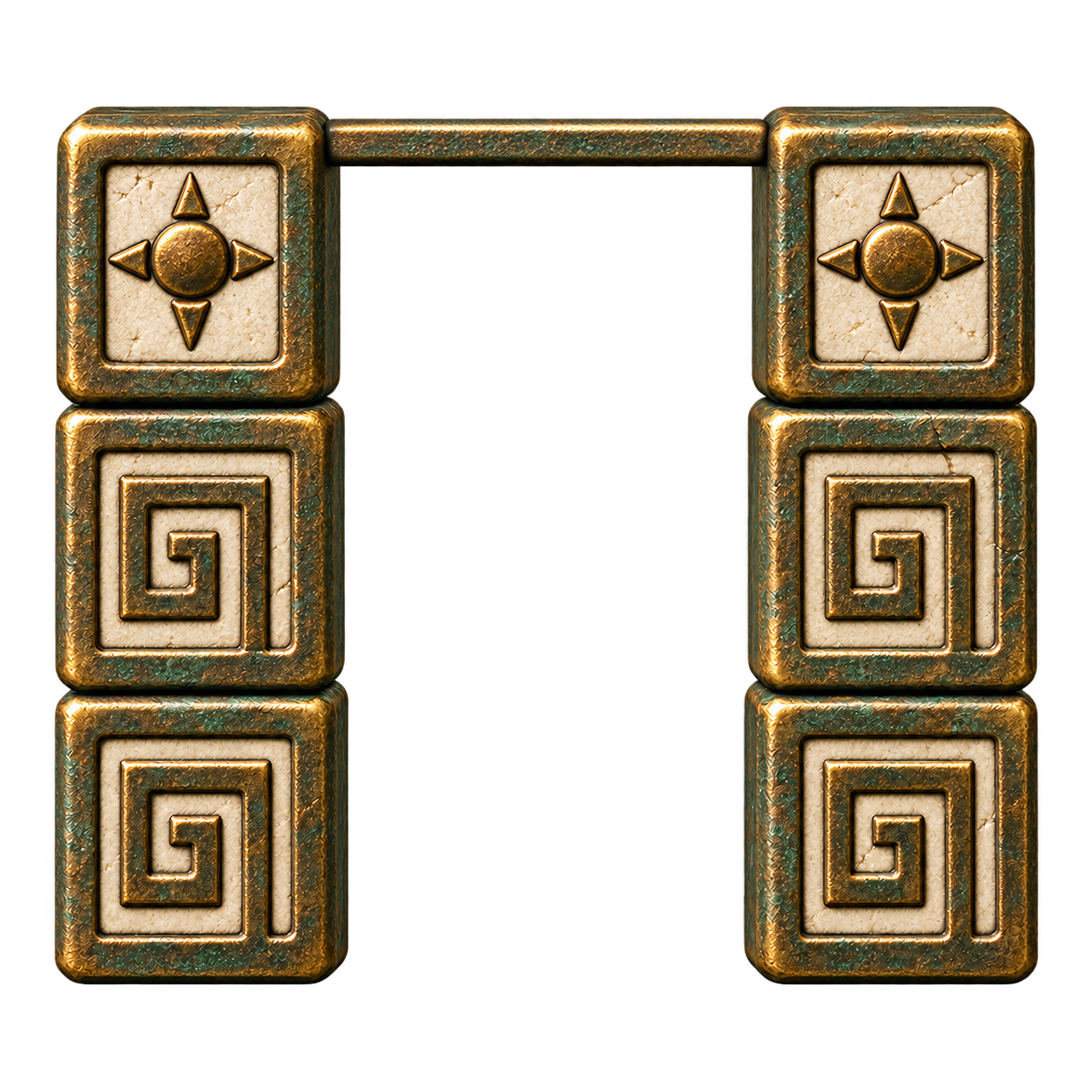
Door ×20
One diagonal step. Four doors can imprison an icon.
1 point · DLantern ×10
A long diagonal ray. Touch the enemy icon and burn it.
1 point · L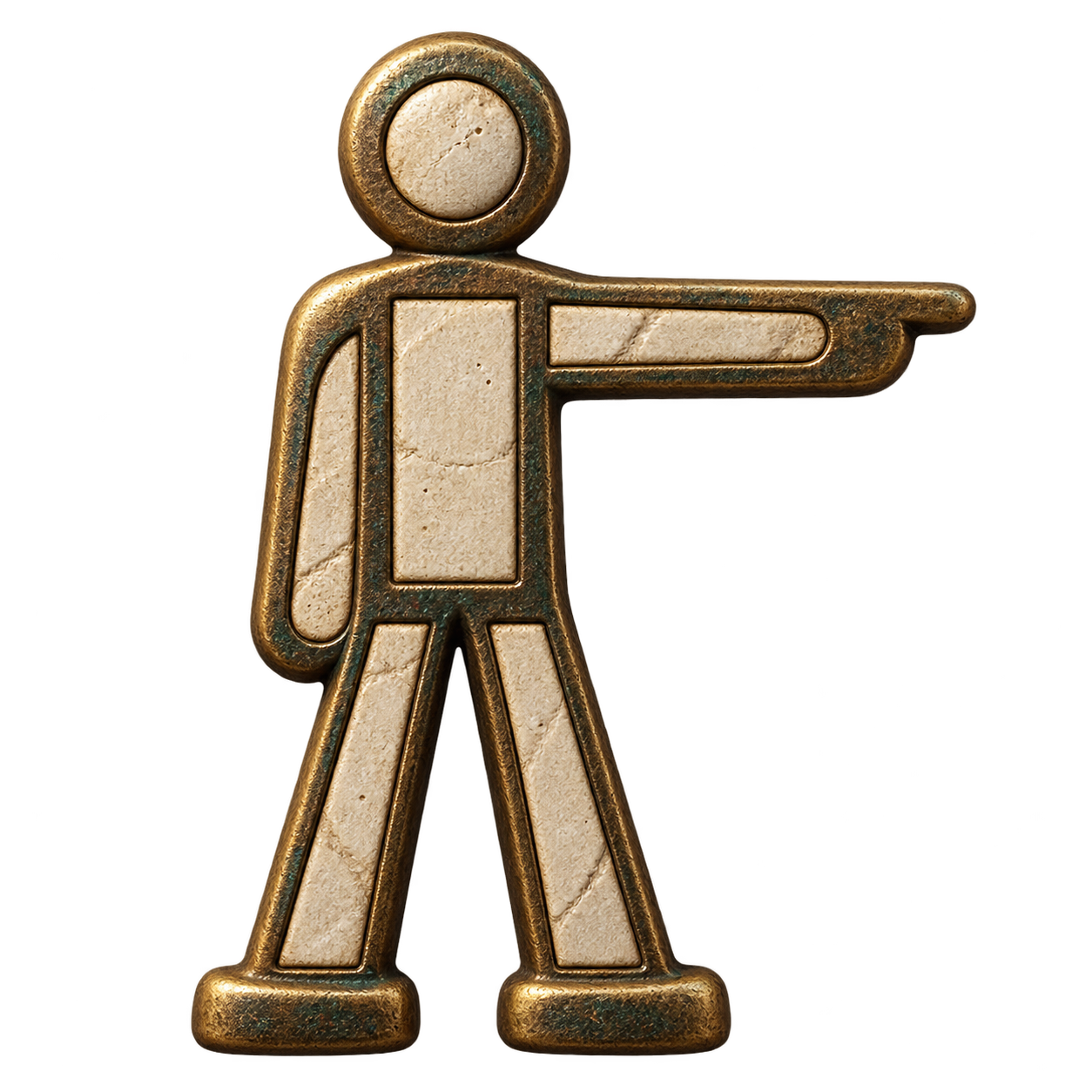
Linesman ×5
A two-square leap. Extinguishes lanterns it jumps over.
5 points · M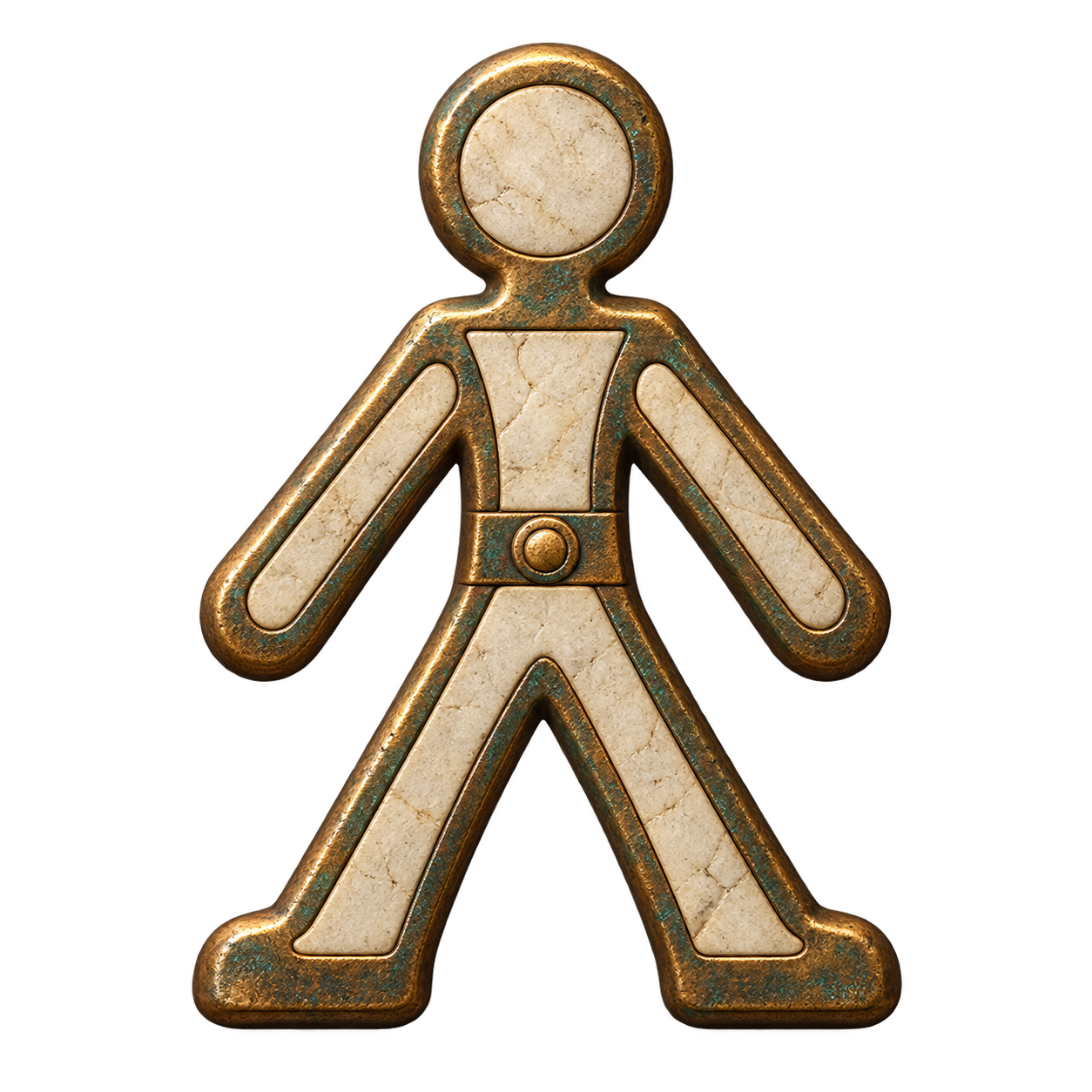
Sentry ×3
Leaps within the icon’s reach. Takes enemies along its path.
5 points · SGuardian ×2
Diagonal contact is deadly. Stay near the icon—until the endgame.
20 points · 40 transformed · GIcon ×1
The heart of the army. Lose it and the game is over.
100 points · ISelect an illustration to download its full-resolution PNG.
The rules of Truth
The game’s founding legend places its invention in 5739 BC, in the cold early months of the year, when a farmer tending cattle conceived a game elaborate enough to trouble civilization for millennia. Its eventual return required a revelation of uncertain provenance and very definite diagonal geometry.
The ancient history belongs to the game’s mythology. The rules below are the playable browser edition; the complete twenty-five-rule manuscript is preserved after the rulings.
Prepare the board
The board is 17 squares wide and 18 squares long. In two-player play, alternating squares are black and forbidden; the upper-left square is white. Each army owns nine rows. In four-player play, all squares are open and each army starts in a corner: Ivory southwest, Jade northeast, Ember southeast, Indigo northwest. The middle column is neutral territory.
Each player arranges 20 doors, 10 lanterns, 5 linesmen, 3 sentries, 2 guardians and 1 icon: 41 pieces. Use the suggested arrangement or select and reposition pieces before pressing Begin game. Free placement is available only in this clearly marked setup phase; movement restrictions apply once play begins. Any opposing pieces already in diagonal contact are resolved when play starts. Swapping friendly pieces is allowed during setup.
Take a turn
Ivory begins. Turns then pass to Jade, and in a four-player game to Ember and Indigo. Move one door and one other piece, in either order; the other piece may also be a door. Use two distinct pieces. A turn ends automatically after those actions. A first action is legal only if a legal second action remains, unless that first action ends the game by destroying an icon. The required door action is never silently waived. If no complete two-piece turn exists, use Pass blocked turn; siege clocks and endgame transitions still advance.
No move lands on an occupied square. There is no replacement capture: pieces are destroyed by crossing, diagonal contact or enclosure. Black squares are never legal destinations.
Move the six kinds
- Door
- Move exactly one square diagonally.
- Lantern
- Move any distance diagonally. Doors, icons and transformed door-role pieces block the path. Other pieces may be crossed, but the destination must be empty.
- Linesman
- Move exactly two squares horizontally, vertically or diagonally, crossing the middle square. Any sentry blocks this leap. An enemy lantern crossed is destroyed. A linesman that crosses an icon is itself destroyed; the icon survives.
- Sentry
- Leap to an empty square within the icon’s range. In a horizontal, vertical or diagonal line from the icon, reach five coordinate steps (six squares including the icon). Off those lines, reach four coordinate steps. Any enemy piece on an intermediate lattice point of the leap is destroyed except an icon. If a jumped guardian is diagonally adjacent to the landing square, the sentry dies with it.
- Guardian
- Move one to four squares diagonally, passing over intervening pieces, landing at most four coordinate steps from its icon (five counted squares including the icon). A guardian destroys diagonally adjacent enemy doors, lanterns, linesmen and sentries, regardless of which piece moved. Ordinary guardians do not destroy each other. Contact with an enemy icon destroys the ordinary guardian.
- Icon
- Move exactly two squares diagonally when starting in your territory, or exactly one when starting outside it. It may pass over intervening pieces. Icons destroy only ordinary enemy guardians, by diagonal contact.
Destroy an icon
A lantern burns an enemy icon by ending diagonally adjacent to it, or when the icon moves into that contact. Alternatively, place hostile doors on all four diagonal neighbors of an icon. The same four doors must remain continuously in place through the ends of two turns taken by that icon’s owner. Moving the icon or breaking the ring resets the siege. At the end of the second defending turn, the icon is destroyed.
The first icon destruction ends the game. With four players, the surviving players share the victory; there is no continued elimination phase. If simultaneous effects destroy every icon, the result is a draw.
Enclosures and exchanges
Four hostile lanterns on a door’s diagonal neighbors destroy the door immediately. Four hostile doors surrounding a lantern destroy it immediately. All completed enclosures and contact effects are read together before any involved pieces are removed. Thus a piece can complete a capture and be destroyed in the same action.
When the light and doors are gone
In two-player play, both armies must have lost all their original doors and lanterns. In four-player play, an army transforms as soon as it has lost all of its own. The transformation activates at the end of the turn, so it applies only after that loss has occurred in a previous turn.
Linesmen and sentries gain door properties for enclosure, obstruction and the required door action, while retaining their ordinary movement and jump interactions. Guardians gain lantern movement with unlimited diagonal range and no icon tether, while retaining their contact attacks. These lantern-guardians can burn enemy icons. Transformed linesmen and sentries obstruct their passage and are destroyed by their diagonal contact.
A guardian diagonally adjoining its own icon can intercept an enemy lantern-guardian. If the attacker touches that defender or attempts to cross it, both guardians are destroyed before the icon can be burned by that attacker. Interception is checked at every diagonal step along the attacking guardian’s route, including contact beside a defender; it cannot slide past that contact to burn the icon. Other simultaneous attackers still resolve their own contacts.
Score and stalemate
Doors and lanterns are worth 1 point each; linesmen and sentries 5; guardians 20; icons 100. A transformed guardian is worth 40. The original army totals 210 points. Captures credit the opposing owner who caused the loss, including an icon or guardian causing a jumper’s destruction.
If every player has no complete legal turn for a full cycle, the engine ends the game by score, unless an active siege still needs to resolve. Endgame activation resets that blocked-cycle count. If all lanterns and guardians are gone and no opposing set of four present or future door-role pieces remains, no icon can be destroyed: the engine finishes the current round, then settles its final scores under rule 23. Strategic stalemate—no player can eventually destroy an opposing icon—requires agreement at the table: use Agree to scored stalemate when the last winning resource disappears. The agreed stalemate takes effect at the end of the current round; those final captured-point totals decide the result; equal top scores share it. The engine does not claim to solve every possible future position.
Rulings used by this edition
The manuscript leaves several questions open. These conventions make the browser game reproducible and apply equally to every army.
- “Touch” means an adjoining diagonal square. Range uses the larger of horizontal and vertical displacement; “counted squares” includes the icon. A stranded guardian or sentry can move only if its destination returns it to the allowed range.
- A sentry may leap in any direction; it captures only occupied lattice points exactly on the straight segment, not squares merely brushed by that segment. A leap with no intermediate lattice point captures nothing.
- Rule 14’s “it is destroyed” after a linesman jumps an icon refers to the linesman, consistent with its lantern-only attack. The stronger prohibition on jumping any sentry takes precedence over rule 8’s enemy-only wording.
- Ordinary guardians and icons may pass over occupied squares, but must land on an empty square; crossing a piece does not itself capture it. Lanterns do not stop at pieces other than their named obstructions. Jump attacks target enemies, except that any icon destroys a crossing linesman.
- Transformed guardians count as lanterns for linesman attacks and fourfold enclosures. Transformed linesmen and sentries count as doors for those enclosures. Two actions must use different pieces. A player unable to complete the required pair skips the turn, rather than taking an extra unrestricted action.
- Four-player rings may contain pieces from several hostile armies. If more than one army causes the same simultaneous loss, points go to the first qualifying attacker in the fixed army order. No player receives points for their own loss.
- “Two consecutive turns” means two completed defending turns with the same ring intact. A four-player game ends at the first icon loss. These are explicit timing and outcome conventions, not additional claims about the ancient legend.