Instead of treating pixels as loose samples, this work turns an image into regions with owners, neighbors, parentage, local coordinates, texture, and a visible reconstruction debt.
THE REPRESENTATION
Not labels laid over an image. A new image made from cells.
A segmentation can color pixels by category and still leave every later operation to begin again. A structured image carries the construction forward. Each cell owns support, knows its runner-up at an interface, fits a local model, belongs to a hierarchy, and contributes to an explicit reconstruction.
The output is therefore simultaneously a partition, a compressed explanation, a coordinate system, and an error map. Vectorization can follow shared boundaries. Compression can spend bits where structure remains unpaid. Super-resolution can refine the cell instead of guessing globally.
ONE DECOMPOSITION, ONE GEOMETRY
FlowCells turns evidence into a population of regions.
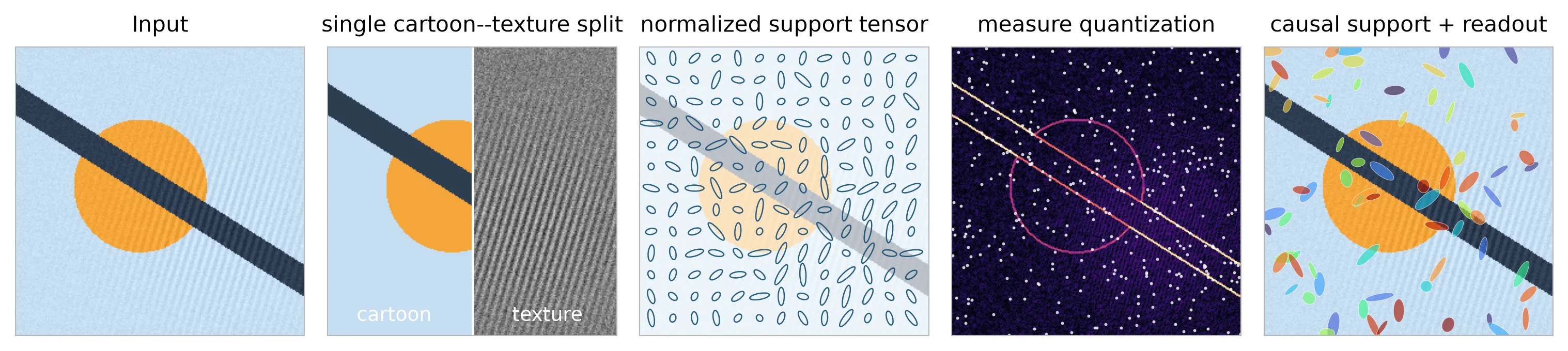
Checked-in FlowCells method figure. A single cartoon–texture split produces normalized support geometry; its measure is quantized into germs; causal support and local readout produce the structured reconstruction.
01Split onceCache cartoon, texture, and residual evidence instead of recomputing a new edge story at every refinement.
02Normalize supportLocal tensors describe orientation and extent without confusing strong contrast with small scale.
03Allocate measureBroad smooth regions ask for few large cells; textured and curved regions receive denser support.
04Transport ownershipFirst arrival assigns an owner and runner-up under the same geometry that generated the sites.
05Fit and read outLocal affine, ridge, texture, and interface terms rebuild the image and expose what remains unexplained.
THE COMPLETE FLOWCELLS RECEIPT
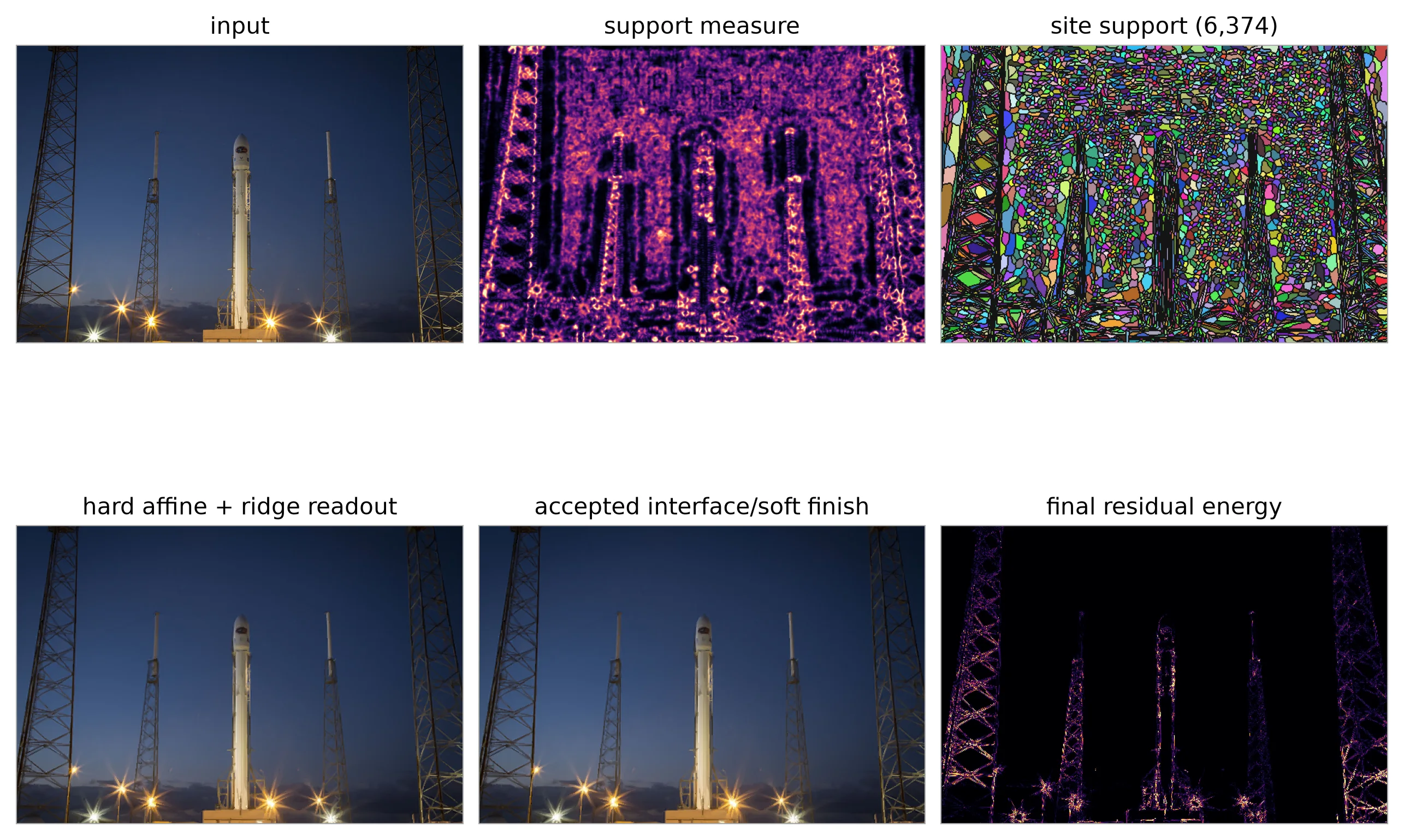
The cells gather where the rocket actually asks for them.
FlowCells rocket diagnostic: input, support measure, 6,374 site supports, hard affine/ridge reconstruction, accepted interface/soft finish, and remaining residual energy.
CELLS6,374
RECONSTRUCTION30.009 dB
END TO END2.32 s
HOST8-core Apple M3
WHAT A CELL CARRIES
Ownership is only the beginning.
OWNER
The site whose causal support reaches this pixel first.
RUNNER-UP
The adjacent claimant that makes an interface explicit rather than inferred later.
PARENT
The structural region that contains subordinate texture microcells.
CHART
Normal, tangent, scale, and owner-relative coordinates for local fitting.
MODEL
Affine, ridge, or other bounded readout chosen for the support actually owned.
DEBT
Residual error that remains attached to a place and can command the next refinement.
THE HIERARCHY SURVIVES
Segmenting V3 puts texture inside structure.
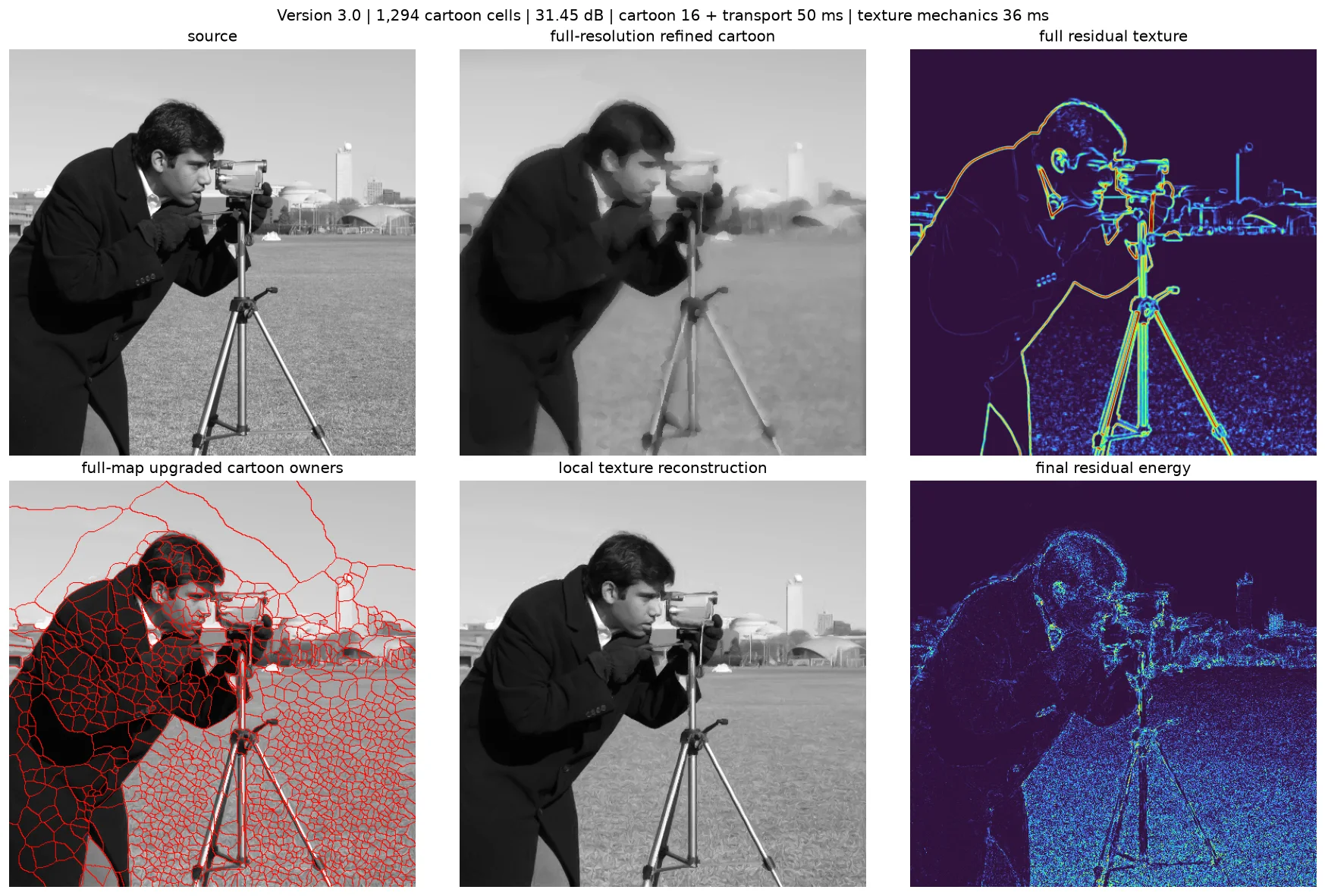
Authentic Segmenting V3 capture. This run reports 1,294 cartoon cells, 31.45 dB, 16 ms cartoon work, 50 ms ownership transport, and 36 ms texture mechanics.
Cartoon first
Large regions and decisive boundaries establish the durable parent topology.
Texture under a parent
Fine cells may compete with siblings but do not cross the structural owner that gives them meaning.
Refine the debt
Residual moments divide an under-resolved cell locally; they do not restart the entire partition.
Keep every view inspectable
Source, owners, models, texture, reconstruction, interfaces, sites, and error remain separate readouts.
ONE ACCOUNT, MANY OUTPUTS
The structure becomes common infrastructure.
VECTOR
Shared edges become paths
Trace region topology once, simplify under measured error, and emit editable SVG without independently tracing both sides of every boundary.
COMPRESS
Bits follow reconstruction debt
Owned regions, residuals, and perceptual structure guide the JPEG and PNG optimizers toward changes the image can afford.
RESIZE
Cells carry moments across scale
CONV and later structural resizers can preserve local variation rather than interpolate a pixel grid blindly.
REBUILD
Error points to the missing object
Super-resolution and decomposition experiments inherit a localized account of what the current representation failed to explain.
THE PUBLIC OBJECT
An image becomes an inspectable program of regions.
The achievement is not a prettier segmentation overlay. It is one structural account that survives allocation, ownership, hierarchy, fitting, reconstruction, vectorization, and compression.